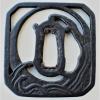
yogoro Posted March 20, 2008 Report Posted March 20, 2008 Dear friends ! What are your opinions about this signature. The first two Kanji is probability "Hiroyuki" + kao sign. regards Mikolaj Quote
docliss Posted March 20, 2008 Report Posted March 20, 2008 Dear Mikolaj The artist of your tsuba is probably Hamano Yasuyuki (H 11367.0), who used Hiroyuki as one of his many gÅ. Born in 1763 and dying in 1836, he was a student of Hamano Naoyuki and of Hamano Noriyuki I. He studied and worked in Edo. This attribution is supported by the style of your tsuba but, unfortunately, none of the kao illustrated on p.2224 of Haynes’ Index; on p.17, no 180 of ShÅsankenshu; or on p. 386d of KinkÅ Meikan correspond to that on your tsuba. Isn’t life difficult .... Regards, John L. Quote
John A Stuart Posted March 20, 2008 Report Posted March 20, 2008 I've run into similar situations in mei before. That is, where the go is perfectly matched but the kao is different. When comparing the work done with the mei and believing the attribution to be right; how can the kao be so different from the one in indices? I have a theory on this. Although some artists have multiple kao and not all are recorded, it might be that a student signed with the masters mei but placed his own kao to differentiate the work from the masters. So meaning really: This is the work from ' masters ' shop by ' advanced student '. Maybe? John Quote
docliss Posted March 21, 2008 Report Posted March 21, 2008 John Stuart’s theory explaining the incidence of mei on tsuba in association with the ‘wrong’ kao is an interesting one. I do question, however, whether a student would sign his work with his master’s gŠrather than with his master’s more usual name. An alternative explanation for such tsuba is, of course, that they are the work of presently unrecognised artists. John L. Quote

Recommended Posts
Join the conversation
You can post now and register later. If you have an account, sign in now to post with your account.