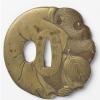
Kurikata Posted April 18, 2017 Report Posted April 18, 2017 Hello, I has those two kanji on a tsuba box containing an Heianjo Tsuba... It down not look as 平安 (Heianjo) Does someone can give me an help on the meaning of such Kanji? Thank you Quote
christianmalterre Posted April 18, 2017 Report Posted April 18, 2017 i just can tell and speak from past.....actually do not know how the present "habitude" is going on ?.... normally.. (prewar custom was in old times)- on old boxes, you do see the writing ( attribution-LOL!) on inside of the cover one, together with an seal....(most times in red ink...several times in blue or brown ink colouration) to beware you but from spending too much money... such has got nothing to do with any slightest significance! so! do keep the box ( to its Tsuba)- only IF!!! there is a seconding origami to this whole ensemble...( most times but, the " origami" is but !??? - missing... )-LOL! otherwise (?) - just very simple..do throw it away! Christian Quote
SteveM Posted April 18, 2017 Report Posted April 18, 2017 I don't know what the kanji on that box are supposed to represent, but it doesn't look anything like Heianjō. Heianjō is a three-kanji compound word written as 平安城 平 = peace, tranquil hei 安 = safe, safety, security an 城 = castle jō In this case, Heianjō is a pronoun, and refers to a place, and therefore the individual kanji meanings are not super helpful in understanding the significance. Heianjō should be understood to mean the city of Kyōto, which in medieval times was called by various names: Heian, Heiankyō, Yamashiro, etc...In the specialized area of swords and fittings, it either refers to the place itself, or to a certain school of artists who emerged from the area. https://en.wikipedia.org/wiki/Heian-ky%C5%8D Quote
SteveM Posted April 18, 2017 Report Posted April 18, 2017 By the way, if you copy and paste the kanji into a search engine and add "wiktionary", you will find out all about that individual kanji. Again, not always useful for understanding pronouns or some compound words or idioms, but it does tell you the origin of each kanji. https://en.wiktionary.org/wiki/%E5%B9%B3 1 Quote
k morita Posted April 19, 2017 Report Posted April 19, 2017 Hi, The kanji on the box says "Yoshirō" (与四郎) 4 Quote
Kurikata Posted April 19, 2017 Author Report Posted April 19, 2017 Thank you all of you for you kind advices (Steve) and again for your expertise (Morita San). Once again my feeling is "The more I know, the less I know" 1 Quote

Recommended Posts
Join the conversation
You can post now and register later. If you have an account, sign in now to post with your account.