atm
-
Posts
206 -
Joined
-
Last visited
-
Days Won
1
About atm

atm's Achievements






-
USA to Japan- shipping swords.
atm replied to omidaijo's topic in Sword Shows, Events, Community News and Legislation Issues
@omidaijo Did it got through Los Angeles? I had a sword rejected by outbound customs in Los Angeles and have heard of this happening several times from others for swords shipped Express Mail USPS. -
Aoi Art can arrange for the sayagaki. In my experience, it is done by the time the export permit is approved, so it does not add to the wait.
-
The new section 301 tariffs seem to exempt some nihonto: “Having considered the public comments, advice of the Section 301 Committee, as well as the advice of advisory committees, and the specific direction of the President, the Trade Representative determined to exempt the following additional products from the scope of [section 301 tariff] actions: . . . certain antiques, collectibles, and art.” Link to text We will have to see how this is interpreted and enforced by shippers and U.S. customs, but at least there now seems to be a path for importation of nihonto over 250 years old without additional tariffs.
-
I suggest contacting Jimmy Hayashi in San Francisco since he is local to you. He polished one of my swords, and I would recommend him. I’d expect to see him at the upcoming San Francisco show, if you are attending.
-
I really enjoyed the Yamato presentation today. It is always nice to be able to examine higher level swords in hand and compare their deki. It wasn’t too crowded in the presentation, so it was easy enough to examine all eight swords and go back again to see your personal favorites. Thanks to all who organize and contribute to these presentations and the show overall. I’m glad I made the trip to the show for the first time.
-
Hi Max. The best advice I can give you is to wait for a better blade. You are right that this is a large sword with large proportions, which can be appealing if it is a good sword. But the ha and the nioiguchi look flat and lifeless. This is a utilitarian sword from a less than desireable school. Kitae-ware aren't always a problem--they appear more frequently with some smiths. They definitely are not helping this sword, though. I recommend learning more before buying. There are lots of swords out there, so take your time so that you do not regret a purchase.
-
Because you can imagine a line evenly extending across the top of the choji due to the consistent height of the choji, I see this as suguha-based rather than midare-based. So I'd probably call it chu-suguha-choji.
-
It looks like it was dropped on the tip of the kissaki. My understanding is that if the metal is still there, a qualified togishi can move the metal back into place. One of mine had a similar issue—the tip of the kissaki was bent to one side—and Woody Hall straightened it. I think it is best to have a togishi look at it before it leaves Japan.
-
Thanks for posting these. I watched the first episode this evening. It is very well done. I am looking forward to watching the others.
-
I believe informational materials, including books, are exempt if properly categorized (HTS 9903.01.31). But I have heard of others having this same problem when Fedex is the carrier. If the package was properly categorized, I’d file a dispute with Fedex. The Supreme Court ruling was as to the IEEPA tariffs, not the tariffs under the US-Japan trade agreement (which probably would not have been in place without the illegal IEEPA tariffs).
-
I would not have a problem owning such a hypothetical sword. I already own swords that, based on their age, could have been used to kill but lack the hypothetical bodycount markings to document that history. I also own WWII German and Japanese firearms that were brought back by American GIs that were very likely used to kill Americans. I respect that this would really bother some people, and they would not want to own or even be around such items. I differentiate between the tool and the person using the tool, so I do not view these items as inherently bad or evil. And my interest in them is based on history, artistry, and technology instead of any macabre interest. That said, I would be less inclined to own a sword (or other weapon) that derives its primary value or interest from the macabre. For example, I would not want to own a test cut sword solely because it is a test cut sword. It would first have to be a sword I would appreciate if it did not have saidan mei. The saidan mei is still valuable to me--albeit secondary value--because it provides additional historical interest. The same goes for kirikomi or Hokke's hypothetical bodycount markings--they provide value to me that is secondary to the craftsmanship of the sword.
-
@Markus has a later version: Koshirae Taikan. I have the ebook version, and it is an extensive resource that I recommend as a complete koshirae novice.
-
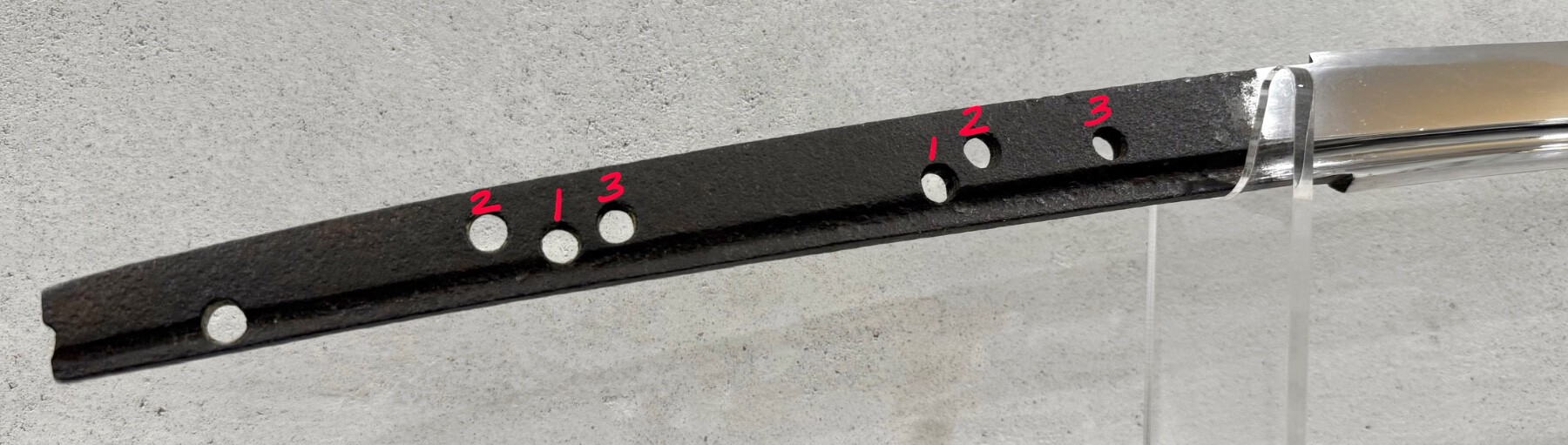
@DocTheRoc @eternal_newbie Several of the mekugi ana on the Ayanokoji odachi seem to be paired based on their size and relative placement. As the nagasa is 100 cm and the blade weighs about 1750g, it was possibly mounted with two mekugi at a time.

-
545g is lightweight for it being nearly 75cm in length. I agree with others that it appears to be tired, and the weight suggests that it has lost a lot of material over the years. But zaimei and ubu would seem to be worth more than the auction’s low starting price. I’m guessing it will go for quite a bit more.
-
I find it interesting when Tanobe sensei deviates from his normal format. For example, his kao is normally at the end of his commentary. In some cases, his commentary takes up the entire omote of the shirasaya and continues to ura, so his kao is on the ura. On this Yukimitsu sayagaki, it first appears that everything is on the omote since it includes his kao. But the bulk of the commentary is actually on the ura. I suspect he did it this way because the blade and the koshirae are together on the same NBTHK origami, so he used the omote to reference both and then he used the ura to describe the blade.