Conway
-
Posts
635 -
Joined
-
Last visited
-
Days Won
1
About Conway

Recent Profile Visitors
3,981 profile views



Conway's Achievements






-
Beginner wanting to know about the sword and authenticity
Conway replied to bkww2's topic in Military Swords of Japan
Nice! A Type 32 Otsu got me into Japanese swords. I think most members on here would suggest you buy some reference books on Japanese military swords before jumping in the deep end and buying something without any foundational knowledge. This would be a good one to start with: Swords of Imperial Japan 1868-1945 Signed by Jim Dawson - Japanese Sword book The author had been selling these on eBay, but I believe he ran out of copies. -
Beginner wanting to know about the sword and authenticity
Conway replied to bkww2's topic in Military Swords of Japan
Why would you do that? In my opinion the cobbled together pieces aren’t worth what the seller is asking for them. You would be better off putting that $890 toward a legit sword. -
Attention Mantetsu Owners: A Survey
Conway replied to Bruce Pennington's topic in Military Swords of Japan
Well I easily spotted the yamagata under the habaki, but I just noticed it has a to-東 on the kabutogane two months later. Not sure how I missed it…. I know this is sometimes encountered on the 1942-onward production. Nonetheless, these little nuances with Mantetsu are part of the reason I find them so interesting!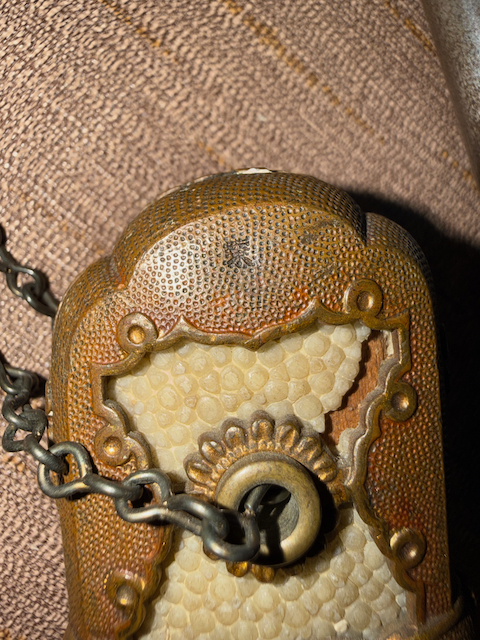
-
Need help found in my grandparents basement.
Conway replied to tumbleweed5780's topic in Military Swords of Japan
@Scogg Can you edit the above post to remove the personal contact info from public view? @tumbleweed5780 Not surprising the vultures have started to circle the ill-informed. My advice, do some research before making any quick decisions. -
Also in Sesko: When it comes to gendaitō and especially WWII-era smiths, this publication includes the ranking of about 300 contemporary smiths carried out by Kurihara Akihide (栗原昭秀) in 1942 under the title Seidai Tōshō Iretsu Ichiran (聖代刀匠位列一覧). He introduced seven ranks: shinpin no retsu (神品の列) Supreme masterworks kihin-jōi (貴品上位) Superior precious works kihin no retsu (貴品の列) Precious works jōko no jōi (上工の上位) Superior master jōkō no retsu (上工の列) Master ryōkō no jōi (良工の上位) Superior skilled artisan ryōkō no retsu (良工の列) Skilled artisan http://www.japaneseswordindex.com/tosho.htm
-
Did you re-align the wires without loosening the backstrap? The end result looks great!!
-
It’s signed Kawai Kaneyoshi. See the below excerpt from Sesko: KANEYOSHI (兼義), Shōwa (昭和, 1926-1989), Gifu – “Kaneyoshi” (兼義), real name Kawai Yoshifumi (河合義文), born October 25th 1902, nephew of Watanabe Kanenaga (渡辺兼永), he worked as guntō smith, ryōkō no jōi (Akihide), Second Seat at the 6th Shinsaku Nihontō Denrankai (新作日本刀展覧会, 1941) Dated May 1944… Not 100% sure about the month, but that’s my best guess.
-
@Nazar How thick is the mune? I have one with a similar style blade and also with an added seppa, but the blade is so thin almost to the point of being flimsy.
-
Hector, Based on the pictures provided, the blade does not exhibit any of the characteristics I have seen in swords and dirks made with WW2 era anti-rust steel. I think you need not worry about that possibility. It looks to be a very nice piece. And even if it was made from anti-rust steel it would be worth far more than what you paid for it.
-
Ian, Sorry for the delayed response. I am not 100% sure, but I did find that the following smith, who was registered in Seki. Please see the below reference from Markus Sesko’s Swordsmiths of Japan: KUNIHIRO (国広), Shōwa (昭和, 1926-1989), Gifu – “Kunihiro” (国広), real name Kataoka Itoshi (片岡愛), born am April 1st 1895, he worked as rikugun-jumei-tōshō and died December 2nd 1965, ryōkō no retsu (Akihide). There were a few smiths who used the swordsmith name Kunihiro during WW2.
-
I agree with the makeover assessment. The late war Type 3 had artificially applied “Suguha.” This looks like a post-war job on the hamon.
-
@Bruce Pennington Looks like a 一 to me. Otherwise it’s a real poorly executed 八。
-
The smith is Kunihiro. Can you post additional photos of the blade?
-
The scabbard looks like it has been painted silver. Likely done because the finish on nickel and chrome plated scabbards are prone to damage. Aside from that, the sword looks genuine to me. Mon are far more common on dress swords than Type 94/98, so the presence of one would not automatically cause concerns of authenticity.
-
Adrian, Looks legit to me. I saw the auction pics too. Did you get confirmation they can ship international? PS - There’s discussion whether this variant of sword should be classified as an “NCO sword/ Type 95."