MHC
-
Posts
294 -
Joined
-
Last visited
-
Days Won
3
Content Type
Profiles
Forums
Events
Store
Downloads
Gallery
Everything posted by MHC
-
Hello John, It would appear that it is always best to go with your gut, especially when you have limited practical knowledge, I think this one would be best to fall by the wayside. The taper of the blade is the most concerning to me for it being older than Shinto, seeing how it is a Wakizashi size. If it where an earlier blade I would have expected less or no taper on such a short blade. There are more photos online, that allow one to make out "Moto" as the third character in the Mei, but everything else is 70-90% obscured. Moot point at this juncture. Mark
-
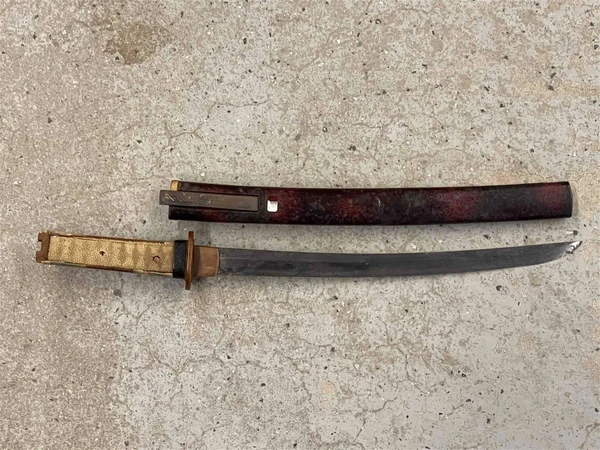
Attached are 3 poor online supplied pictures, this is not an Ebay listing. It is signed, but basically unreadable due to corrosion. I'm guessing Shinto era, of older revival style blade??? 14.25" Nagasa but incorrectly advertised as a Tanto. Not looking for advise, just observations. Thanks Mark


-
Received my soft cover copy 1 week ago, already read it cover to cover. Excellent job, thank you Yurie! Mark
-
Hummm...to put a stigma onto an inanimate object, just because an action is documented for that object is odd by itself, but then to wear blinders toward all other identical objects and pretend they did not deal the same type of action? This is a seriously delusional approach to logic, facts and reason. The reality is that many a Nihonto sword has been used for their intended purpose, whether it was in battle or in testing. Absolutely no way to know which is which on a un-marked blade, and no way to know if a sword is a "virgin" or not. I have no interest in trying to change anybody's ideals or morals, nor do I wish to entertain any dialog about these. In the end, I guess it all comes down to what ever lets you sleep at night. Mark
-
Hello Gary, Sure would be nice to see all of these stunningly beautiful swords that you have been posting as of late, in the Sashikomi style of polish. Hadori just hides too much detail of the grain structure. I'm aware that Hadori is the current accepted style, and what is expected to be seen today by the NBTHK. Too bad the age of the sword doesn't dictate the style of polish, instead of the current trending fashion. Of course that is simply my opinion and personal preference, I mean to take nothing away from your extremely fine collection. Please by all means, keep making us all jealous of your collection by displaying more of your offerings. Mark
-
Hello George, For everyone's sake, in the future, could you please downsize your photo templates before you post. Your current file size is unnecessarily large and take forever to open. I'm guessing (?) that I'm not the only one that has problems with opening huge photo files on this forum. Mark
-
Shosoin and the imperial collection after WW2
MHC replied to jsv's topic in General Nihonto Related Discussion
Hey there Pat, Just to pick the fly s**t out of the pepper......the 2 bombs dropped on Japan in WWII were NOT hydrogen bombs, they were straight Atomic bombs. Even though I think you did not intend to imply that the USA dropped atomic bombs on Tokyo, however, your verbiage was unclear and hinted at that being the case. Hiroshima and Nagasaki were the only 2 targets for the atomic bombs used. Hydrogen bombs were a further development of the base atomic bomb, which increased the yield substantially. No Hydrogen bomb has ever been used in combat anywhere in the world to date. Additionally, technically a cluster bomb is not an incendiary bomb per say (albeit an incendiary bomb canister contains many individual ordinance pieces), a cluster bomb contains individual explosive ordinance while an incendiary bomb contains individual incendiary ordinance. Now back to our regularly scheduled program. Mark -
Opinion dialogs on unseen/unknown swords for sale, regardless of seller or sales format, could inadvertently cause damage to any sellers reputation. Now once a sword has been purchased, and quality pictures made available, well that's a different topic all together. Simply be respectful of sales offerings, no matter where they are posted. Sure there are scammers out there selling questionable items, but the likes of them quickly get weeded out of the bunch. Lots of reading and education is your best defense from buying a turd. Mark
-
Hello Krystian, Could you post or PM me a few more pictures of the #6 Fuchi/Kashira set, thanks. Mark
-
You had better be careful, or people will start asking for you to make stuff for them. Mark
-
Hello Tony, Right now the entire stack-up of parts and pieces fit perfectly, all real tight. The Tsuka slides onto the Nakago perfectly, nice and tight, no wiggle at all & the Ana hole lines up perfectly, all without any Seppa's. The Saya also fits the blade perfectly. When all is assembled, everything locks up good-n-tight, and the Habaki firmly holds the blade into the Saya, without any seating pressure needed, just a nice tight slip fit (almost "clicks" into place). I would expect if it was a war time, in the field repair, to not be such a precise fit, but maybe I'm underestimating the field skills during the war? Maybe it is just blind luck everything fits? Mark
-
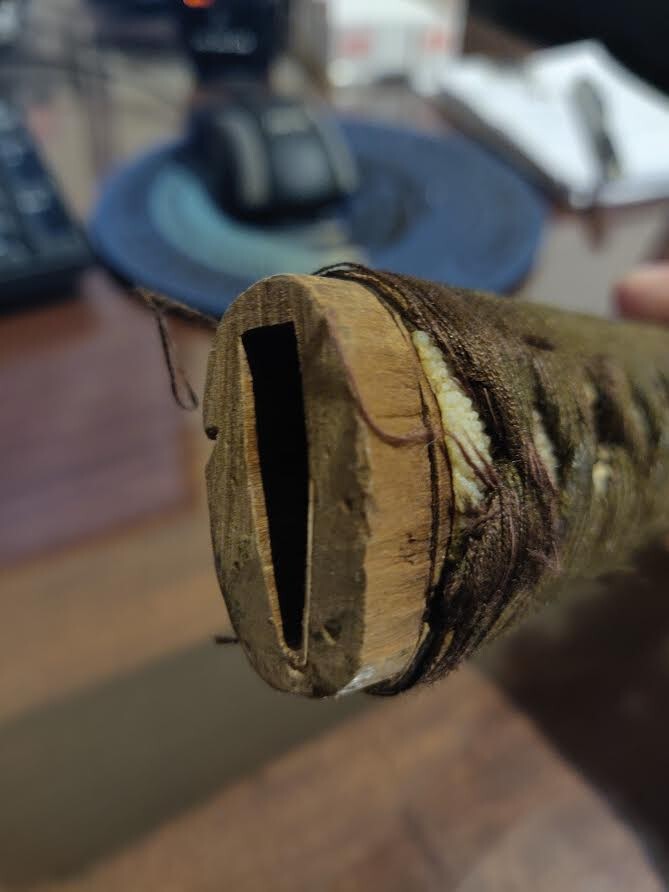
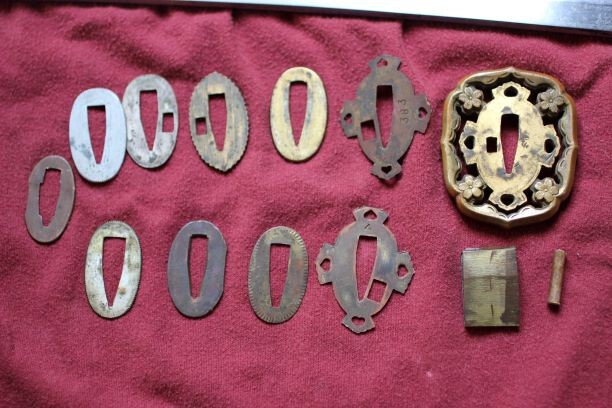
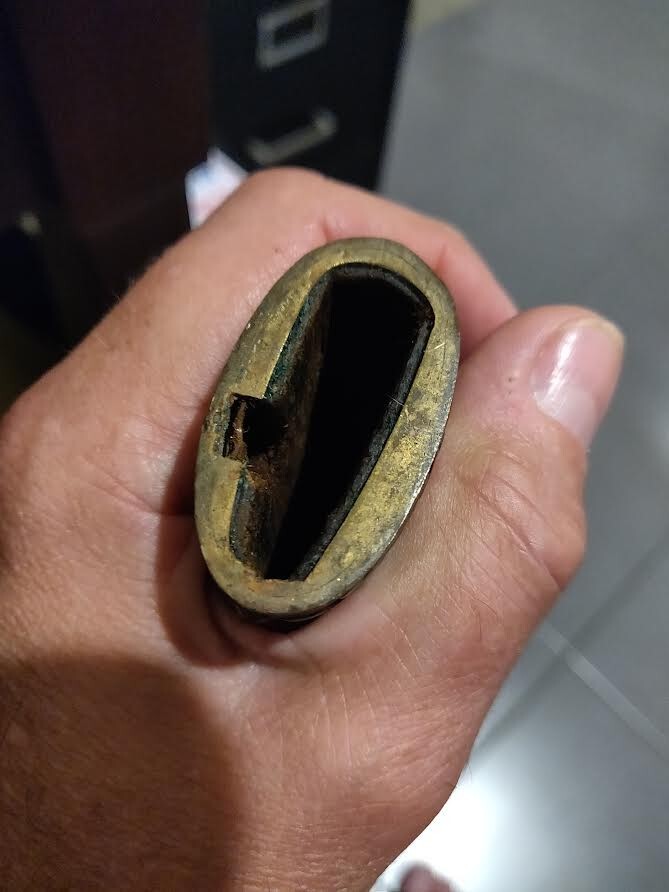
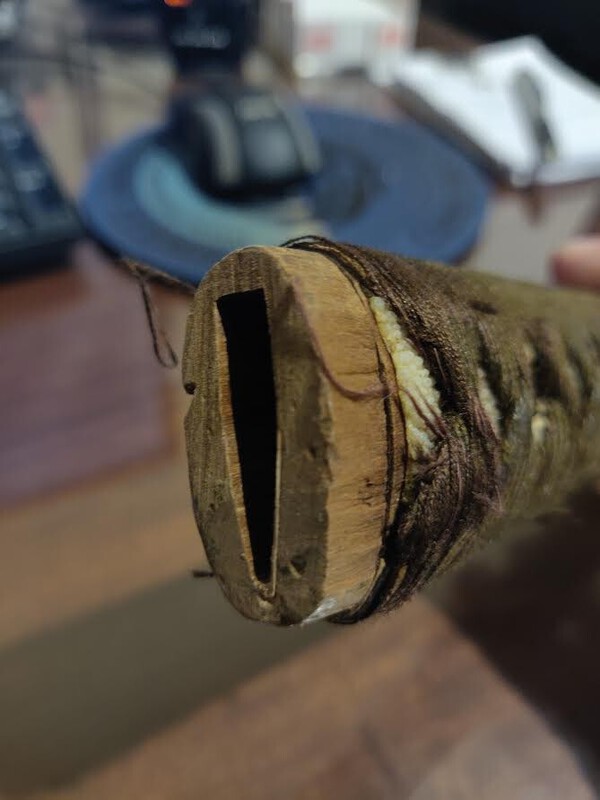
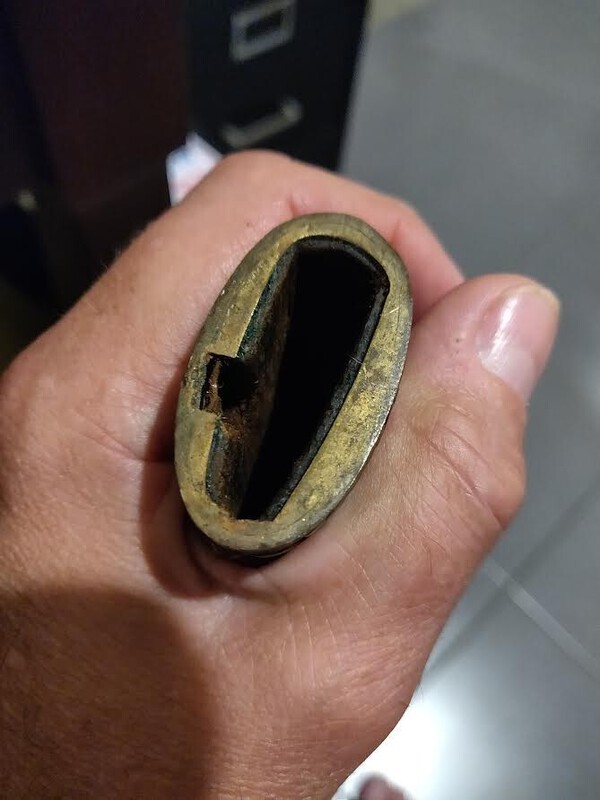
Hello all, The Tsuka on my Frankin Gunto has no retaining release button notch, so what type of retention might this sword/Tsuka had originally? All of the fittings parts-n-pieces, are a jumbled conglomeration. Tsuba is pierced and has a release tang hole that is on centerline. The 2 large copper Seppas have the release tang hole lower than centerline. Of the remaining Seppas, some have holes, some are on centerline, some not at all. The Fuchi has a release button hole, but nothing on the Tsuka {as seen in the photo}. The Saya has a release catch pocket and collar, but is lower than centerline {matches copper Seppas}. The strangest fact that is bewildering, is the fact that the Tsuka and the Saya fit the Nakago and the blade very precisely, maybe just dumb luck? War time repairs? Therefore it is hard to figure out the original configuration, maybe impossible. I would almost like to reconfigure the sword so that it is properly complete, but just don't know how I should approach it or even if I should bother??? Mark


-
It would be cool to see a "window' opened up, to see what was what. There appears to be some rather deep rust pits on both sides of the blade and tip, could cause serious issues if a polish was attempted, but maybe the far away pictures just make them look worse than they are???? Mark
-
Hello Jake, The style of the Mei from one side to the other does not seem to match, same goes for the patina inside each Mei, from side to side. Signature side is square and blocky with shallow incised strokes, while the date side is arched and curved with deeply incised strokes. It appears that each side were done by different people at different times. My money is on Gemei. Out of shear curiosity I bought a sword from this seller (super cheap, like $200), just to see for myself, what was up with his seemingly endless supply of swords. Verdict......yep, you get what you pay for. Mark
-
Found an inscription, are these initials, or?
MHC replied to vitamin's topic in General Nihonto Related Discussion
Well, you just committed a cardinal sin, NEVER EVER CLEAN A NAKAGO!! You just reduced the value of it considerably. The patina on the Nakago helps determine the age and authenticity, and should never be altered. Prepare yourself for what others will also tell you about this dastardly deed that you have done. Mark -
Tsukamaki first attempt: harder than it looks
MHC replied to Jeff fromNYC's topic in General Nihonto Related Discussion
Jeffrey, Wow, that looks really good, congratulations. Did you use a tying stand? Did you insert the swords Nakago into the Tsuka, to insure that it did not collapse too much during the tying? Mark -
Chris, Since you are also in Thailand (Bangkok), have you been west of Bangkok to the memorial in Kanchanaburi for the British and Australian soldiers that were killed building the "Burma Railroad". The site is a stones throw away for the real "Bridge on the river Kwai". And not too far from there is another memorial called "Hell Fire Gorge", which is cery worth seeing and very sobering as well. And just a side note, Hollywood got a bit of the story line incorrect about the "Bridge on the River Kwai", it is NOT built out of bamboo nor is it in the middle of the jungle, it is smack dab in the middle of town, built of steel and concrete and still currently being used. Further up north in Lamphun is a museum located at the current military airbase, which was the original Japanese main airbase during WWII, and includes wreckage of a P38 Lightning as well as other artifacts. There are other museums and such scattered all about Thailand, would make an epic road trip to go visit all of them! Mark
-
Hello Chris, Ok, I know I'm probably picking the fly s**t out of the pepper here, but technically China is considered East Asia where as Burma, Thailand, Laos, Cambodia, Vietnam, Malaysia make up South East Asia. The Flying Tigers were in China and had fixed air bases and operated for an extended service period. Mao's advisors were once again based in China. The advanced US engineer's in China were again, in China. The interdictions into Burma were individual operations which occurred over short time periods with no fixed bases. Merrill's Marauders operation was one of the longer time frame operations in the area. The OSS camp in north east Thailand you mentioned, was a 1 time occurrence in the late summer of 1945 at the very end of the war, consisting of only a handful of OSS operative trainers. This handful of operatives were parachuted into, what was then considered Japanese held territory, trained approximately 300 "Free Thai" to act as gorilla units, but the war ended before any substantial uprising occurred. It is my understanding that in a case of a single operation [such as the Merrill's Marauders raid}, this would still not be considered a Tour of Duty in the military. As a Tour of Duty is generally considered as an extended period of time during your service commitment (example, 1 year in country in Vietnam or 1 year in country in Afghanistan etc.). Marcus mentioned the story that was pasted down about his Grandfather doing a "tour" {of duty} in South East Asia, and I simply was commenting that there were no per say, Tours of duties on the mainland of South East Asia during the war. Getting back to the actual topic at hand, that being the sword Marcus now has, regardless of the circumstances, what he has is still a modern-ish tourist item and not an authentic South East Asian DHA sword. So historical minutia just doesn't come into play here. Mark
-
Hello Marcus, I'm a bit of a history buff, so a little more details for you. The only Head Hunters of any marked claim were located on the island of Borneo, no where near Burma/Thailand/Laos/Cambodia/Vietnam. If I recall correctly, the last claimed occurrence of any headhunter falderal was in the late 1800's-early 1900's, but I have not delved into that to any extent. Borneo swords and knifes are dramatically different in shape/style/form. As far as The US being on the ground in South East Asia during WWII, that was extremely limited, a few combined tiny efforts with the British in Burma, and an air war campaign out of china called the "Flying Tigers", but that was air warfare only, no boots on the ground. There was no "tours of duty" on the South East Asia mainland during WWII for the US. There were no US bases/outposts anywhere on the mainland. The US military action was island hoping warfare only. With that being said, once the war ended, there was a fair amount of allied visiting of many South East Asian countries, helping with rebuilding and such, so......maybe then??? Mark
-
Marcus, First off be careful, family stories rarely hold water when subjected to scrutiny and facts, so take any past down story with a bit of caution and a grain of salt. Doing your math of being in the family for 50 years, only puts the blade at around 1971-ish, WWII in Europe was from 1939-1945, but earlier in the east as the Japanese actually invading China in 1937. That being said, yes these types of souvenirs have been around since at least the late 1940's. The real swords were predominately made during 2 separate times in history. The original military weapons were during the Lanna era of the late 1700's, but when the British occupied Burma in the 1930's-1940's they made a huge comeback, as the British commissioned the local smiths to manufacture vast numbers of them for the indigenous military forces of Burma. Swords from that later period usually have a stamp near the handle that depicts a turtle or a star, etc. All of the original style are made with a wrapped steel forging technique, where thin layers of steel are wrapped around an iron core, usually about 6 layers. Each layer hammer forged onto the previous layer, then differentially heat treated to yield a hard edge with a softer backing/spine. This is not to be confused with a "folded" forging method such as the Japanese style. Even some modern replica's look accurate, but can be told apart from the originals as they often will have small pieces of copper or brass inlaid on the spine near the handle, and or small lines notched across the spine, and are not of the wrapped forging technique. Just about anything with Sanskrit or fuller grooves on it, is a modern replica/tourist item, with the blade made from a truck leaf spring. Of course as with anything, there are variations on these themes until the cows come home, so nothing is etched in stone when it comes to South /East Asian DHA swords. There were flamboyant originals and plain Jane originals, just like there are the same with modern replicas. As with almost anything that is potentially old, one needs to do research, learn, observe and view actual items in hand, before a calculated determination can be made as to authenticity, era, locality etc. Unfortunately what you have is not even a good copy of an original, everything about it is incorrect for an original, and simply screams tourist item. Sorry to be the bearer of this news. Mark
-
Here is an example of a real one from northern Thailand. Mark
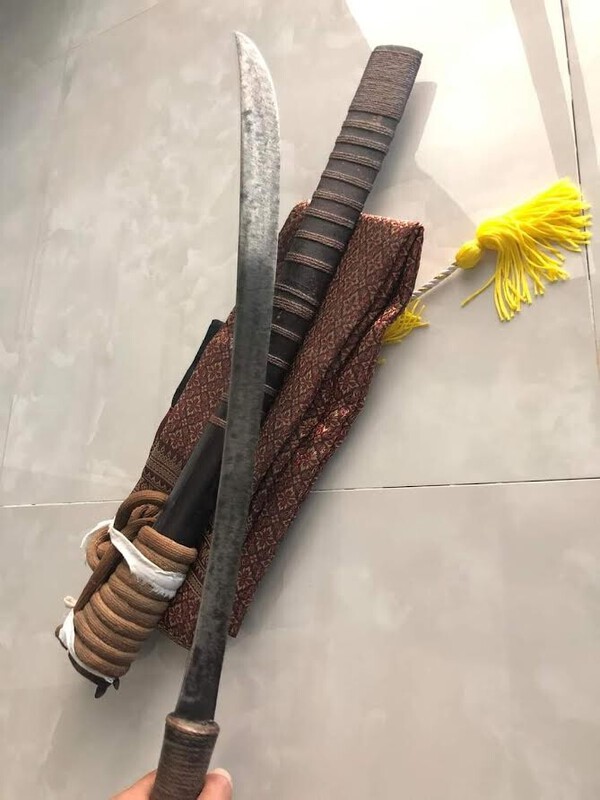
-
That is essentially a tourist souvenir, styled after a South East Asian DHA sword. The styles varied a lot between Burmese, Thai, Laotian and Vietnamese, but all have a similar shape with a long-ish handle. This particular one is widely available even today in and around tourist areas in most of Thailand, especially up north, I have seen many examples. They have been available for many decades. They come in red, black and brown, some have silver plated handle details and many have extensive Sanskrit writing engraved on the blades. Base models go for around $20 US, higher end ones go for around $50 US. Mark
-
Hadori Whitening Component of a Kesho Polish
MHC replied to waljamada's topic in General Nihonto Related Discussion
Ok, please humor me with the following comment, Does anybody else see and have concern, about the absolute razor straight dark thin line that delineates the area of the Nakago and the area normally covered by the Habaki, which are on both sides at exactly the same linear location? I have seen most swords with normal patina/coloration variations in this area due to being covered by the Habaki and/or the Tsuka, but never a razor straight line with no visible pitting or deformation? I can only surmise that a polisher could have applied tape or something like that, in order to be able to show signs of polishing absolutely stopping at that line, without even a hint of overtravel, but just a wild ass guess. There are signs of more recent rust overtopping of that thin line area, but the overall patina on the main base area of the Nakago looks dramatically different than the original patina above the thin dark line in the Habaki area. Once again, I'm sure this is me an aero space inspector, seeing things that aren't there or applicable. Mark -
So am I to understand you basically bought this more-or-less sight unseen from a couple of sketchy pictures? Where on earth did you find such a gem? Mark
-
Sorry Jean, yes my error, I was typing faster than thinking, should have written Nakago. Mark