kaigunair
-
Posts
732 -
Joined
-
Last visited
-
Days Won
1
Content Type
Profiles
Forums
Events
Store
Downloads
Gallery
Everything posted by kaigunair
-
Wow, definitely was inspired by Curran's level of commitment! Checked various school from Vol 2 and 3 of the Wakayama 8. Kono, Hamano, Iwamoto and a bunch of others I can't recall right now. What I learned is that while the kozuka itself is quaint, it ain't no masterpiece. I can't even place the school, since most of the examples in this book are so nice! The ground work on this kozuka is pretty plain in comparison. Not much luck with the sesko books. From the Baur Collection, I enjoyed flipping through all the pics. Again, couldn't really find a work that resembled this. Did find some other interesting items, but for a different previous post. Was a nice stroll, but again, realizing that if anything, the signature and kao on this kozuka is what is pretty nice/shows above average skill. I decided to go through the entire Joly Kakihan. I definitely saw the connection Ford made to the Haruaki/Kono. What I think is unique in this kao is the two right most strokes. I only found a couple which seemed to have two longish strokes on the right side: 99 Masakiyo 299 Noritada 239 Shummei hogan 243 Soho 409 Tsunefusa But alas, no real strong matches. Going back to trying to kantei the piece itself and place it in a school, any ideas would be appreciated. I note that the shibuishi ground is pretty plain, but there is some carving and surfacing of "dots" to show hills. The main elements appear to be inlayed: the two branches to the right of the hawk do have branches of different colors (I'm thinking different metals, but could be that the patina is removed for the effect), and gold highlights on the branch, hawk (talons & eyes), as well as gold eyes for the sparrow. Its nice enough that I would have thought the artist would at least merit a small entry in the meikan or haynes. And with the NBTHK issuing a paper, thought maybe there would have been something on this shoryuken. But alas, looks like another tosogu-ko lost to time.... Thanks all.
-
Thanks john for trying. Thanks Ford for the lead into the Hogen school. Will hit the books tonight for Hogen to see if there is any artist in that school who used something close. If not in the three references already mentioned, then perhaps the 7 vol wakayama. Will report back.
-
Yes, same kozuka. I can't find this artist in the haynes and I can't find the same name beginning with 小 under こ or し in the kinko meikan. The 3 vol wakayama has a different first character which is for a different artist under しよりゅう. If there are book recommendations too, I'm always interested in expanding my library. Thanks in advance all...
-
Picked up a nice little kozuka from Ed's sale (cannot say enough good things about Ed and yakiba.com). Nice that it was papered too. http://yakiba.com/Kozuka_Hawk.htm Many thanks to Morita-san who helped with the translation: 小柳軒 shoryuken or syouryuken Problem is that this one is not listed in Haynes (their listings don't include character 小). Would appreciate any info on the smith. Maybe ideas on school (looks a bit hamano to me...)? Thanks in advance.
-
Was looking up info on a recent purchase when I came across a JSSUS reference to the Nihonto Koza, Part 6 Tosogu Part I. Got to reading different sections and came across one entitled: Four Broad Classifications of Kinko Kantei Methods. (unfortunately, it seems there was more clarification in Part 2 of this series, but I don't think that got translated... ) Basically the author outlines the following four types of kantei methods: 1. Authenticity (Shingi) kantei method 2. Naming (Shimei) kantei method 3. Maker determination (Saku Kiwame) kantei method 4. Quality (Yuretsu) kantei method I find its interesting to note that #4 is attributed to "O-Benji" or europeans and americans. Never heard that term before. But I did think method $4 is probably how I have been approaching my kinko studies and tosogu evaluations. #3 is attributed to the Goto-ke. #2 appears to be some sort of kantei contest approach. #1 is a bit humorous as I think it describes what happens here often: "...Unless one grasps the broad outline by means of oral instructions and books of a kantei master and then has many years of experience, mistakes are probably unavoidable, particularly in this kantei method. Even if you say that there is no greater pleasure or enjoyment than studying well the authenticity (SHINGI, genuine or spurious) with congenial friends, at the most seven or either, under a bright light on an uncluttered desk, and evaluate well the superiority or inferiority, a yes or no cannot be arrived at, the question is divided into several theories, pros and cons are offered, and it seems that various compromises cannot be made (note: the one long run on sentence is how it was written). Confusion occurs in separating the genuine from the false at each one of these bad sessions, and eventually it comes to create antagonism and alienation. This is one evil which accompanies this kantei method." So, given that we have: -forum members whom we would not consider ourselves "congenial" with (perhaps due to past thread wars) -not 7 or 8 persons at a time but 10, 20, 100+ voices; -to study not under a bright light , but using photos with bad lighting, angles, pixels, etc ; -a lack of an uncluttered desk, using the internet as cornucopia of data to pull from; -the fact that many of us are neophytes with neither oral instructions or books of kantei masters, nor years of experience, then its only natural that the most informative and interesting forum threads often end in antagonism and alienation. We might also posit its probably those threads which are un-informative and un-interesting which best avoid this conclusion. Why bring this up ? Well, hopefully to encourage comments from those experienced sensei's who have gotten burned one too many times with the "antagonism and alienation", and have become use to self censoring their input. Just because a topic ends up a bit , that might be an indicator its actually going the right way, since everyone is able to learn what the differing sides of the "authenticity" issue is. Not that we want to anagonize or alienate, but that certain aspects of that happens when we have an opinion. No opinion, no issues but no thoughts either. If there is enough interest in more details of the kantei method classifications, I'll gladly try to add them to this thread. I would be lost without this kodogu forum, so everyone.
-
Edo Period Tsubashi - some insight into the approach to work
kaigunair replied to Ford Hallam's topic in Tosogu
So selfless honesty guided by impartiality, and independence (financially and ideologically)... I can see why a passionate collector would make for a poor critic, second only, perhaps, to the artist himself.... -
Edo Period Tsubashi - some insight into the approach to work
kaigunair replied to Ford Hallam's topic in Tosogu
Yes. Trying to understand "Nobility of mind" when in comes to critiquing/evaluating tosogu. Alt definition is "the state or quality of being morally or spiritually good; dignity". Goodness/selflessness and honor/integrity when viewing tosogu...? Sounds good, but how does this play out in real life? Better yet, if one lacks this, how does one develop such "Nobility of mind", if it can even be developed. Not just musing here as it seems a very serious but necessary state of mind... -
Edo Period Tsubashi - some insight into the approach to work
kaigunair replied to Ford Hallam's topic in Tosogu
"Nobility of mind, absolute impartiality ( not to choose sides ) , and entire disinterestedness ( not judging on the basis of your own taste ) are the three essentials of a sound critic." Could someone unpack the first characteristic? -
Thanks all. I completely understand that those who have been studying for many years can probably find what they're looking for under any light, just as a master craftsman (or phoenix foundation agent) could probably make whatever he wanted out of a pocketknife . But I'm hoping better lighting makes the difference between knowing what to look for, and being able to teach a neophyte what to look for (i.e., myself). I'm not trying to reinvent the wheel, and while a light source that costs x3 or x4 more than a normal bulb does not equal to x3 or x4 the viewing ability, its the incremental improvement to those who aren't as experienced which I hope is worth it. In the case of a show venue, the time save by better lighting allowing quicker examination and more users at a time is a top goal. I found a great article by Darcy on photo lighting for nihonto from 2003. He uses a combo set of up florescent tube and halogen spots, and mirrors. Pretty neat stuff, but it does say that it takes advantage of the fact that the camera's eye sees less than what the human eye picks up. Its also imported to learn how to properly hold and move the blade around as part of the nihonto learning experience. Hmmm, perhaps I might see if the club will allow me to try a set up where a user can choose between the type of light he would like...might make for a interesting experiment and hard feedback. Since I have to pick up some clip housing and extension chords anyway, might as well try a few different bulbs. Tentatively, maybe a single pole of lights consisting of the following which can be turned on/off individually (or in combo) by the user: 1) 60 watt incandescent bulb (or 100 watt bulb?) 2) LED blub 3) Halogen (have a photo quality lowel tota) 4) FLR blub *5) perhaps a small photo quality LED panel light if I can find one.... Regarding the blocking out of ambient light, yes, I again had some "out of the box" ideas which I sent off to Tom. For a novice like me, its the overhead room lights which I feel I am constantly fighting against, but I know you don't want to have a dark room full of sharp blades... http://www.wayfair.com/Privacy-Pop-Bed- ... 9-PVPP1000 http://www.globalindustrial.com/g/outdo ... amp-canopy If anything comes from my OCD musings about lighting, I'll write back what worked or didn't.... Thanks all.
-
Bump Anyone used large LED panels? Halogen lamp vs 60 watt tungsten or single LED? Feel free to pm me with your experience/recommendation.
-
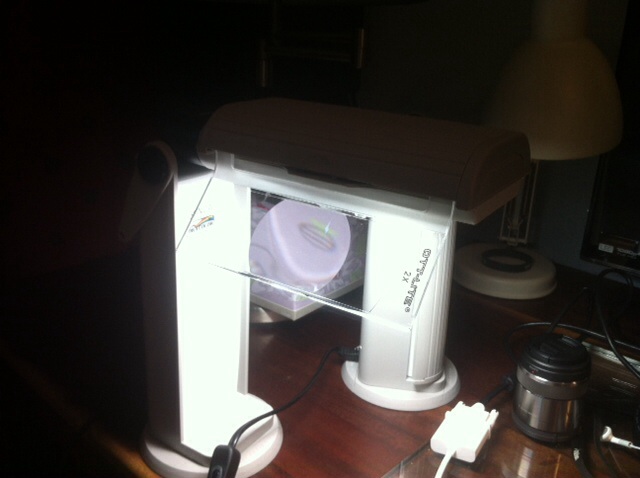
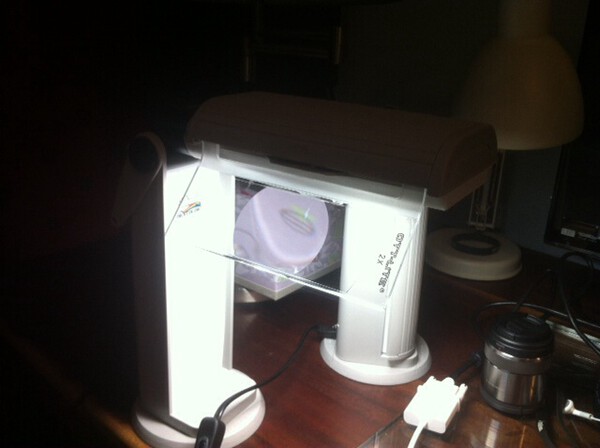
This is the lamps I found for tosogu. Built in magnifier, swivel base, florescent bulb with better color correction. Normally used for crafting, esp quilts and knitting where color is important. I bought two second hand as they aren't that cheap at retail. I took a risk when I bought them, but thankfully it seemed they were very warmly received by members this past meeting. Fred and Tom also set up a separate table just for tosogu viewing and to demo the lamps, but not sure if this will be ongoing or not. Not sure what other clubs normally do for tosogu, but I felt this was an experiment that turned out well. If single incandescent bulb is the way to go for most on the board, I will construct a set up around those as they are also probably the least expensive option. But I'm also open to alt light sources since my own limited experience makes me hope there is something better out there....
-
Thanks for the suggestions. So LED followed by florescent. No one likes halogen? A camera light stand with directional shutters, with an led bulb might work then. I'm guessing a single point of light reflecting on the surface is needed? I was hoping an led panel light would illuminate more of the area, perhaps reducing the amount of motion needed to view a blade, thereby decreasing space. The idea of the set up is to enable multiple set ups side by side, probably one person per set up with at most two. Anyone have experience with larger Led panel? I'm now curious whether a photo set up would work with live viewing. I take it most or all of the hamon has to be visible at one time with that set up...
-
thanks Mariuszk. do you have any guidance regarding particular size of led panel? I'm also wondering if variable brightness and spectrum is helpful. example: http://www.amazon.com/Fotodiox-Barndoor ... mera+panel don't mean to make a mountain of a mole hill, but am trying to figure out something that would scale up and for public use (also that would last for a long time). ideally, user would be able to control any light adjustments (remote or inline control), but not sure if this is possible in a public set up.
-
I second Brian's comments on the suaka tsuba! Mei seems stylized kanji, so will be harder to figure out. Am away from my reference books this weekend, but if nothing by Monday, will take a crack at it. I think some may comment that the first one may be more of an "export" or decoration tsuba rather than a functional tsuba, based on the position of the design. Doesn't diminish the beauty (and value) of the piece in my book. Very nice.
-
As a mainly tosogu collector, I don't have as much experience in this area. However, I have been tasked with setting up an area that would assist in nihonto kantei, which includes acquiring light fixtures. I'm looking for some advice of set ups that have worked best in a larger hall kantei setting. I have the tosogu lighting covered. So I'm not really looking for an academic discussion of what should work, but actual experience with a set up that has worked really well. The club usually uses a string of lights hung on a wall, containing both halogen and clear incandescent bulbs against a black drop cloth. Usually an ok set up, but I was finding it very hard to look at what turned out to be an ko-aoi blade. It doesn't help that the room overhead lights are of the florescent type. It seems florescent light is good at showing jigane, but not so much the true hamon under the hadori, especially if nio based (in this case, I think it was suguha based ko-chogi or something). I'm currently thinking of placing the entire setup under a small collapsible tent/gazebo to block out some overhead ambient light. I might try to use the black drop cloth to also partition "stalls", with each stall having its own lighting setup. Was wondering if there is an ideal incandescent bulb wattage, or if LED or halogen lights worked better. Any experience with multiple bulb set ups or is single better? Is a black velvet cloth background the best or is white, grey or some other color more useful? If there was a particular set up that really made the hamon pop, I'd really be interested in hearing about that. Thank you in advance for the advice.
-
Just some initial observations which is be correct by the more knowledgable members: By the pattern of the stitching, looks to be that all pieces are matching (except for kabuto which is matched to the dou by the crest), which is a +. I think this is a Date pattern Dou (maybe called 5 sided, but not sure), due to the number hinged sides making it up. Looks like it is missing the arm and shin guards. Kabuto is interesting....has earlier period type brim and "ears", but the style of the helmet is not the older rivited type but is a either a momo (peach) shaped or a possible a priest headgear shaped, which I think falls into the kawaii category. I do not know if this is Edo period or even Meiji or later. Some of the chords on the rear picture look very bright, almost nylon like,but this could just be the flash. For age, details and pictures of the inside of the dou and kabuto would be more helpful. I believe it is quite expensive to restore armor....
-
interesting. the first two remind me of abalone shells. the second might be amida rays, and the last is a tachi tsuba I believe. post pics of the armor too!
-
Very nice John! Much appreciated. Probably pushing it, but any rear shots of the menuki?
-
I just wanted to thank both Ford and Boris for the recent posts, which are full of thought provoking info. While its quite evident that there are very strongly held opinions and beliefs, I really appreciate how both have really taken the time to explain their positions and the problems they see with the opposing view point. I know many would not take the time to do so, especially when it gets heated. But it really is helping to enlighten the subject for someone like myself. While maybe all the parties who have contributed so far might not feel the same way, I only wish I could be having this conversation over drinks and in person (my treat of course), because I truly feel this is a case of "iron sharpening iron"....perhaps at some future token kai event... I haven't fully processed all of the newest posts, but I did want to throw out some of the ideas that have been bouncing around my head. Hopefully this might encourage others who have researched this area to add their thoughts.... 1) The period dating of "Ezo" menuki - I appreciate Ford's comments regarding the difficulty of dating such pieces, and take the Edo period comment as a somewhat exaggerated example. Shibuishi alone does not equal early date, but I don't believe the BB theory has ever solely relied on that. I fully believe that its here a comparison of ko-mino and other early tosogu works would help to buttress or refute the earlier dating (i.e. pre-edo period) of some types of ezo works. Unless there's also some sort of controversy or need to push up the dates of ko-mino tosogu, the similarity of construction methods (sans base metal) should compliment the pre-edo dating of certain shibuishi ezo pieces. So: A) What's the support for the early dating of ko-mino pieces? (possibly better documented koshirae?) B) How similar is the construction of certain shibuishi ezo pieces to ko-mino, or a subset of ko-mino pieces? C) How similar is the construction of certain early shibuishi ezo pieces to various early/middle/late Edo-period works? 2) I appreciate the details provided by Ford that outline how difficult it is to work with Shibuishi vs yamagane. But working on the underlying assumptions that the Ezo menuki are a)made of shibuishi and b) as early or earlier than ko-mino pieces, wouldn't an equally valid conclusion be that the fact that they were made using shibuishi was because it was a requirement as expected by the commissioner? I know the quality of the internals of a mechanical watch does not make it tell time more accurately than another watch, especially compared to a cheap quartz one, but there is a reason why certain jewels and metals and "complications" are used in high end luxury watches. Therefore, one conclusion that could be drawn is that it wasn't the normal low ranking foot soldier who could commission these pieces, but someone from the middle to higher ranks? Similarly, if we assume shibuishi was used, it might point to a production location where the cost of silver vs yamagane may not have been as great as in other areas of Japan, during the same time. Therefore indicating an area either rich in silver ore OR which had an active traded in it from mainland China or engaged with European trade. -I think we might be able to exclude certain locations in a similar way, also by assuming that if Ezo fittings went out of style after the jidai period, it was perhaps because they weren't favored by the areas which finally gained control - the ko-mino style being preferred by the winners (hence Ezo styles possibly coming from an area that lost). This idea comes from a recent and very enlightening conversation with a fellow board member regarding the sudden cessation of Oribe ceramics once Toyotomi came to power and killed off a certain tea master.... 3) It does seem to me that the menuki in question and the style it represents does have a more aged/weathered look than compared to the early koshirae examples. Tracing the history of Zen Buddhism and development of the Tea Asthetics as well as wabi sabi, which existed well before the Edo period might also help date Ezo menuki, as well as provide details about the environment of the location of production if combined with ideas from #2. Yes, lots of conjecture, but possibly a means on which to refine the theory of Ezo that later, more academic research can support.... and
-
YES, YES YES thread NOT dead!!!!!!
-
Ok, so I'm going to rile some feathers now, but since I started the thread and its another late night , I am feeling a little justified in communicating what I have felt has cause lots of undue confusion and where to go from here. Here goes... Having mulled over all the posting over the past week, trying to make sense of all the confusion, I see how detrimental the discussion about outside influences like persian and chinese art have been to this thread topic. I understand and sense how passionate some are in really making a point that the Japanese style isn't devoid of outside influences which permeate all aspects of everything traditionally thought of as Japanese art. I get that, really, I do. But that is a larger issue that would actually cloud all discussions about any tosogu school or style (which it normally doesn't). So it pains me it took such a large and prominent stage in this thread. Such discussions were related to and would have been better handled in the context of a thread on tachi fittings or pre-kamakura period fittings. Many of the pictures showing various comparison of artwork and fittings were actually showing pictures of fittings of pieces from the shoso-in which are not considered "ezo", as used under the traditional definition in Japan (which everyone seems in agreement is incorrect anyway). Its only when I went back to the Sesko koshirae book that I could confirm and state that many of the b&w as well as color pictures of various koshirae shown here were not and are not considered "Ezo" style in any sense. As a neophyte, the terms didn't mean much. These pieces are and have been considered outside influenced works from the Nara and Heian periods, but NOT EZO. If we are discussing such tachi works, it should have been in the context and to the extent that the traditional "ezo" fitting- post Heian and beginning in the Kamakura periods up to the muromachi periods - resemble or mimic tachi fittings, and what implications that might have on the origins of the Ezo style. I freely admit that maybe its because I am trying to formulate a theory that the traditional "Ezo" style is more of an extension of tachi-kanagushi fittings, even to the extent of a lack of any "northern" influence, that such discussions of persian and chinese influence is irrelevant to this discussion. Whether outside art influenced the early yamato court fittings (way before ezo fittings) or the hirazumi northern area (not a major influence on the ezo style): not really relevant. This thread was about trying to understand a specific style of "ezo" menuki. As poor as it is, Ezo is a current designation, and there was an example of juyo menuki which should have been the basis of the following discussions. This is completely lost when trying to make a point about outside influences, influences that is more clearly seen directly affecting a precursor of the ezo style, the tachi kanagushi. Now a debate about whether or not the tachi kanaguchi style was or was not major influence in the "ezo" style and the possible implications on the background and development of the "ezo" style, THAT would have been relevant. But I didn't much (any) of those types of posts here.... Anyhow, not sure if I should restart a a cleaner thread in the future to continue the discussion on more relevant topics. If I could, I would move all those posts into a different thread about foreign influence on "early sword fittings" or "tachi-kanagushi" or "akasaka and goto schools". This forum thread would then be much cleaner, with the more important points in contention about "Ezo" fittings made clearer. Where to go from here?: I have learned so much from this thread, and the forum in general, that I feel some obligation to try to "right" this thread at the risk of stepping on some toes, rather than leaving it for dead and staying in the good graces of those I have yet to offend. My hope is that futures others who are interested in "Ezo" info might find this thread still more useful yet. So, I would love to try to refocus the discussion towards "Ezo" fittings, by: First, it would be very helpful to clarify what/which early kamakura pieces and what aspects specifically of these pieces would make them considered "Ezo", in the traditional sense. That is, those early koshirae pieces (which Boris showed back on page 4) that are related (or not) to the menuki at the beginning of this thread. If those are "ezo" in the same way the menuki are "ezo", then we can see a definite lineage and progression of the ezo style. Second, a good point of contention to address which seems pretty important and possibly very relevant is whether or not early "Ezo" menuki were made of shibuishi or yamagane. Here, discussion about tachi fittings, and whether shibuishi was used by tachi-kanagushi or ancient metalworkers like the persians or chinese would be relevant. I'll save my thoughts (and cage rattling) on that topic for a *slightly* later date, while I steel myself for the possible retaliatory responses.
-
the breaks are welcomed after such intensive information exchanges. So glad that it hasn't become: So much good info, I have a virtual spinning hour glass in my head trying to process and develop my own personal "unified theory" of these joko-kinko (ancient period soft metal) fittings. A little humor helps to avoid having a mental "blue screen of death", too much and the thread becomes useless. I'm fully aware that my attempts to try to combine the various elements might cause me to completely offend everyone and everything that has been put here, as I've seen how I've already misunderstood or misinterpreted some of the info give.... So, here's to one last mental/off topic break:


-
Thanks Ford! A very helpful response and definitely makes it easier to understand and better grasp the counter viewpoint. Now I have even more to mull over. I think the main idea surrounding the counterpoint can be found in the statement "Just because something looks old, doesn't mean it is." That, for me anyways, is an anchor point in trying to wrap my mind behind these two very different theories about the "Ezo" juyo piece in question. I didn't realize that there is a disagreement about the base metal being shibuishi or yamagane! This is very interesting indeed. I would have thought it would be a very easy thing to verify. Boris mentioned doing some electron microscope scanning that would support shibuishi. So I wondering how the insight brought up by Ford, that native copper (yamagane or impure unrefined copper) mined in Japan was significantly Argentiferous, would affect the electron microscope results/analysis? Other than buying the piece in question and then cutting or melting it down, would there be a better way to test it for shibuishi or yamagane? How about polishing a small portion of the back of "early period ezo" fittings to see if it looks more like shibuishi or yamagane? (hmmm...crowdsourcing enough funds from the forum to buy and destroy juyo fittings papered to ezo... ) All the other good points/counterpoints are so dense, will take me a little while to unpack. But I am very thankful for all the wonderful insight and informative view points! Might I say this is a very exciting discussion so far , and thank you to all who have provided helpful input! (ps: chances of having a well stocked tosogu examination table at the august show, sponsored by the NCJSC no less, are looking good! Might even be a nihonto/tosogu examination full corner booth area. Please keep fingers crossed!)
-
While I can appreciate the questioning and requests for sources made by both Henry and Ford, I do want to thank Boris again for all the posts that help to clarify his thoughts on the origin of ezo theories. It really expands and explains the original ideas expounded in the Butweiller articles that were published back in 1979 in Bushido. At the same time, while its good to question the new ideas, it would be equally helpful for this thread and neophytes if there was a more point/counter-point made with support. Boris had brought up several different ideas about the origins of "Ezo" fittings, and its hard to discern (at least for me) what is in contention, if not all of it. Going back to the original piece: NBTHK Juyo Ezo: http://tsuruginoya.com/mn1_3/b00114.html I'm going to label the "new" thoughts about Ezo as "BB" for Boris/Butweiller. My understanding is that this ezo piece was deemed NBTHK Juyo worthy and priced at $7500 for the following reasons: Historical: BB-pre momoyama fittings, possibly 12th century pieces, pushing current timeline of tosogu studies back. BB-developed in northern area after the fujiwara gained power in the area and took over the rich natural resources from the emishi. Aesthetic: BB-represents early kinko craftsmanship in a northern style BB-similarities to o-yoroi armor decorative metal work Kantei Points: BB-Delineated into several different periods (early, middle, late). The current example is early. BB-unique meturllurgy of non-homogenous shibuishi ( in advance if I've made a mistake here - Please correct as I have not had time to fully process Boris' responses) Opposite these ideas, the more traditional view of same piece would be given the following attributes: Historical: 14th/15th century fittings, developed around the time of ko-kinko works. made by, or mainly used by emishi/ainu Aesthetic: different tradition than ko-kinko works. austere depictions favor well when viewed through tea ceremony aesthetics Kantei Points: no discernment between early, middle, late periods; all one category or school. General Kantei Points for early(BB)/top quality ezo pieces: Gold over shibuishi Edge is uniform thickness. Rear punched/cutout areas left rough. Design is asymmetric, of vines and plants, sometimes including animals, insects , crest motifs Going over the BB point, I think there are a few where everyone is in agreement? But hopefully by identifying which of the BB points one does not agree with, and providing the support for the counter argument of the traditional or alternative idea, that would help inform and enlighten the forum. Thanks in advance.
-
Thanks so much for the amazing response. Will re-read and digest the latest post (as well and the entire thread) over the next few days...