kaigunair
-
Posts
732 -
Joined
-
Last visited
-
Days Won
1
Content Type
Profiles
Forums
Events
Store
Downloads
Gallery
Everything posted by kaigunair
-
unusual practice of yasukuni kabutogane...?
kaigunair replied to kaigunair's topic in Military Swords of Japan
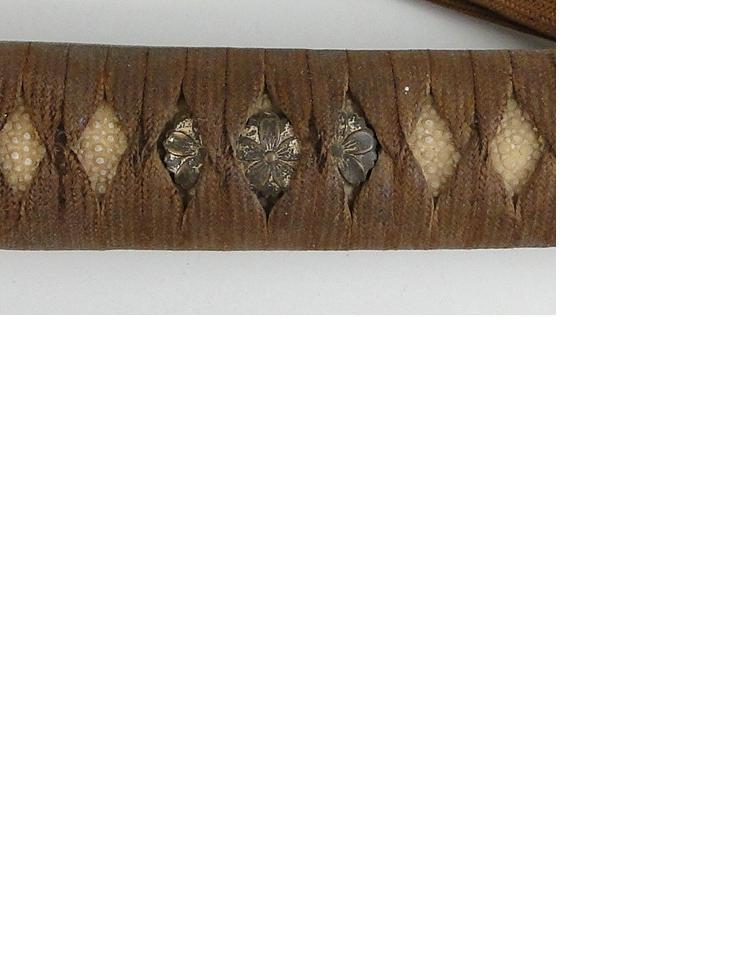
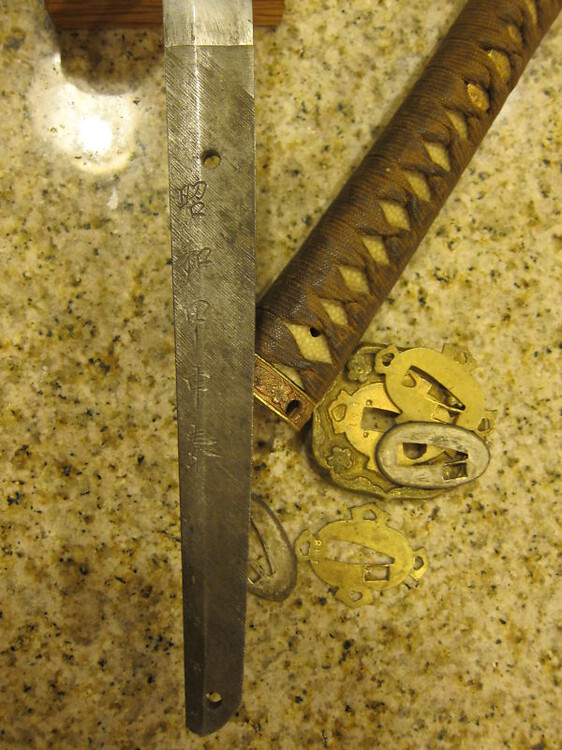
some update on the kabutogane pegs: The peg holding in the second kabutogane is actually a broken pencil (yes, with a graphite core). The kabutogane was also very loose. A pencil was also used for the mekugi ana on this yasukuni. Upon closer look at my original yasukuni, a bamboo peg was used but it slightly oversized (i.e. sort of sticks out of the side of the kabutogane). Based upon these two examples, they seem less like a field job and more a post-war mod. Perhaps they were done by the owner to keep the tassle, or perhaps done by the US occupational authorities when they were collecting and cateloging the surrendered blades? The pencil really shocked me (the one in the mekugi disintergrated and I replaced it with a temporary one made from a take out chopstick). Guess I'll now post for gunto sarute's and rings in the wanted section... -
I'm really interested in this aspect of "what makes a real nihonto", and this could potentially open up a "can of worms" regarding my many questions about gendaito/guntos, mantetsu/seki smiths, and what shinsha teams will and will not look at. Also of "namban steel" made shinto and shin-shinto blades. Probably best to open up a new thread. I've enjoyed the thread and hopefully has the original poster... :D
-
I feel the same way and hope he doesn't stop with this blade. Re: emura blades, I was under the impression that most of these were not made with tamahagene? Also, has the prison labor/smiths story been verified or debunked?
-
First off, I enjoy collecting gendaito blades and I give you credit for taking on the cost and the 5 year wait time (which I believe is extreme for this type of blade, or most any normal blade TBH). That being said, I think it only honest to say that your time and funds might have been better spent elsewhere? Emura blades aren't exactly "real Japanese swords", unless possibly forged by Mr. Emura himself. They're more gunto than gendaito. I'm was really surprised when I heard you went through the whole polishing/saya making process because of the cost and this fact. You possilbly would have been able to pick up a decent "real Japanese sword" for the price. Did some one advise you to do this with the emura blade? I've been told one reason to stay away from ww2 blades is because one needs to view quality blades to get an eye for quality work, and ww2 blades normally don't fall into that category. To this end I do stick with collecting yasukunito/mina-to, but have been tempted to collect other forms of "gunto" for the history aspect. The history/era/use of ww2 swords is important to myself, since I am not yet an art conissour of nihonto. Through study, I hope to be able to develop my eye for nihoto and begin collecting "nicer" and older blades. The emura blade appears to have been a great learning experience for you. B/c it doesn't quite fall into true "nihonto", you may want to see if you can exchange it for something more worthy of study if possible. Again, I would be really shocked to hear if anyone here advised you to go this route. But since you appear to really appreciate nihonto, the best thing would be to get something better to study. my humble opinion, from a fellow novice collector....
-
how to read date/unusual date on mantetsu blade...
kaigunair replied to kaigunair's topic in Military Swords of Japan
totemo sumimasen morita-san. I don't own the blade, and the pictures were from an ebay auction several months old. I found the blade while looking at the feedback of a seller on ebay. I am trying to find the ebay listing again, and will post it once I find it. I do not recall there being any better pictures of the nakago, as didn't even realize there was a serial number on it. update: found it! http://cgi.ebay.com/ws/eBayISAPI.dll?ViewItem&_trksid=p4340.l2557&rt=nc&nma=true&item=320641229265&si=PvwUFU85XYmaIKu8NdLE19hWvmU%253D&viewitem= -
I'm really surprised you had what must have been a very expensive polish if it was done traditionally and resting saya made for an emura blade! Since it is an emura and doesn't look particularly unique, would I be correct in guessing this wasn't done by a formally trained polisher? (I would also be very surprise if one accepted it) Also, the pics are pretty blurry, so while the saya looks very decent, I honestly think the pics make it look like the polish is very rough with lots of scratches....
-
If anything, the color of the menuki would be the one indicator whether the silver plating/painting was done post war or if its original to the gunto mounts. As mentioned earlier, its the one piece that would the most difficult to remove, and the tsuka wrapping looks untouched. Anyhow, me thinks its gold, but it could be the lighting. If it were silver-colored, then the mounts possibly wouldn't be a complete fake, but still, crazy $$$.

-
-
So it's Gimei? What do we do with it?
kaigunair replied to george trotter's topic in General Nihonto Related Discussion
Gendaito for me! Actually, this is the main reason why I felt I should become more active on this board, to learn about older nihonto. I've stayed away from anything older because of this exact problem: fakes and gimie blades. Would love to see more knowledge shared in this area, as well as kantai. As of now, I am looking towards the local nihonto club to get real help in this area, although they only meet once a month... -
:x what is going on? http://cgi.ebay.com/ws/eBayISAPI.dll?ViewItem&_trksid=p4340.l2557&rt=nc&nma=true&item=390302635944&si=IiGfI6x8vbpqCF0%252FRF3NcBCRcFk%253D&viewitem=&sspagename=STRK%3AMEWAX%3AIT boy oh boy. spray silver paint over gunto fittings, and you get this?
-
Handle from japanese.antiques
kaigunair replied to troy8's topic in Auctions and Online Sales or Sellers
one experience I share about my visit to Japan a few years ago for the first time to see family: In tokyo, I saw lots of "urban" clothing stores (fubu, marc echo, etc). Not my thing, but what I noticed were the clerks or greeters in front of the store. I live in the San Francisco bay area, a very diverse place by any definition. Yet, there in the urban clothing stores in Japan was where I saw and met the most number of people from different African nations! Ghana, Nigeria, etc, it was the most hilarious thing I had ever seen and spoke volumes of the Japanese perspective of US urban life. and and all at the same time.... -
Handle from japanese.antiques
kaigunair replied to troy8's topic in Auctions and Online Sales or Sellers
I would also agree that sellers in Japan get a "pass" because they're based in Japan. Its also interesting to note that many of the sellers located in Japan are not Japanese but transplants from the US, Europe, and Asia. Doesn't mean anything good or bad, just the truth. Due to the Western perspective of Japan (say vs China, Africa, Eastern Block countries), there is a positive view, which is more for the culture and values as perceived by non-Japanese. Its an interesting comparison since the same pass isn't given to sellers based in other countries like the US and England. I wonder how much this is due to actual interaction with citizens from those countries, and how much of it is perceived or press influenced. The warning is appropriate (since I hate seeing Japan-based sellers listing junk or worse, fakes, getting premium prices) and should not necessarily be considered racist, just cautionary. Hey, I had a more positive view of those "over the pond" before joining boards like this... :D -
how to read date/unusual date on mantetsu blade...
kaigunair replied to kaigunair's topic in Military Swords of Japan
stamps commonly noted for mukden/mantetsu for reference (from Dr.Stein's site - i hope this is ok)

-
how to read date/unusual date on mantetsu blade...
kaigunair replied to kaigunair's topic in Military Swords of Japan
great info. thanks all. here's the mei w/stamp for reference (stamp is different from others noted in some websites):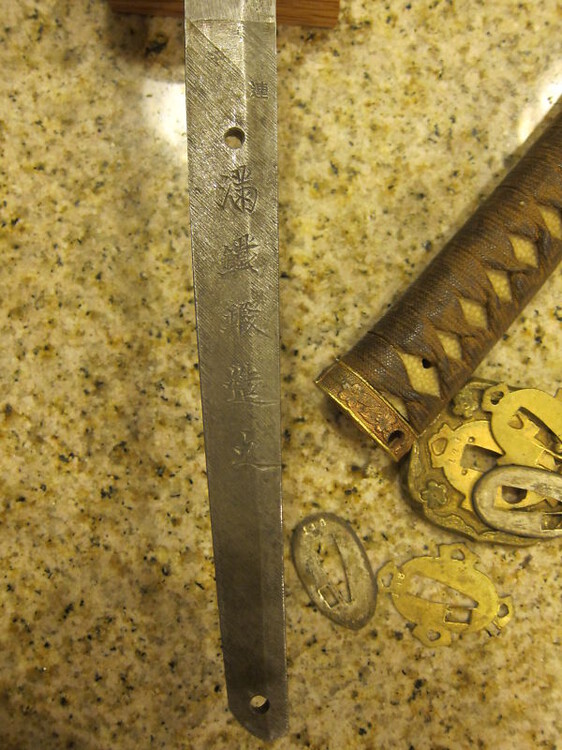
-
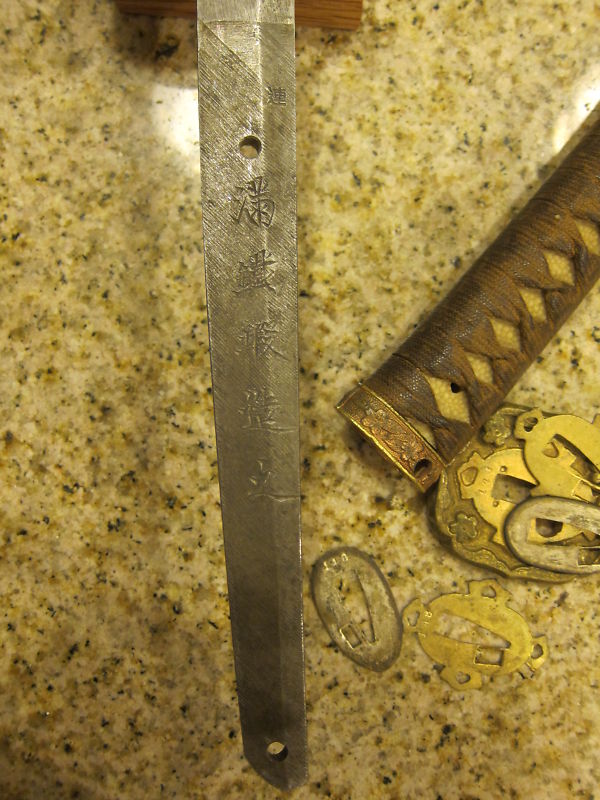
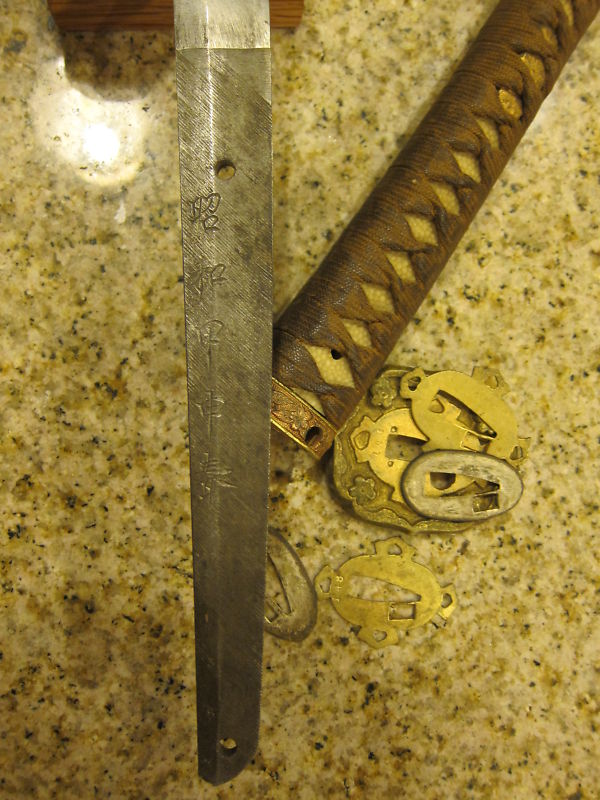
I see the showa 4, but don't understand how to read the rest of the date...don't see a month day character. This was off a mantetsu nakago. Is this date variation commonly seen only on mantetsu? I dont' recall it on isshin or other mantetsu blades. As someone will probably point out, this was from an older ebay auction (already ended). I didn't win it, but came across it searching for more info on other showa period blades. (i.e. I cannot provide any additional pics) thanks in advance...
-
unusual practice of yasukuni kabutogane...?
kaigunair replied to kaigunair's topic in Military Swords of Japan
Nice! Now there is an example if an emura blade with this mod. Estetic reasons also a possibility. While we may or may not ultimately know the true answer, aren't these the type of questions that make collecting nihonto so interesting? Maybe it's just me.... -
I was hoping there might be info on variations of the signatures, such as that in the book on yasukuni blades- such as the signature used when the smith made the blade vs one of the students. The pic from wallenga looks identical to the known example post of dr.steins site. So no help there. Since the minato smiths did not rank as high as the yasukunito smiths,mmaybe the interest and research in jpn is lacking. I've always been interested in Jpn naval items, hence my interest in minato. Yup, the eBay one is the signature which got me thinking. I also have a small pic from another similar signature on an eBay blade 5-6 years ago. I read somewhere that yasukuni signatures were being faked, and thus minato variation peeked my interest. The eBay blade was one I was thinking of buying and restoring. Any comments on this would also be appreciated as it would be solely for my personal collection.
-
unusual practice of yasukuni kabutogane...?
kaigunair replied to kaigunair's topic in Military Swords of Japan
That post seems to imply that there is a lot of experience and expertise behind it. I don't agree with how it equates condition of the blade or possibly the mounts to determine field use. You would do well to research known surrendered blades, ESP those from officers in places like Burma and the Philippines. One may argue the blades from the high ranking officers weren't "field" used, but I would disagree since in other battlefields, they would lead the final banzai charge. Also, as I've stated, I've now seen two examples, but wasn't paying attention in the past to this detail. I find it almost a statistical improbability that I alone would be privy to this experience, so I think it is a more common, though unnoticed, occurrence. Hopefully the post will raise awareness of collectors and then we'll see more examples pop up (or not). I appreciate and enjoy all the comments with great insight. And I think I'll be spending more time in this forum! -
novice question : nihon to kozu books....
kaigunair replied to kaigunair's topic in General Nihonto Related Discussion
thanks all for the quick responses! I guess the hunt is on then.... -
I've been slowly collecting all the recommended "reads", and was wondering about the nihonto kozu set. Specifically, the translation set by AFU watson. Is the translation a stand alone set with all the oshigatas (like the english version of the yasukuni jinja book) or is it meant to be read in conjunction with the original Japanese set? Basically, do I need to find both the Japanese (for pictures) and the english versions (for reading)? thanks in advance.
-
unusual practice of yasukuni kabutogane...?
kaigunair replied to kaigunair's topic in Military Swords of Japan
I never really thought about keeping the sword silent. Could this mean that mount with this modification were carried into a battle area, while those with may have been taken from "desk jockey" officers? If this were the case, the modification would been seen across many gusto/Gendaito. Is this a common occurrence? I guess I'll be paying more attention to this detail.... Is this also the reason why I sometimes see cords instead Of a metal Sarute at the end of naval mounts? -
I've seen this twice now on yasukuni blades, and was wondering if others had seen this done for other gendaito/guntos. Basically, the sarute and the round, 2 piece metal tube that held the sarute is removed from the kabuto-gane, and a piece of bamboo is placed inside. I figured this meant that perhaps the owner replaced the entire kabuto-gane, since the original one may have had a kamon/crest on it, but now I've seen an example where the kabuto-gane has a kamon, but the sarute & 2 piece metal tube/loop hole are removed and a bamboo peg installed. In both cases, the bamboo peg is aged. If someone was trying to remove a tassel, I can understand the sarute missing, but not the sarute and the screw in metal tube holder. Unless most yasukuni-to's had a kabuto-gane & sarute but no tube holder. The only other reason I can think of doing this is that perhaps there was a post-ww2 use for sarute/tube holder, maybe a nice key chain? Or the combination is needed to display a tassel on the wall/family shrine? Is there something especially symbolic of a sarute that it needed to be removed (like the grounding of the imperial chrysanthemum on rifles)?
-
Nothing more in wallinga's publication on the subject either. I found an old ebay auction pic I printed out 4-5 years ago with a mei similar to the questionable one. Guess there isn't much interest/info in minatogawa blades....
-
Assuming that this is in the typical Gendaito style with suguha, what are the additional characteristics of a mina-to that would confirm genuine or fake? I had previously thought that most gimie could be determined on the mei alone, esp ww2 smiths. This one definitely didn't look like the "known" signature to me, so I was thinking maybe a fake or a student. I was really hoping there might be more nakago signatures for reference....
-
If I posted this in the wrong topic, please let me know. Any help regarding how to determine fake signatures on minatos or yasukunitos or gassans would be much appreciated. Was hoping this was the place to be for nihonto questions....