kaigunair
-
Posts
732 -
Joined
-
Last visited
-
Days Won
1
Content Type
Profiles
Forums
Events
Store
Downloads
Gallery
Everything posted by kaigunair
-
Many of the cleaning tips I've come across are aimed at iron tsuba. Does ivory/bone scraping apply to brass and copper or are these metals too soft for that sort of treatment? I need to find some old brass door knobs or pipes to experiment with....
-
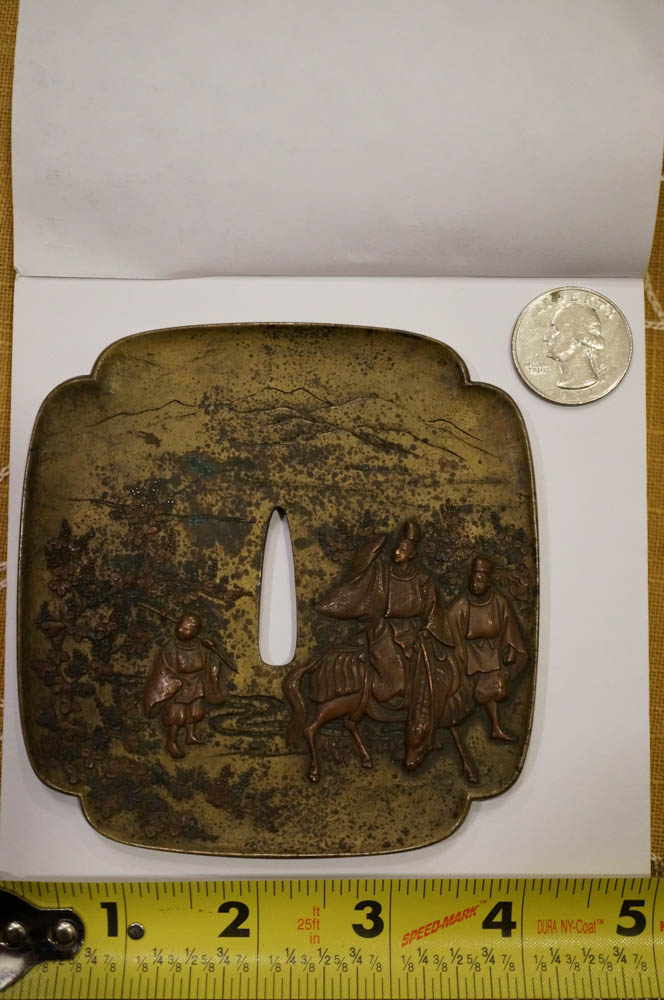
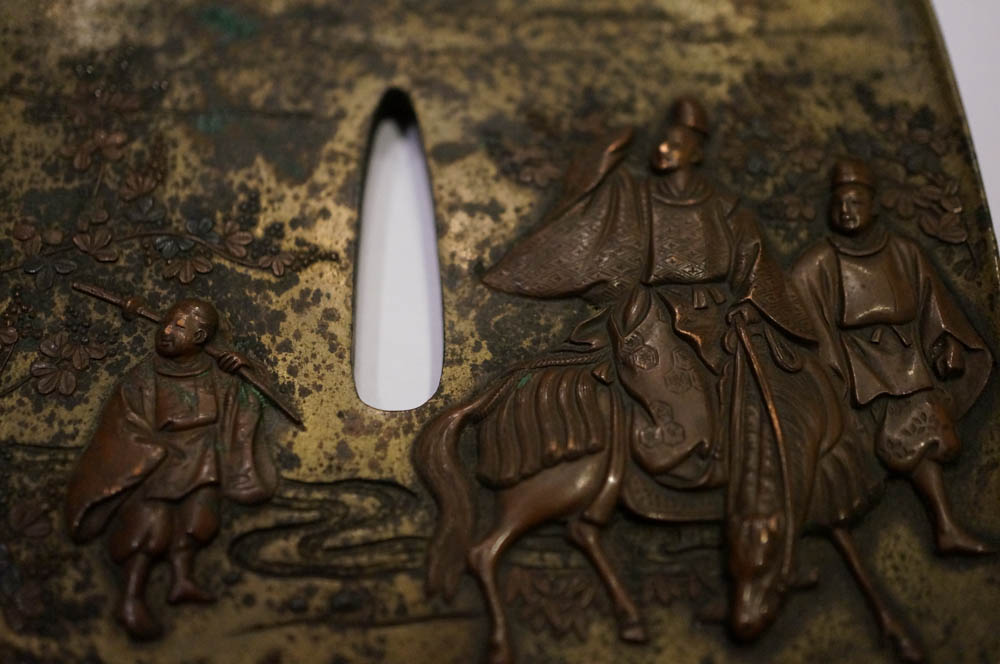
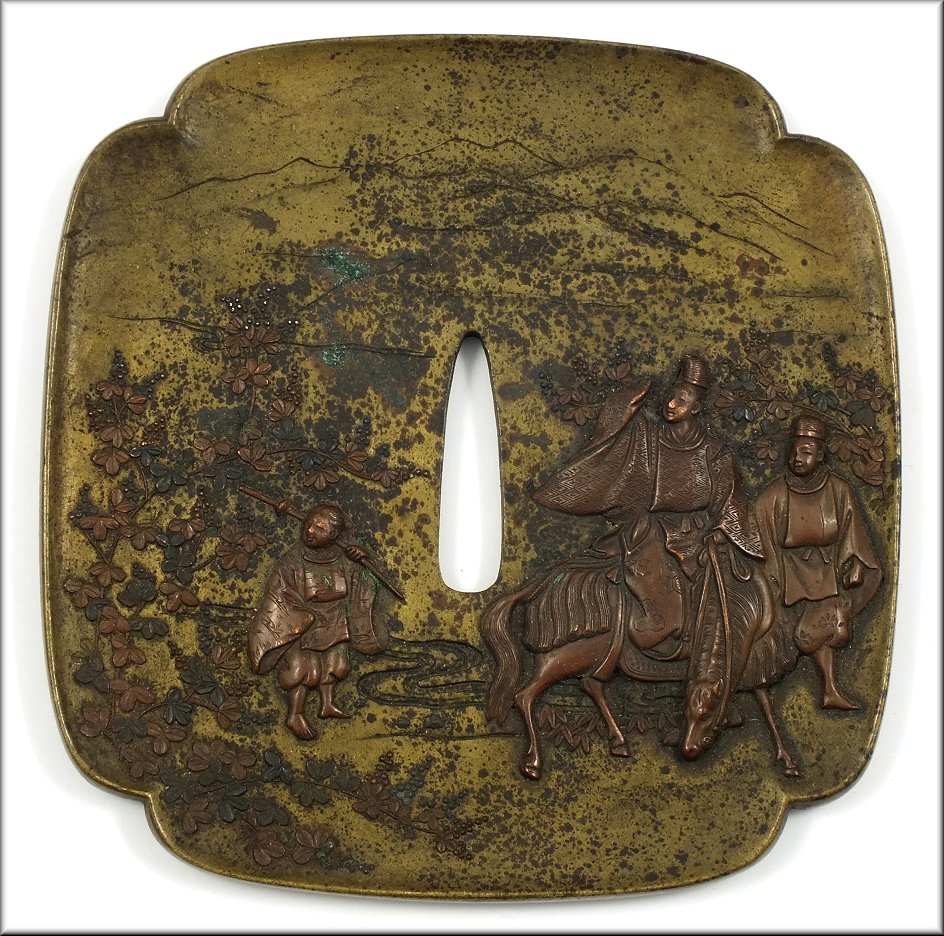
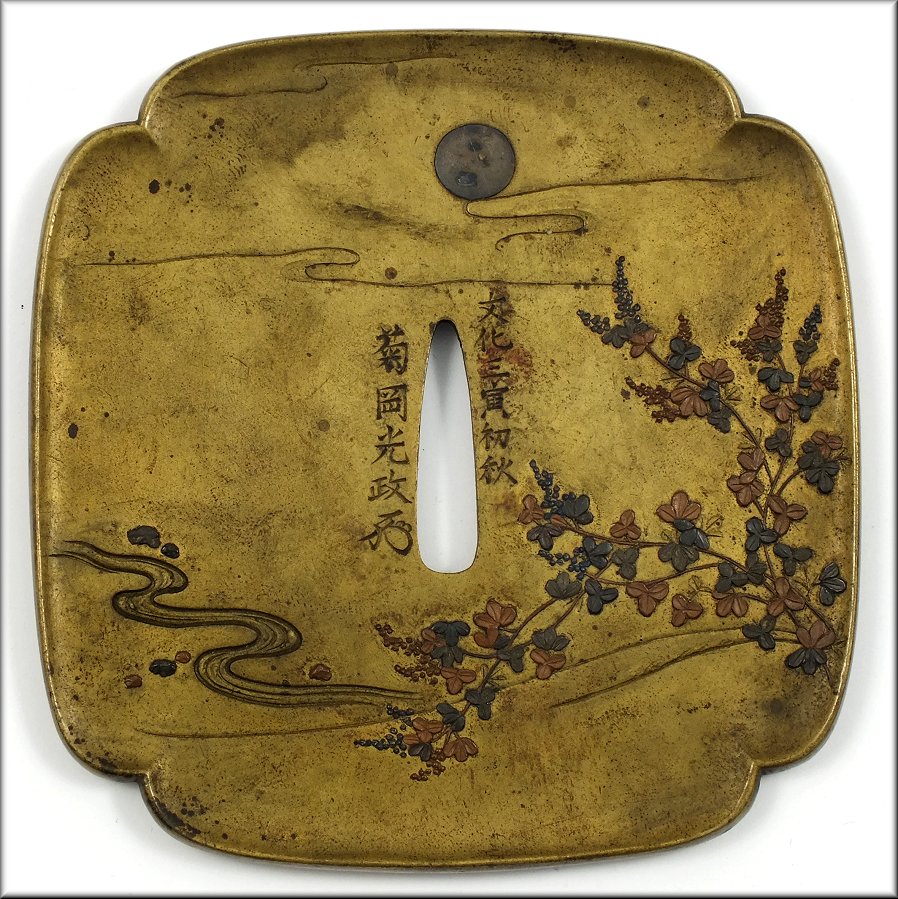
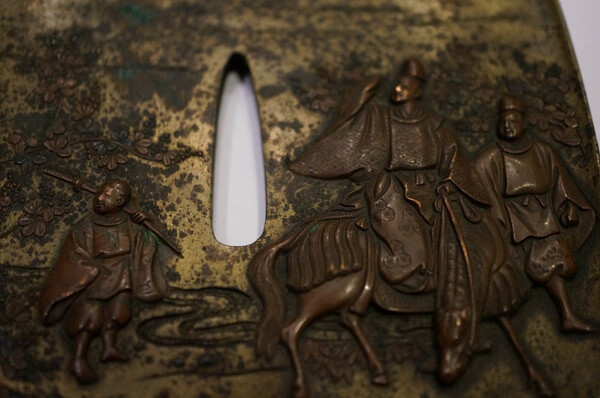
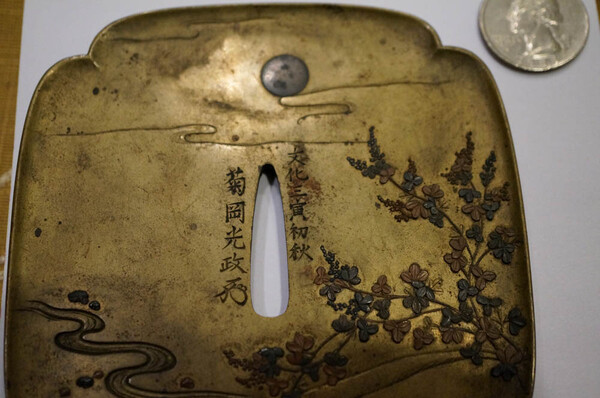
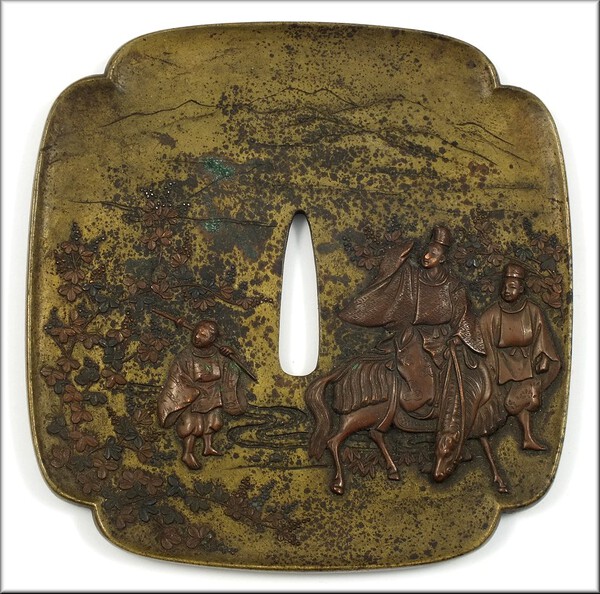
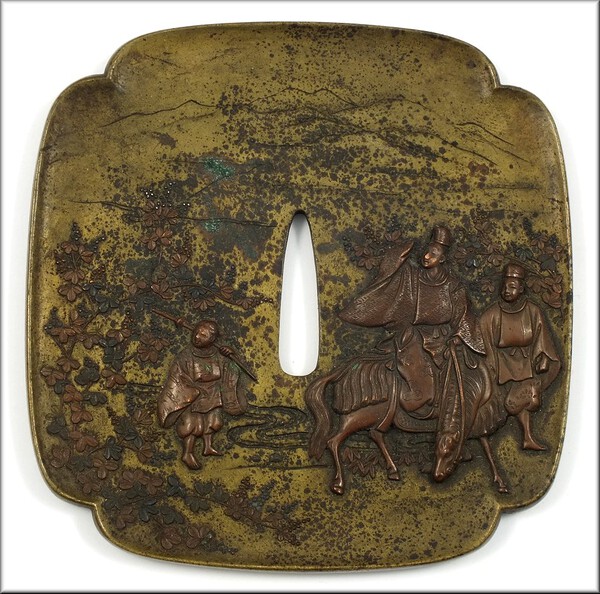
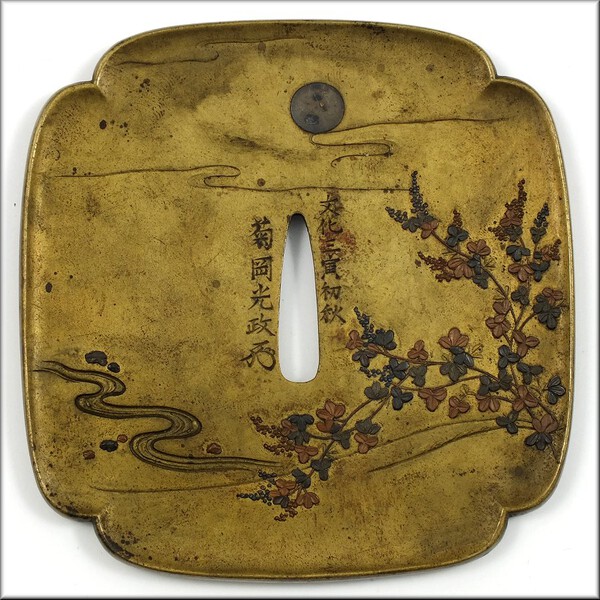
Picked this one up recently (probably seen by many), which is in need of a good cleaning. Probably opening up a can of worms, but am looking for some opinions on what I plan to do to clean it up. This is a very large tsuba, which I believe is properly described as a hamamono tsuba - made for export and usually placed with important edo era names (so gimie?), named so b/c a great quantity of these came from Yokohama. Signed 菊岡光政, mitsumasa kikuoka, and also what I believe is 文化三貴初秋 . The 4th kanji (in combo with 3rd) is throwing me off, at it might be 寅(tiger)? I don't quite understand the meaning, but its something to the effect of culture ??? early autumn. Not sure if its 3 tigers, or "Miki". Looked for Japanese artwork about a tiger hunt but can't match it. I know I'm missing something here.... Since this is hamamoto and signature is most likely gimie, I feel ok about trying to do some light cleaning. I bought it because I enjoyed the fine details of the copper figures and the moon scene in reverse. I'm guessing it was stored with the main scene up and then covered by something which trapped in moisture. I didn't realize how large this tsuba would be! Most pressing part is the presence of verdigris which I want to get off asap. Initial Proposed steps to clean: (plug nakago ana with candle wax first) 1) Distilled water in ultrasonic cleaner (holds approximately 2 quarts ) 2) Distilled water plus 3 tablespoons of white vinegar in ultrasonic cleaner (very light acid) 3) Distilled water plus baking soda in ultrasonic cleaner (very light base) Anyone with experience cleaning brass and copper tsuba that can offer helpful comment would be much appreciated. Will try to have thick skin for all the rest....

-
very nice articles! thanks for the question and the answer!
-
Nice find. Me likey!
-
found these but none labeled "drawer pull"
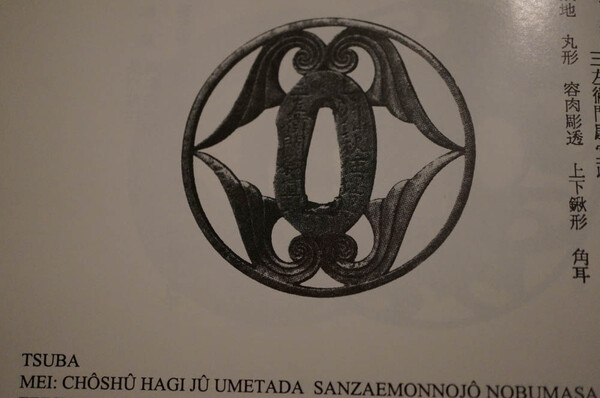
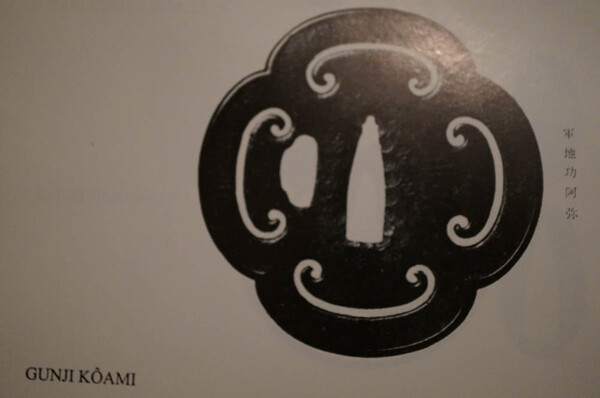
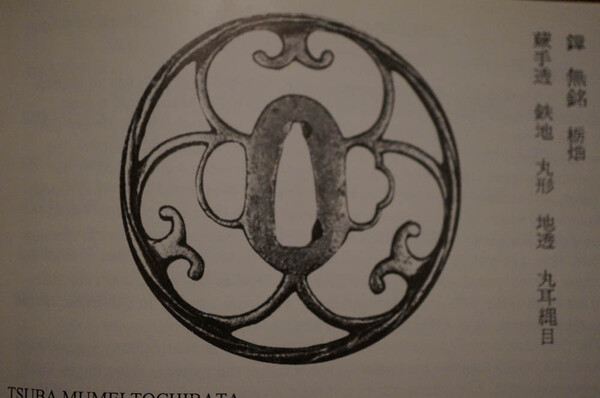
-
new ginza catalogue 館蔵品...kanji help...
kaigunair replied to kaigunair's topic in Translation Assistance
Ah, thanks Chris. Much appreciated! I'm trying to figure things out word by word but the full meaning is very helpful. So is kanzohin = collection? or is it something more akin to treasury item, something stored in a safe? If anyone's interested, here's a few hours worth of translations from the new 2013 catalog... Monthly Interest Swords General Information Magazine がつり とうけん、そうごう、じようほうし 月利 刀剣 総合 情報 誌 Ginza Information ぎんざ じようほう 銀座 情報 2013 New Year にせん、じゅさん、 ねん、しんしゅん/いちがつ、さんびやくご、ごう、 2013年新春 1月−315号 Ginza Celebrated Sword Gallery きんざ、めい、とう、Gallery 銀座名刀ギャラリー Shop Item’s collection for appreciation guide かん、ぞう、ひん、かんしょう、がいど、 館 蔵 品 鑑賞 ガイド Posting Goods Applications and Stock Inquires けいさいひん,の,おもしこみ,と,ざいこうひん,の,おといあわせわ 掲載 品 の お申し込み ,と, 在庫品のお問い合わせ は (I've left out the info in the upper right hand corner, as this is a bunch of dates and catalog number info, well that's what I think it is....) -
Just began subscribing and decided to try my hand at translating articles of interest. I'm stuck on the cover page. How is the kanji in the title translated? 館 蔵 品 鑑賞 ガイド I hiragana, I believe its "かん、ぞう、ひん、かんしょう、がいど". I'm having trouble figuring out how to translate the first 3 characters. Is it "Collection of products", or "Museum storehouse products" "castle warehouse goods" appreciation guide. Am I close? Thanks in advance.
-
Looks like I may be jumping on the isopropyl bandwagon. I was wondering if there was an objection to using the blue shop towels? My collection is mainly Gendaito in original polish but one day soon I hope to have a nicer one go through a Togishi. I had been using the kit uchiko ball on blades that were out of polish or when I first get them, and then switch to a bob benson one for the periodic cleanings.... I do like the smell of the clove oil so I don't think I'm ready to give that up just yet. I know a friend who likes to use auto wax on his gendaito collection....! Not for me!
-
Also of interest is a translation of an informative books put out by the South Manchuria Railway Co,Ltd. Dalian Railway Factory Sword Works. It is labeled "Kōa Issin" and was published on July 25, 1939. (The english grammer is a little off in some parts): http://www.k3.dion.ne.jp/~j-gunto/gunto_149.htm Not sure if this will solve the question about koa isshin's made in Japan or for the yasukuni exhibition.... If any one has any additional references, web or paper, would be great to try to fill in the knowledge gaps of mantetsu/koa isshin/manchurian railway/yasukuni exhibition (at least in my head).
-
Well, since no additional info was fourth coming, I went and read up on koa isshin and mantetsu in the fuller and gregory books. The smaller doesn't have much info, but there is some more in the larger. According to fuller/gregory, the difference between the two is that koa isshin mantetsu blades were made in Japan while those marked only mantetsu were made in manchuria. The former was "superior" and the latter an "inferior grade". Not sure what the support or proof of that is, but there it is. They also explain koa isshin as a patriotic phrase meaning "single-mindly praying for the development of Asia". The more literal translation is "one heart" which is what I had been referring to, which is explained better at the stein website, link below. http://home.earthlink.net/~steinrl/koa.htm Stein notes that its possible that the use of mantetsu in koa isshin does not necessarily mean the same mantetsu steel but could mean a generic "foreign" steel. One last thing from fuller/gregory, they quote Han Bing Siong saying that koa-isshin might have been traditionally tempered since the metal could withstand the shock of water quenching. Hope this helps.
-
thanks all. it is a wake up call for me. Mike, yes, of course a polish would cost more than what I paid for and I expected that. Problem is that it has blisters which were undisclosed. These could open up during a polish. And the one flaw that was mentioned, an opening that was filled, was actually much larger than the pictures showed. Plus, it seems someone uneducated tried to do a rough polish on it. He knew all these things as his messages to me show. I was very interested in it because of the kamon on the habaki and its remote possible connection to my family. But even the habaki is damaged and ill fitting, which makes me wonder if this blade was a replacement by him. Seller does not seem to be willing to deal with this in an honorable matter. He is knowledgable about nihonto, buying lots of blades himself and looking at his ebay profile pic. He would probably never try to sell this sword in person or at a sword show. He was probably trying to off load a bad blade using ebay. What ticks me off is that after writing to him and pointing out all the problems, his response is that "its old" or that "blemishes = blisters" and "scratches = previous bad polish", and that if I want a "good" sword, I should be ready to spend $6000 on one of the other blades that he has listed. I wasn't expecting a sword in polish, but something that I could possibly restore that had the maru-ni ken katabami on it. This edward mcmurray in hilo hawaii seller is definitely someone I would steer clear of at this point.
-
Agreed. I am open to correction especially if I misstated things so please feel free to post corrections, or send me via a pm. It would be much appreciated.
-
Great question! Here's my theory: mantetsu steel was developed/marketed as a new type sword that could withstand the mainland winters. These swords were sold/issued to the troops as a better type sword for these conditions. Koa Isshin blades were probably made as a superior quality mantetsu blade. The phrase itself, Koa Isshin was a patriotic slogan underlying one of the reasons put forth for Japan's push into asia. So blades marked with this were probably made with more care than those merely marked mantetsu, being imbued with the imperial mandate to unify asia. Kinda like how most/all gendaito is made of tamahagane (mantetsu) but yasukuni and minatogawa blades are of superior quality (koa isshin). ....my $0.02...
-
Mikolaj, Looks like adobe professional has some additional functionalities. I'm working with reader right now, and it doesn't seem to work for me. I think my work offers a discount for adobe professional, so that may be the way to go. Thanks everyone for the input! -Junichi
-
Just got the Hayens index and finding it very helpful. I thankfully have both the hardcopy and CD version. I was wondering if anyone had been able to use the adobe search function for Japanese kanji characters? I'm thinking that in the adobe version, the Japanese characters aren't coded as text but as images....
-
Thanks all. The seller hasn't responded since. I'll give him until tuesday to respond but if he says nothing, then I will begin the refund process with ebay along with negative and cautionary feedback.... Will update as necessary. Thanks.
-
I would think it has to do with how the tsuka was shaped. Could have been tighter in all areas except for the non-rust parts where it didn't make contact. Sometimes I think the rust is developed due to the moisture coming from/through the tsuka. Maybe oil from periodic cleaning leaking down the habaki through the tsuba/seppas and the fuchi guarded the area? Worse case I can think of is maybe it was retempered at some point, and the file marks added back?
-
Thanks Mark and Jiro49...makes one wonder why the seller would take such a tone if paypal is going to refund me anyway. I don't think I'm being unreasonable, having stated clearly the serious undisclosed problems. I will definitely pursue this to paypal if we can't resolve it in a civil manner. The end result is that he'll get a negative feedback from me, instead of a positive one saying "An honest seller who resolved a problem quickly. No worries here. A+++" Ron, that's a good best practice and I will being using that for future purchases. Thanks for the suggestion.
-
It was bound to happen, but I finally bought a sword from ebay I wish I had not. Seller goes by 808jackiep. He signs his messages and the package as E.A.McMurray. Located in Hilo Hawaii. The blade I purchased had multiple problems that weren't disclosed, including two fukure (blisters), habaki bent/damaged to better fit the blade, loose fittings, etc. Even the one problem that was noted in the written description, a filled opening, was not shown very clearly in the pictures and much larger and poorly filled when I finally had the blade in person. I contacted him with a description of the un-noted problems. The initial response was that "My ad described scratches and blemises, and also stated more pictures available on request.I did nothing to this artifact to alter it for the sake of selling it.It's also a 300-400 yr old used nihonto--they just don't sell in perfect condition for a $1000.00 dollars." I'm hoping future responses will be more reconciliatory, but..... I know ebay is caveat emptor, and I could should have done a lot more to vet this blade before buying it, but I've been on ebay since 1999, have hundreds of feedback and I didn't think the better or worse of the seller. I guess I'm lucky that its taken this long for something like this to happen to me. But as you can tell, I'm pretty upset . Anyhow, before I leave negative feedback and try to escalate the claim, I thought I might ask to see if my experience is just an isolated one and if others have had more positive experiences with this seller. If there are more positive experiences, then I'll just leave a neutral and toned down feedback if we can't work things out. Ok, thanks for letting me vent. I'm also already ready to take my lumps from the forum members....
-
Sorry I missed all of the recent replies. I appreciate the comments and am taking them all in. I understand the need to evaluate a piece on its merits first before considering a signature, the problem being my eye hasn't studied all that many tsubas and other tosogu "in hand". I've also found often that I can't see the stylistic subtleties that make one good smith from a famous school better than his even more famous predecessor...this is especially true when it comes to the different bori/carving strokes. I did make my second tsuba purchase based on how much I liked the design and what I perceived as quality work. Then, as I went about researching the artist, I found out that the work I like wasn't typical of his school at all, at least from images found online. But after reading about his background, I found the artist had a pretty strong link to another larger school which the work does represent. I am still doing my own research but plan to do a little post on this over the holiday break to get feedback from the members here. From all the advise here, I think I will try to find copies of the machi-bori book for its pics, and the 3 vol wakayama for the signatures before I continue. I'm trying (very hard) to follow another piece of advice regarding the fact that building a good collection is also about knowing when to pass over lesser items in order to go after the better ones. Definitely is a lot of appealing items out there to buy. At the same time, all the appealing tosogu books would leave me without any funds to go after the actual items!!! Much appreciated.
-
Thank you all for the info and help. -George: I came across the text version of that german book online. Does seems to be a good reference but might be difficult to find? Will try to search the forums for the counter opinion to wakayama. -Pete: Thank you for the books suggestions which I had not been aware of before. The fukushi looks great and I will keep an eye out for the machibori volume. -Grey: wonderful website. I did send an email a few weeks ago regarding one of the catalogues but probably got lost in the holiday shuffle? I ended up finding a copy at local university which I am borrowing at the moment. I will hopefully be placing an order for books sometime in the near future. Thank you all for the book and ref info!
-
Thanks curran. What is the 8 vol set normally used for then? Is it more background? Is it less useful bc not cross referenced in English?
-
Would like to build up my library on tosogu as this seems even more diverse in study and gimei prone area than nihonto. I currently have only a few books (lethal elegance, two volumes of the kokusai tosogu kai, some past auction catalogs). Mostly learning from online articles, some very good about the different schools and thoughts about tsuba and tosogu appreciation... I'm looking to knock out some of the more expensive reference books first, since these seem to be the most useful for research. I have recently ordered the large haynes tosogu index from a overseas bookstore so hopefully it will be here in a few weeks. I was looking at the wakayama books for shoshin signature examples. It seems the 3 volume is the one for signatures, but I was wondering how people use the 8 volume and if it would contain more shoshin examples than the 3? Right now my tastes are towards the artsy tsubas of mixed metal;I haven't developed an eye for the iron stuff. Perhaps that will come with time, but it means I am not looking at the sasano books (I think). I will also probably order the Marcus Sesko book on geneologies since what I've seen online has been helpful, but I know that it won't help with signatures or examples. Any other good reference books for soft metal study would be much appreciated. I've seen the FAQ on books but it is geared towards nihonto and less tosogu. I do like the murakami school and was wondering if there is a catalogue of jochiku and his student's works out there in any language? Thank you in advance!
-
+1 for Ed Marshall, got my first two tsubas from him recently and was a pleasure to work with. +1 for Andy and Boris; purchased my only kozuka and some books a few years ago. I initially inquired about a gusoku and andy was very patient and responded to emails. couldn't go after the gusoku, but had to buy something as a token of my appreciation of the time he spent with me.
-
Just wanted to say I had a great experience with Ed at yakiba. Purchased my first two tsubas from him, two different transactions. Both transactions went smooth and shipping was quick. Ed was great to communicate with and was willing to work with me on a pricier item. Now I have to focus in building up my library and knowledge on tosogu but if I see something on his site when I'm ready to buy, I wouldn't hesitate to acquire from him again. Thanks Ed!