Kiipu
-
Posts
2,450 -
Joined
-
Last visited
-
Days Won
11
Content Type
Profiles
Forums
Events
Store
Downloads
Gallery
Everything posted by Kiipu
-

Arsenal Mark on RJT sword Fittings
Kiipu replied to george trotter's topic in Military Swords of Japan
Do you a have a picture showing the entire reverse side of the nakago? Also, are there any markings on the nakago mune? And finally, I will need your shoe size and blood type! -
@Daniel If this 越後住清勝 [Kiyokatsu] sword, serial number 86, is still at hand, can you check the nakago and nakago mune for any army inspection marks. Also, do you have a picture of the date side?
-
Akimitsu - Unusual Date Inscription
Kiipu replied to Bruce Pennington's topic in Translation Assistance
Do you have a picture of the obverse side of the tang and a picture of the nakago mune? -
@Foo Dog Is this a star stamped blade by chance? If so, does it have a katakana character followed by Arabic numbers like the one linked to below? star stamped show blade
-
Mal, this is the only pronunciation that I am aware of. 大澤 = 大沢 = Ōsawa. I mainly use O'Neill's book for translating names. Details below. O’Neill, P. G. Japanese Names: A Comprehensive Index by Characters and Readings. New York: Weatherhill, 1972.
- 12 replies
-
- 1
-

-
- manufacture
- gunto
- (and 1 more)
-
Thank you for the prompt replies Paul and Marco.
-
Arsenal Mark on RJT sword Fittings
Kiipu replied to george trotter's topic in Military Swords of Japan
Could this be タ1369 instead of タ1361? -
I would like to know the date of this sword. If dated, can a picture of the other side of the tang be posted?
-
Arsenal Mark on RJT sword Fittings
Kiipu replied to george trotter's topic in Military Swords of Japan
I think there is enough information at hand to create a thread just for the "Star Stamped Prefecture Serial Numbering System." It would be a good place to discuss and post links to examples as they are located. How about it Bruce? I relooked at the Sukehiro and it looks like 1525. -
Arsenal Mark on RJT sword Fittings
Kiipu replied to george trotter's topic in Military Swords of Japan
I thought I would elaborate a little more on this prefecture numbering system. 北海道 Hokkaidō ホ HO = Hokkaidō 北海道. 東北 Tōhoku Area ア A = Akita Prefecture 秋田縣. オ O = Aomori Prefecture 青森縣. フ FU = Fukushima Prefecture 福島縣. ? = Iwate Prefecture 岩手縣. ? = Miyagi Prefecture 宮城縣. マ MA = Yamagata Prefecture 山形縣. @Bruce Pennington There are two swordsmiths in Iwate, namely 國安 Kuniyasu and 助廣 Sukehiro. Could the Sukehiro below be a イ prefix for Iwate? Three Gendaito For Sale, Post #2 -
has anyone heard of this swordsmith?
Kiipu replied to nihonto ken korekuta's topic in Military Swords of Japan
It is the katakana character ホ. It is thought that these markings are association or arsenal related. See this post by Bruce and my reply that follows. Arsenal Mark on RJT sword Fittings, Post #103 The blade is dated using the legendary founding of Japan in 660 BC. 皇紀二千六百三年五月日 = A day in May 1943. Below are the markings on the other side of the tang. 竹下宏國作之 -
has anyone heard of this swordsmith?
Kiipu replied to nihonto ken korekuta's topic in Military Swords of Japan
Yes, 泰國 [Yasukuni] lived in the City of Hakodate, Hokkaidō [北海道]. His real name is 竹下・猛. -
Looking for examples of late war NCO swords
Kiipu replied to WilBru5's topic in Military Swords of Japan
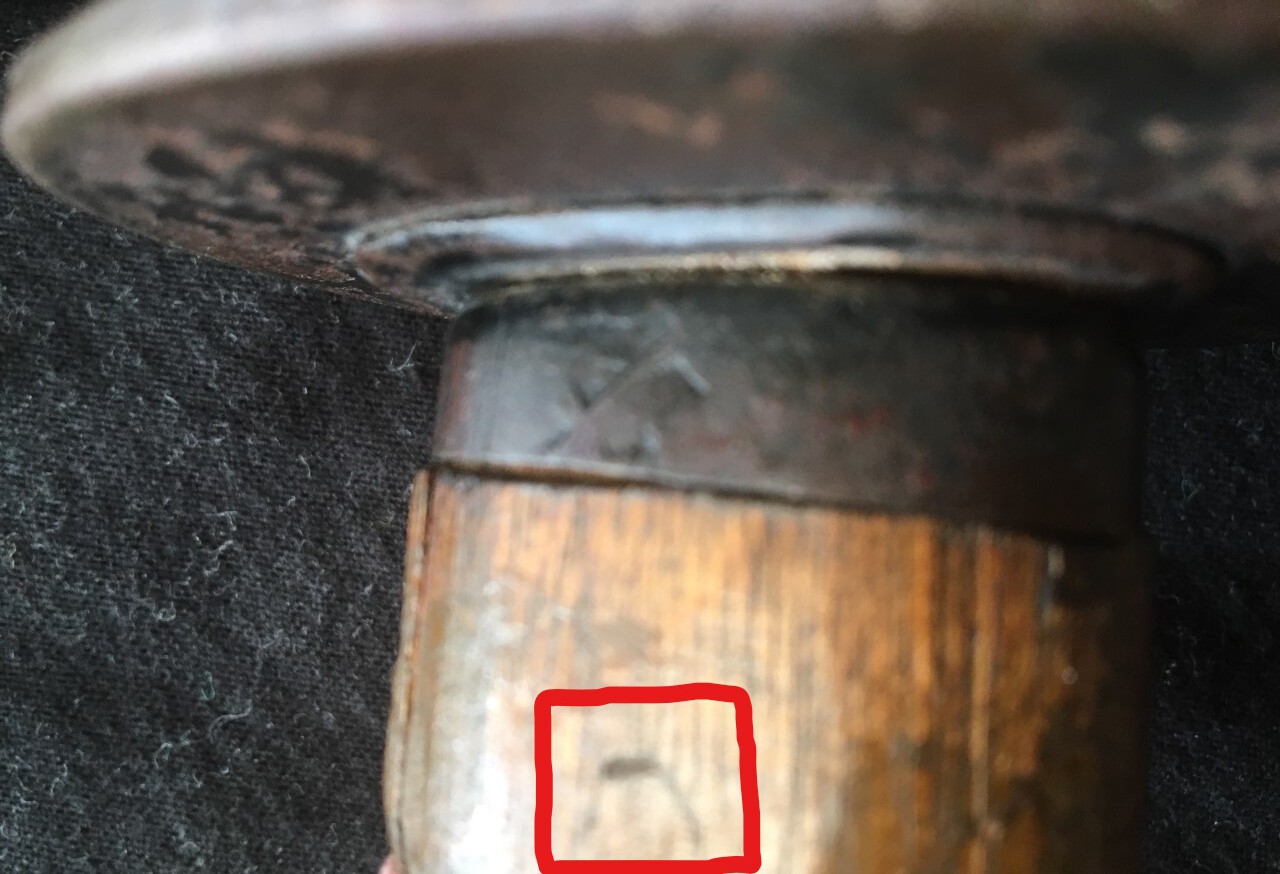
In IJASwords post #2 above, on the fourth picture down from the top, is that a ヘ inspection mark or just an indentation and/or scratch in the wood grip? I have marked the area with a red square in the picture below.
-
Bibliography of Japanese Modern Edged Weapons, 1868-1945
Kiipu replied to Kiipu's topic in Military Swords of Japan
The 1997 F&G book, Japanese Military and Civil Swords and Dirks, mentions in the bibliography a Japanese language work entitled Teikoku Rikukaigun Guntō Monotagatari by Okochi, Tsunehira. This book is cited in footnote 17 on page 232, see below, and the reference can be found on page 218. Does anyone know anything about this book or has seen or owns a copy? I would like to acquire an image of the cover and/or title page for citation purposes. There was a Japanese author by the name of Okōchi Tsunehira 大河内・常平 (1925-1986) that did write articles and books about Japanese swords. However, I can find no titles that match the one mentioned in F&G. I would like to extend my thanks to @Bruce Pennington for his help in looking into this matter. As usual, he went above and beyond what would have been expected. -
Help Identify Sword Passed Down From Grandfather
Kiipu replied to LonnieJ's topic in Military Swords of Japan
Your Pattern 8 sword was made by Jinsen Army Arsenal in 1945. It is more likely to have been obtained in Korea during the postwar occupation. The US Army stationed two divisions in Korea immediately after the war. The inspection mark that is referenced in post #3 will look like this ヘ. Below is a link to another Pattern 8 sword showing the various locations of the ヘ inspection mark. Questions about "late war", NCO swords -
Blade photos attached:Inoue Katsukiyo/Sadakane
Kiipu replied to huntershooter's topic in Military Swords of Japan
Thank you for posting the characters for his first name. I was having a hard time deciphering the first character in his given name and thought it could be 葚. Upon closer examination, it is indeed 甚. His full name is 井上・甚作 Inoue Jinsaku and his address in 1937 was 天田郡西中筋村石原八八 [Amata-gun Nishinakasuji-mura Ishihara 88]. He had two apprentices and could produce five swords per month. -
Sword Forge At Inari Shrine Kyoto
Kiipu replied to george trotter's topic in General Nihonto Related Discussion
I followed-up on this and there is no 國秀 Kunihide listed in 1937. He could have been an apprentice though during this time frame. Since I am here, I transcribed the characters and this is what I see. Do you concur? 伏見住高島國秀作 = Fushimi jū Takashima Kunihide saku -
Bibliography of Japanese Modern Edged Weapons, 1868-1945
Kiipu replied to Kiipu's topic in Military Swords of Japan
And another Japanese language monograph courtesy of @k morita. Adachi Kenzō 安立・健三. Nihon Seikōjo to Zuisen Tanto-Sho ni tsuite 日本製鋼所と瑞泉鍛刀所について [About The Japan Steel Works and Zuisen Sword Forge]. KK Nippon Seikōjo Muroran Seisakujo ㈱日本製鋼所室蘭製作所, 1974. 81 pages. Symbol Context, Post #16 -
Below is the transcription, reading from right to left, of the book cover shown in Post #16. Any comments or corrections welcomed. Column 1: 講演資料 = kōan shiryō = lecture materials. Column 2: 昭和四十九年九月十四日 = 1974-09-14. Column 3: 第十回刀苑合同研究会 = Dai-jū-kai tōen gōdō kenkyūkai = ??????????. Column 4: 室蘭全国大会 = Muroran zenkoku taikai = Muroran National Convention. Column 5: 日本製鋼所と瑞泉鍛刀所について = Nihon Seikōjo to Zuisen Tanto-Sho ni tsuite = About The Japan Steel Works and Zuisen Sword Forge. Column 6: ㈱日本製鋼所室蘭製作所 = KK Nihon Seikōjo Muroran Seisakujo = The Muroran Factory of Japan Steel Works Co., Ltd. Column 7: 総務部長代理 安立・健三 = Sōmu buchō dairi Adachi Kenzō = Deputy Chief of General Affairs Department Adachi Kenzō.
-
The whole clan can be seen at Tokyo Kindai Tosho Index, starting at V. Hanazawa Tanren Jo (羽沢鍛練場) and the Horii (堀井) Group.
-
Nobody, thank you for the additions. The kanji character 御 is rather interesting. It can be pronounced GO which is a honorific prefix or it can be pronounced GYO as an imperial honorary prefix. Do you think in this context it could be GYO?
-
Besides the above references, Guy (AKA ghp95134) over at War Relics Forum (WRF) has a pamphlet from the Japan Steel Works (JSW) that depicts all of the swordsmiths. He even shows an example of a business card which I found rather interesting. It is worthy of a look if you are so inclined. The Emperor’s New Clothes, Post #37
-
In regards to the first two characters 延宝 , the spelling given by Nelson is Empō, which is the phonetic spelling, while Wikipedia uses Enpō, which is the same spelling that Steve uses above. So in answer to your question as to what it would sound like, then I would go with Nelson. However, it should be properly spelled as Enpō. For an explanation as to why this is, take a look at the link below. N (kana)
-
Bibliography of Japanese Modern Edged Weapons, 1868-1945
Kiipu replied to Kiipu's topic in Military Swords of Japan
A couple more Japanese language books for the bibliography. Thanks to @lucidorise, @mecox, and Guy (ghp95134) over at WRF for the additions. Jingū chōkokan nōgyō-kan 神宮徴古館農業館 [Jingū History & Agricultural Museums]. Gendaigatana no hyaku-nen: Fukkō to keishō 現代刀の100年: 復興と継承 [One Hundred Years of Modern Swords: Revival and Succession]. Ise 伊勢: Jingūchōkokan nōgyō-kan 神宮徴古館農業館, 2010. 71 pages. Show Us Your High Class Gunto, Post #466 Horii Tanetsugu 堀井・胤次. Enishi: Katanakaji Horii-ke hyakugojū-nen no rekishi えにし: 刀鍛冶堀井家百五十年の歴史 [Enishi: The 150 Year History of the Horii Family of Swordsmiths]. Muroran 室蘭: Horii Tanetsugu 堀井胤次, 1996. NLF Gunto Discussion, Post #32 -
To get the ball rolling, there are four rows of kanji characters on the back. The second row is repeated on the front which also has the police emblem at the top and firefighting emblem at the bottom. This is what I have trancribed so far. 1st row: 梨本総裁宮殿下 = Nashimoto sōsai kyūden-ka. 2nd row: 御檢閲記念 = O ken'etsu kinen. 3rd row: 昭和十二年四月十一日 = 1937-04-11. 4th row: 岡山縣 = Okayama-ken. As for what the characters are referring to, I will leave that to someone else. However, I think the reference to Nashimoto could be to 梨本宮守正王.