Carlo Giuseppe Tacchini
-
Posts
2,121 -
Joined
-
Last visited
-
Days Won
8
Content Type
Profiles
Forums
Events
Store
Downloads
Gallery
Everything posted by Carlo Giuseppe Tacchini
-
Far by me to try to resemble what is obvious I'm not. Just very interested in the exercise (an its outcome).
-
Either Reinhard got more evilish then Guido's twin *or* something doesn't work in your answer... Stand with my previous opinion. Left one Shoshin, first strike to place mekugiana better placed, calligraphy and fluency of the strokes looks better as when you copy something you'll likely make it a little bigger rather then smaller. For what it's worth...
-
At work me too, Brian, but I would consider the placement of the first stroke as "signal" for mekugiana drilling. Left one looks more appropriate but can't right now look at all te other details.
-
 Especially when your nails begin to bleed...
 -
Seems to me to remember that Giuseppe is a fellow forumite here too. Surely in Samurai Archives.
-
I *think* Ted/Keith have a good one on Aranie. I've posted it once but guess you need permission for publishing.
-
Beer is better and serve the same purpose... Best wishes.
-
(Sorry, people, can't resist).
-
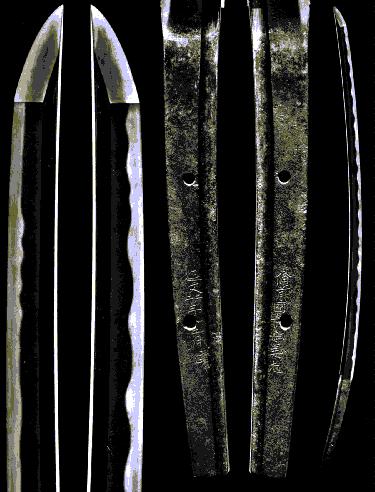
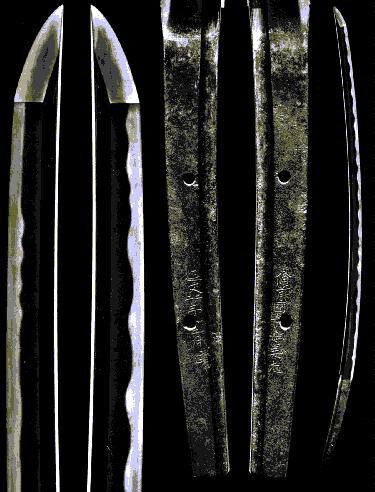
Not sure if this is the one you're referring to, but it was on Jim Kurrash/Albert Yamanaka's articles I've stored on my HD : Quoting : A Tachi signed Bishu Osafune Kanemitsu - Jûyô Bijûtsû A Tachi signed Bishû Osafune Kanemitsu and dated Enbun ni nen hachi gatsu hi. It was designated Jûyô Bijûtsû on December 24th 1937, and was 3 shaku 4 sun 3 bu long. The JB set number is 666, and the Yamanaka number is 4. This was another submitted by Uesugi Yoshiaki to the Yonezawa police. There is no known photograph or ôshigata of this blade at this time. The book Shôwa Dai-Meito Zufu by Homma - Kunzan reports that “it was returned to Japan by a friendly American” (possibly by Dr. Compton Sama). The information I had given was “Tachi signed Bishû Osafune Kanemitsu and dated Enbun ni nen hachi gatsu hi. It was designated Jûyô Bijûtsû on December 24th 1937, and was 3 shaku 4 sun 3 bu long. The JB set number is 666, and the Yamanaka number is 4. This was another submitted by Uesugi Yoshiaki to the Yonezawa police.” But Showa Dai-Meito Zufu describes this tachi sword as 3 shaku 7 bu / 93 cm. long, and dated Enbun yo-nen jûni gatsu. It is sword number 230 in that set. The mis-information given was at least partially due to it apparently being the only formerly missing Jûyô Bukasai blade without a photograph. And considering the erroneous information that had been available it was extremely fortunate that it was recovered. In Shôwa Dai-Meito Zufu Kunzan states “This is one of the three nô-dachi, signed and dated, of Kanemitsu included among the thirty-five blades that had been long handed down in the Uesugi family, descendant of the reknown Uesugi Kenshin. It is true with the three long Kanemitsu examples that they were all made perfectely without any defects in both ji and ha, which testifies to the exceptional talent Kanemitsu is accorded in swordmaking. It is one of the blades confiscated by Occupational Forces and taken to the USA after the last war; fortunately it was returned to Japan by a friendly American citizen.” The JB set number is 666
-
The ones that got away
Carlo Giuseppe Tacchini replied to Gabriel L's topic in General Nihonto Related Discussion
Yes, Gabriel, I have and it's still a pain to remember even after so many years. Not owner's fault nor mine, long history to be maintained private. Here they are (katanakake was included) : -
I would agree. Looks like a nickname.
-
Nihonto from China??
Carlo Giuseppe Tacchini replied to Brian's topic in Auctions and Online Sales or Sellers
I think there's room for profesisonal work for you there, as soon as the language will be no more a barreer. Lots of oppurtunities. You're luky. -
Nihonto from China??
Carlo Giuseppe Tacchini replied to Brian's topic in Auctions and Online Sales or Sellers
Guido, the post looks like from some nihonto-addicted that now miss his daily input of shiny things... :D So, a lot of work to educate them for both of you... -
Thanks for sharing Morita-San.
-
Menuki comparison/ help with translation
Carlo Giuseppe Tacchini replied to Mantis dude's topic in Translation Assistance
Markus, guess the ones that already know you have no doubts about both your knowledge and good attitude that are always welcomed. -
Nihonto from China??
Carlo Giuseppe Tacchini replied to Brian's topic in Auctions and Online Sales or Sellers
OooooK.... from the picture seems to me to see : 1 chinese falchion 1 strange *possible naginata* (yari in strange mount ?) 1 bone tachi 2 shingunto mounts (what's inside ?) 1 kyugunto (what's inside?) 1 cavalry saber possibly Japanese 1 Quin saber 1 Quin Jian 1 talwar. Remains 4 mounts that might have NihonTo inside... If these are their best, Guido re-location in China have triplicated the number of NihonTo in the country not talking about quality... -
http://www.nihontomessageboard.com/arti ... eaning.pdf
-
Kesho Migaki... These lines, if we're really looking at a Kesho-Migaki, seems positioned were once was the Habaki so we should infer by this that the polish which they'r related to is the one before the Suriage. In this case the Suriage might have been made in recent times to have the blade not touching the floor in the Gunto mounting, that was worn attached to the belt, and possibly the original owner was not tall enough to maintain all the length of the blade. If this hypotesys is right they are not related to the present polish but to some previous one, and the use of Kesho Kigaki is quiet a recent introduction. So the polish they are referred to might be already of the XX century C.E. Unless the machiokuri was of epocal dimensions and the suriage is really ancient... Silver Mon are usually a good sign. Often before the sword was surrendered they were removed to avoid shame to the family, so might be this wasn't surrendered but picked-up on the battlefield. *Might be*...
-
Here's a new tactic
Carlo Giuseppe Tacchini replied to Brian's topic in Auctions and Online Sales or Sellers
Brian, Karimata were out of supply in Japan ? :lol: -
From these pics the lotus seems not polished down to me (at least not as much as the dragon), so possibly added later.
-
Brian, shouldn't you find another avatar for Milt now ? :D
-
New articles uploaded
Carlo Giuseppe Tacchini replied to Brian's topic in General Nihonto Related Discussion
Now is all in order. Maybe the cache needed a refresh. -
You've got a prepared customer for sure...
-
New articles uploaded
Carlo Giuseppe Tacchini replied to Brian's topic in General Nihonto Related Discussion
Brian, either I'm too drunk for the Venice carnival or something is not working. Cant find them. -
Guido, how's the beer in China ? Scholars even doubt how much of the original text is still present in the later transcriptions (130+ years later) we've got... Considering the clause as legit and original, I think it was an embarassingly failed attempt to follow the strict rules of quality control present in China from as early as Han Dynasty, requiring that maker, quality control responsible and date of construction had to be inscribied on the items created for the Army (from crossbow to swords that bear even the quality of the steel refining). Different social environment and control ability by the Court made the difference in the (failed) application of the rules. This can be inferred cross-referencing W.W.Farris "Sacred Texts and Buried Treasures" and "Heavenly Warriors" with Y.Hong "Weapons in Ancient China" and Donald B. Wagner, "Iron and Steel in Ancient China".