Carlo Giuseppe Tacchini
-
Posts
2,121 -
Joined
-
Last visited
-
Days Won
8
Content Type
Profiles
Forums
Events
Store
Downloads
Gallery
Everything posted by Carlo Giuseppe Tacchini
-
Exactly what I was referring to.
-
Hi Keith. If you're going to make a tsuka from this, I would like to see the result. :D
-
I'll be not that one, not here, not now, but guess you'll enjoy this one :
-
Guido, I said "most of the time". Obviously your example is one of the few good ones... :D
-
Not entering the core of the topic, I would highlight that under an historical point of view usually : a) ancient scrolls are (usually) quiet reliable. b) Edo prints are less reliable. c) movies most of the time are not accurate, then not reliable.
-

This Week's Edo Period Corner
Carlo Giuseppe Tacchini replied to Bugyotsuji's topic in General Nihonto Related Discussion
Sound interesting. Any pic Piers ? -
Question about Aoi-art
Carlo Giuseppe Tacchini replied to Gunman's topic in Auctions and Online Sales or Sellers
Indeed, it looks very close. Maybe I'm late in this topic, but I wonder if I can halp anyway. George, in Italy it works this way, try to find if there is any similarity : 1) Customer have to get the Licence of Antique Weapons Collector (may include firearms or not accordingly to request). This has to be achieved only once and will last forever (first trip to Authorities) 2) Customer have to get permission from police authorities to import *that* specific sword giving all the details and pictures needed to identify it (even if police can't discern a Naotane from a Paul Chen). No Torokusho translation required (in Italy...). Just pictures and measurements to check the blade on due time (Japanese terms have to be avoided for obvious reasons). This permission is specific to the sword (second trip to authorities). 3) Customer can ask the sword to be shipped 4) Sword arrives at customs and they advise the customer. 5) Customer send permission of import via registered mail (always scan it). 6) Sword sent from customs to customer 7) Customer have to have his Licence updated with the addition of the imported sword. This must be performed each and every time you aquire (or sell) a sword. So customer have to go again to the police station when sword is received (third and final trip to authorities). Sword not required to be fisically present. After some imports they get accustomed to you and permissions are given in a quicker way. So far I've never had a sword damaged for Customs inspection. I suspect they just check the mounting and what is inside unsheating only a small portion of the blade. Guess they're more interested in the fact there is nothing else then a steel bar inside and not C4 or cocaine :lol: . No shortcuts allowed and strongly discouraged. As stupid as it can be, due to lack of legislation here a sword is still considered a war weapon. "Italians and greeks, one face one race" (even if you might be not a native greek) :D -
This Week's Edo Period Corner
Carlo Giuseppe Tacchini replied to Bugyotsuji's topic in General Nihonto Related Discussion
A masterpiece, and my children's preferred cartoon movie Ashitaka's ring-pommeled sword and the use he makes of it when firing arrows is sooo intriguing.... -
This Week's Edo Period Corner
Carlo Giuseppe Tacchini replied to Bugyotsuji's topic in General Nihonto Related Discussion
Well, there is very much confusion with the word "Teppo" that might indicated also the much earlier chinese "fire-lance". Ian, you hit the nail on the head. Quoting from Samurai Archives : Quote... Joseph Needham cites a record, dated 1287, only six years after the second mongol invasion of Japan, that strongly suggests the use of some kind of "hand gun" or "portable bombard" in battle. He further speculates on the possibility that a primitive firearm he calls a "fire-barrel" may have been employed against the Japanese during the invasions themselves. Moving beyond such speculation, we find that the earliest reasonably reliable references to guns in Japan come from the late 15th century. A buddhist priest recorded in his diary in 1466, on the eve on the onin war (1467-77), that a ryukyuan official visiting the ashikaga shogun in kyoto fired a "teppo" in the air, perhaps as part of a ritual or celebration, that greatly startled the inhabitants of the capital. In 1468, the year after the onin war began, the eastern army in that conflict used a "fire spear" that was probably a type of handgun. (Then it looks at the traditional theory of tanegashima) then: The chronicle of the Hojo family of the kanto, hojo godai-ki, tells us that a gun- teppo- from china was presented to Ujitsuna, the hojo daimyo, by a monk in 1510. This gun may not, however be chinese, but rather a weapon from SE asia that was originally turkish design but had been modified at least several times as it was transmitted eastward from turkey. There are other scattered records of accounts in the records of firearms - perhaps chinese or SE asian - in Japan before 1543, although none of these gives a clear idea of what these weapons may have been like. (footnote: In an unpublished paper, Needham suggests the possibility that "turkish guns" first made their way to china from the country's northwest via the Uighurs. See Science and Civilization in China, vol. 5, P. 440) ...unquote. -
I've read your post on the "collectors age" and know you're not new too the collecting "disease" :D . I was under the impression it was common knowledge that they are often used to hide defects and this is especially suspect when they are poorly made :? so I suppose I'm not getting right the type of defect you're talking about, as seems to me this is referred to WWII blades. Is there anything I'm getting wrong ?
-
This Week's Edo Period Corner
Carlo Giuseppe Tacchini replied to Bugyotsuji's topic in General Nihonto Related Discussion
Thanks Piers. -
This Week's Edo Period Corner
Carlo Giuseppe Tacchini replied to Bugyotsuji's topic in General Nihonto Related Discussion
Thanks for sharing sources Ian. -
This Week's Edo Period Corner
Carlo Giuseppe Tacchini replied to Bugyotsuji's topic in General Nihonto Related Discussion
close... :lol: It's supposed that Japan had the worldwide higer ratio of guns per capita at that time. I wonder : after unification, when the Shogunate prohibited guns (Japan is the only nation I'm aware of to go back to swords trashing firearms) where all those guns went ? Is it possible they used the barrels for swords ? This question could apply also to low level armor for Ashigaru, made in the thousand as well, but I think this metal could have been of lesser quality so less desirable by a swordsmith's point of view. And again how much both Teppo and Ashigaru's armor counted in the increasingly demand of foreign steel before unification ? Maybe they didn't need Nanbantetsu for swords but for other weapons instead ? -
You Tube Nihonto
Carlo Giuseppe Tacchini replied to Paul Martin's topic in General Nihonto Related Discussion
If you're interested in a scientific explanation with pictures, you can download it here http://xoomer.virgilio.it/tsubame/ZZZZZZ_DOWNLOADS.htm Choose "Tatsuo Inoue Swordsmithing File". "Control of inclusions in Japanese ancient iron and steel making" is another good reading. -
This Week's Edo Period Corner
Carlo Giuseppe Tacchini replied to Bugyotsuji's topic in General Nihonto Related Discussion
God bless you Piers. -
This Week's Edo Period Corner
Carlo Giuseppe Tacchini replied to Bugyotsuji's topic in General Nihonto Related Discussion
Thanks, Ian, this is the evidence an old friend of mine (now passed away) was right. We've found evidence of the arsenal you mentioned but stopped to the function of maintenance of cannons for the fleet/fortifications in that area instead of sending them back to Portugal. I've evidently missed your sources on matchlocks , even if I was quiet sure of their production. I know at least one handgun arrived in Japan before Tanegashima shipwrek but its importance as a weapon was understimated by the Daimyo it was offered to. I wonder if it could have been one from Goa. Out of curiosity (and possibly off-topic) have you ever found an estimate production for those matchlocks and possibly how many were sold to Japan ? Even supposed figures might help as well as any title or source about the production of handguns in Goa. I missed them for too much time. EDIT : Googled for that catalogue but no luck. Ian, is any way to get pics and captions or better a copy of it ? I love this thread. -
Enphasis is mine, but it's implicit you're stating Rainhard is wrong in his assumption. Care to enlight us with your explanation on the matter, i.e. why the nakago looks so butchered ?
-
This Week's Edo Period Corner
Carlo Giuseppe Tacchini replied to Bugyotsuji's topic in General Nihonto Related Discussion
Yes, it's now clear to me what Piers meant. Guess my term "continental" was too vague. Indeed Moghul affected quiet a large area even outside of their control, at their time. Once I was very interested in find out if Teppo were produced in Goa to be sold in Japan, but so far no hard evidences available. So is more thank likely that good quality items arrived from Moghul to Japan via Portugueses/Dutch or or in some other way. -
This Week's Edo Period Corner
Carlo Giuseppe Tacchini replied to Bugyotsuji's topic in General Nihonto Related Discussion
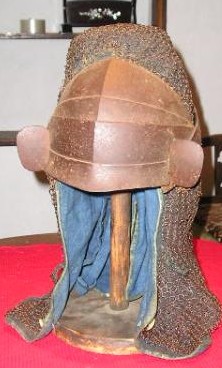
May be you're thinking to continental items, but I'm quiet sure there is no arabic influence in the Japanese samples. Seems arabs stopped to have direct contacts with Far East at the end of the Tang Dinasty, so far before these suites were even just engineered even if I'm not sure about the period in which these items made their first appearance. Firefighters protections are also very similar. Fully agree with Ian's excellent explanation about Fukigaeshi evolution. About the horse's armor, if we ever arrange to visit Stibbert Museum together, I'm sure Mr. Franci or Mr. Civita will show you some more not available to public... -
Even if I can understand and in some way (or till to a certain level) agree with the very last statement, what people is trying to say you is to develop the knowledge and taste thru direct experience. This way you'll not forced to ask on every single piece for an overall judgement, but only once in a while, possibly on a specific detail you're not sure to have got correctly. This is not related to your collecting level. Collecting and studying are two entirely different diseases that may or may not be found together in sword lovers. You can study without collecting, but You definitively shouldn't collect without studying. This doesn't mean you can't collect low-end stuffs. My opinion is that you're still young and with plenty of time to build-up money for your hobby. Nonetheless, you should build-up your mind before. And now to explain you what I meant hereabove... Menuki should go in pair. You shouldn't match different items. If you got a single, high-quality very good one, still you should maintain it as a collectible, not to mount it on a sword. If you really can't resist, you should ask for a mirrored mold to be taken and a twin one reproduced but it's an easly detectable trick. If you had seen some more, better if in hand, you would have realized this is a popular theme, mass-produced and not so hard to find. Molds for cheap pairs have been popular from a certain period on. I myself have an almost identical set on a scarce mounting :


-
This Week's Edo Period Corner
Carlo Giuseppe Tacchini replied to Bugyotsuji's topic in General Nihonto Related Discussion
Maybe too late and quiet different but...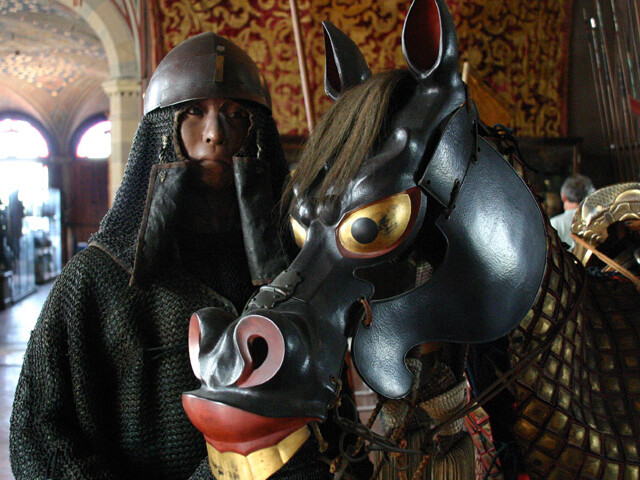
-
sergio magotti
Carlo Giuseppe Tacchini replied to BenoitD's topic in General Nihonto Related Discussion
PM sent. -
Shan, don't take it personally, is not you rather your attitude. Nobody here is judging you as a person, rather your approach to the matter. You're blessed by your geographical position that, together with US West Coast and Japan itself, is a good one to join Nihonto/Tosogu study groups and attend expositions/auctions/events/museums in a way that most of the rest of the world can only dream of (ask Brian if you need feedbacks on this). No matter how good this board is, you'll never learn as much as following the recommendations given so far, so often and by so many knowledgeable people.
-
Deer horn katanakake
Carlo Giuseppe Tacchini replied to Lorenzo's topic in General Nihonto Related Discussion
Lorenzo, all very good samples but the one posted by Moriyama San is my preferred. Looks like a fusion between a Suiseki and a Katanakake. If you can put your hands on walnut roots, maybe you can do even better. Please keep us updated on the result. -
Nice one Reinhard. Would we call the tell-tale a *possible* example of Shogunal "propaganda" ? About a similar matter I would like to assk to all the Kodogu specialists : as per you knowledge, has the tell-tale of Ubagaishi (姥が石) at Himeji-Jo (the old woman providing a millstone to help Hashiba Hideyoshi in building the castle) ever been pictured in Kodogu ? Would be helpful for the Phd of a friend of mine.