Carlo Giuseppe Tacchini
-
Posts
2,121 -
Joined
-
Last visited
-
Days Won
8
Content Type
Profiles
Forums
Events
Store
Downloads
Gallery
Everything posted by Carlo Giuseppe Tacchini
-

Where were the yari?
Carlo Giuseppe Tacchini replied to IanB's topic in General Nihonto Related Discussion
Ian, my 2 cents. Yari is a much simpler weapon to use (mind, I'm NOT saying to master) than a bow or even than a sword. Hence it needs no professional to be used in an effective way. Or should we say in combat it pays more than a sword and a bow when conscripts are needed ? Japanese started with mass formations of conscripts and spears, the chinese way. Switching from the chinese model of mass-fighting to a small professional force of (mainly) mounted archers relegated the spear to a marginal role and doomed the hand shield to disapperar forever in the Japanese arsenal. Back than the bow was considered a better investment, being the sword the weapon of excellence (and the only available) mainly when Samurai got in close combat, either mounted or dismounted, shield being replaced by improvements in the armor. I think this was due to the problems to carry/use both a bow and a spear on horseback. Naginata were a good option for footsoldiers to fight against horsemen cause no close formation was involved. Later when the mass (and close) formations begun popular again the changes in tactics lead to the return of the spear, both for professional soldiers and Ashigaru, and the mounted archers begun a minority, as well as Naginata that requires space around to be used effectively, space no more available with the new close formations. Kikuchi-Yari is so renowned also cause it's *presumed* the battle of Hakone or the battle of Chikugo River (according to which one you prefer to link the Kikuchi) started this trend that possibly reached the apex with Shizugatake. Of course, we should remember that everything is relative and changes didn't occur in one day. My opinion is that the changes occured not only for military reasons but at least partially also for social ones. Can't elaborate better as I'm at work. Interested in your opinion about this and get in touch a better way this evening (italian time). -
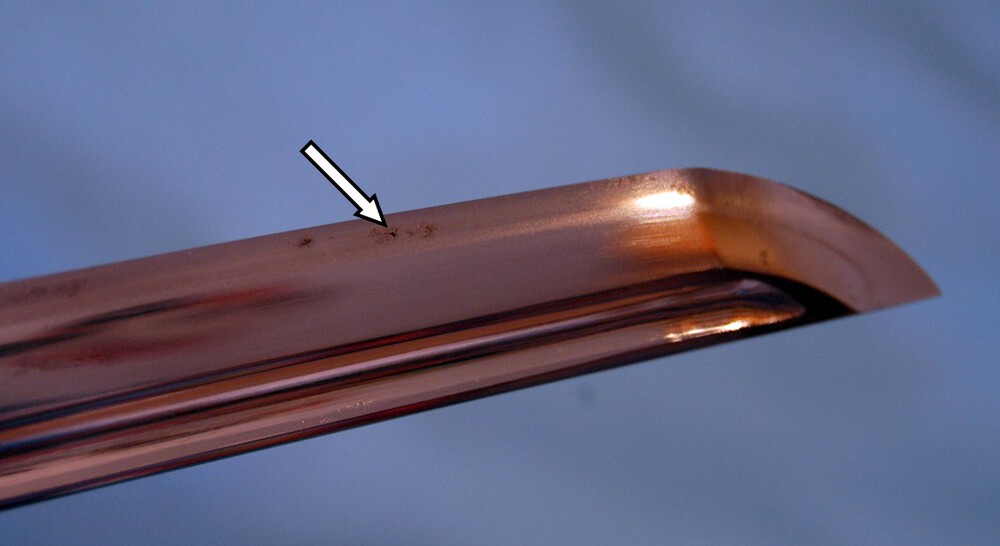
Chris, I'm a bit concerned on this one. Seems the upper part of a possibly larger Kitaeware still to be revealed. The fact that all the rust-pits seems located in (almost) the same area of the blade on both sides is not a good indicator as well. I could be wrong, of course, but I would look at it in hand with a magnifier before buying. Mikasa-To ? Interesting...
-
Could be, even if there's no maki there. Possibly an Edo show-off Nakamaki staff ?
-
Shorter (Te-) Yari and Naginata are supposed to be conceived for fighting in confined spaces as indoor or Japanese small courtyards. Can't subscribe totally, but it makes some sense.
-
Another really rare armor, the kusari dou.
Carlo Giuseppe Tacchini replied to estcrh's topic in Katchu
Koelliker ? You've lost just a pale shadow of Watanabe's one. (IMHO) -
Anyone know what this is called?
Carlo Giuseppe Tacchini replied to estcrh's topic in General Nihonto Related Discussion
If it walk like a duck and quack like a duck chances are it's a duck... Chain and weight look not rust-pitted as the rest. Might be later additions. -
Anyone know what this is called?
Carlo Giuseppe Tacchini replied to estcrh's topic in General Nihonto Related Discussion
Assuming this is a weapon, it should be a percussion one, not meant to cut. May I highlight that if such a short chain is entrangled on a neck or a whirst there's no room enough left to pick efficiently with the point ? And lacking an edge you've no options for cutting as usually is done with a regular Kusarigama. It's puzzling, maybe some martial artist can give more info in this one. -
Goerge, please be *very* careful with anybody claims to be the owner of this blade. There are morons searching for undeserved advertising and legitimation out there that can fool most of the ones not enough in the field and giving access to the media to them is definitively not what the Nihonto world needs, either the genuine blade is still in existance or not. My guess is that you'll end up with one of the shortest Nihonto documentary ever, anyway best whishes and apologizes for the harsh welcome.
-
Here's mine

-
Happy New Year
Carlo Giuseppe Tacchini replied to Brian's topic in General Nihonto Related Discussion
Not for me. Happy new year to everybody. -
Chokuto?
Carlo Giuseppe Tacchini replied to Tsugio Kawakami's topic in Auctions and Online Sales or Sellers
Being an active auction and having no issues with this seller I'll try to give my opinion on the matter without stumpling on anybody's feet. First, I've to say I've just got a reply from the seller to my question about possible info on the site of excavation. He states the sword comes from a "fairly old collection of NihonTo", supposed to be pre-WWII and no info on the site of excavation are available. AFAIK, these weapons were extremely rare and treasured in Japan back then. The small pre-war bibliography available on such items report of just a fraction of the blades available today. This make quiet hard to consider the option of a Japanese origin of the blade, if we consider it exported from the '10s to the late '30s, cause Japan' social and political situation. But I'd rather focus on the condition of the sword. Which environment could give such a strong oxidization still allowing to preserve so well the tsuka ? Even if badly maintained after excavation and no attempt to stabilize the rust, seems that the difference in conditions between steel and organic material is too great. This could lead us to consider the possibility of an artificial aging, almost for sure not performed by the seller, maybe dating a 20 years ago in China. All the contemporary swords I've seen have a blade in similar conditions with no organic material attached or a blade in better conditions with (very seldomly) organic material remains still attached, not the mix we find in the topic's blade (next two pics are from chinese swords) : or *very seldomly* a faint mineralized copy of the silk on the bronze/steel The texture of the topic' sword tsukaito also looks odd, very similar to the texture of modern ones : Here a well preserved, genuine one : And finally how it should looks like according to Japanese archeologists : I'm aware of a (bit later) chokuto (not ring pomelled) that still have wood attached to the tang because it was laquered (a few urushi still there). Owner is a fellow forumite. But in no other cases I've seen a Japanese ring pomelled chokuto that has the tsukaito preserved. This is of course no warranty the blade is not genuine, cause excavated items are hard to judge even in hand, and definitively wantn't be an accusation of any sort toward the seller that has been collaborative in replying to my questions. -
My bad, I realized my mistake reading your post of her being TH.
-
Looks nice Jean, congrats. Next kantei with Kitsuno for attribution means she has no papers yet, I assume... Purchased in Japan ? Ubu (seems to have 2 filled mekugiana) ?
-
Chokuto?
Carlo Giuseppe Tacchini replied to Tsugio Kawakami's topic in Auctions and Online Sales or Sellers
Very limited acces to the Net in San Lazzaro degli Armeni :lol: . Can't check the link, but could be a chinese sword labeled as Japanese. Easier to find these ones (either fake or originals) on the market. I'll give a look asap -
Darcy have (had?) a nice sickle-like blade for sale on his website. But the use could have been related to (or more likely meant to remember an ancient) naval warfare use (IMHO). Can't check from where I'm now.
-
Merry Christmas to all
Carlo Giuseppe Tacchini replied to Martin's topic in General Nihonto Related Discussion
To the ones which I've not the e-mail (or I've lost it... ) -
Utsushi and Yugen - Ford Hallam Videos
Carlo Giuseppe Tacchini replied to Ford Hallam's topic in Tosogu
Awesome. -
What is more important, Kantei or picking a good sword?
Carlo Giuseppe Tacchini replied to David Flynn's topic in Nihonto
Not a bad point. Effectively, power hammer, light bulb, priority in choosing Tamahagane and the harsh life condition of today's Japan weren't bashing Kanemitsu back then. -
"...and then you messed it up!"
Carlo Giuseppe Tacchini replied to werner's topic in General Nihonto Related Discussion
Sometimes I understand Ford's attitude toward clergy... -
Thanks Guido. Guess my info on different tatami mesurements for houses between, say, Osaka and Tokyo is just a urban legend.
-
And possibly according geographical places as well, like tatami. Would be interesting to have a feedback by Moriyama san or Morita san...
-
You recall correctly. If memory serves as it should, he was the first one to use early high-end microscopes to study textures and activities and published articles about this following Suenaga's pre-war example.
-
Someone hi-jacked Guido's
Carlo Giuseppe Tacchini replied to Ichi's topic in General Nihonto Related Discussion
Sorry for the occurrence, Guido. E-mail address unchanged ? -
crook-bay does it again!
Carlo Giuseppe Tacchini replied to werner's topic in Auctions and Online Sales or Sellers
He thanks me for just having scared him instead of calling the Polizia Postale. That still remains a viable option if the crook will re-present himself, just as an "extrema ratio"... -
crook-bay does it again!
Carlo Giuseppe Tacchini replied to werner's topic in Auctions and Online Sales or Sellers
Thanks Stephen for his e-mail. Was useful. @ Lorenzo, per favore se lo rifà per favore contattami.