Carlo Giuseppe Tacchini
-
Posts
2,121 -
Joined
-
Last visited
-
Days Won
8
Content Type
Profiles
Forums
Events
Store
Downloads
Gallery
Everything posted by Carlo Giuseppe Tacchini
-

Where were the yari?
Carlo Giuseppe Tacchini replied to IanB's topic in General Nihonto Related Discussion
To be honest, no the matter is not from a single repository but from a great deal of literature available about Japanese spears. However, I agree. Under informed collectors are a big problem, especially for themselves. Great chances left to the above mentioned collectors. Guess I've made my time on this thread, however would like to remember you another interesting say from one of the smartest heretics I've ever met : "Rigorous reasoning from inapplicable assumptions yields the world's most durable nonsense." -
Where were the yari?
Carlo Giuseppe Tacchini replied to IanB's topic in General Nihonto Related Discussion
Reminds me of the last one hereunder. Museo di Cà Pesaro, Venice. -
Where were the yari?
Carlo Giuseppe Tacchini replied to IanB's topic in General Nihonto Related Discussion
Piers, guess you're referring to the "Seven branched". It's also refererred as "Seven branched spear", even if it has been linked to written evidences talking about a sword (supposed to be the Nanatsusaya no Tachi in Nihon Shoki). Yet another thing that is in my "to do" lists but not near the top. It's not the only shafted oddity from ancient times (wherever they come from) : -
Where were the yari?
Carlo Giuseppe Tacchini replied to IanB's topic in General Nihonto Related Discussion
Right, Ian. It's a Teboko. As per ancestors of Naginata or Nagamaki,hard to say, as always with these so ancient items. On a similar subject I'm puzzled by the way the blade referred to "Seven Branched Sword" is explained in "Kodaito to Tetsu no Kagaku" : -
Chokuto?
Carlo Giuseppe Tacchini replied to Tsugio Kawakami's topic in Auctions and Online Sales or Sellers
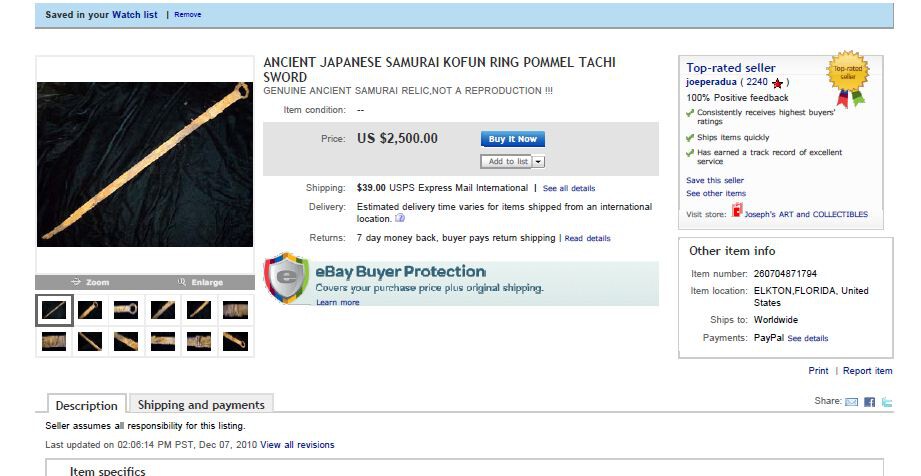
An evidence of how we should be careful in posting info on this board (when sales are involved) cause its popularity. The topic's sword is now twice the original price (cause the seller saw the second one posted here?) and the seller quote the reason being this very thread. I also wander if the suggestion of provenance has been taken from here as well. Note that my question (and seller's kind reply) is *not* reported for the sake of anybody's not registered here. Still possibly a negligible mistake.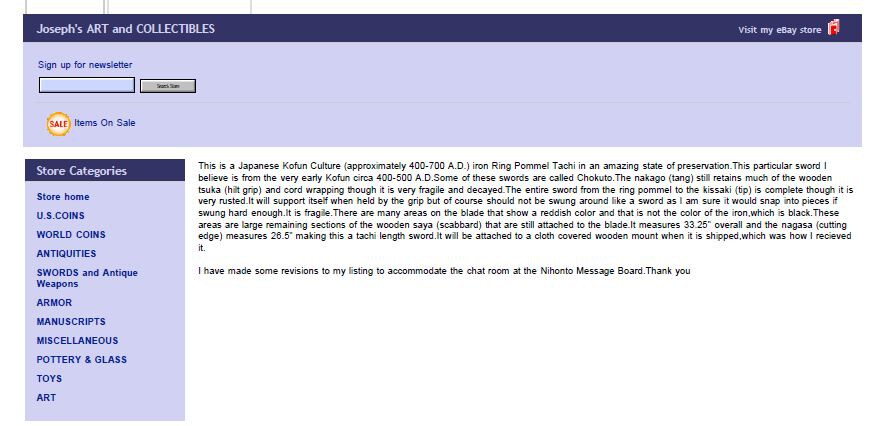

-
Where were the yari?
Carlo Giuseppe Tacchini replied to IanB's topic in General Nihonto Related Discussion
Many, already back then, were meant for votive functions. Others are as close to a Fukuro yari as you can think of, so they *could* have been used in any fighting context. Keyword : We. The chances are close to zero cause there are scholars that got enough knowledge to relief us from such an hard task. As Ian have suggested the problem is not the shape, but where they were produced. *This* is very hard to judge and usually works the other way around i.e. how many *chinese* blades are considered Japanese while actually produced in China (almost exclusively referred to Jokoto). Eric, I'm afraid of the future use you'll do of the quote "Absence of evidence is not evidence of absence". I've not read the source by Captain Frank Brinkley, but if he describes Hoko from the Shōsōin, then definitely he is wrong. *All* the blades preserved in Shōsōin are described and pictured in detail, both sides, large dimensions, in "Sword Blades in the Shōsōin", edited by Shōsōin Office, The Nihon Keizai Shimbun, Tokyo 1974, that's the source I'm referring to and the pictures I post comes from. I'm not aware of any Hoko with a shape similar to the captain's description preserved anywhere in Japan. However "there is always somebody that have a larger library then yours...." In an academical discussion, descriptions by voyagers and sailors have to be taken with a pinch of salt. They often mixed up things either consciouly or not, for different reasons. My opinion is that Captain Brinkley has never seen the Hoko in question but only heard of them and mixed its description by the natives with the description of the ones of the chinese blades he actually saw elsewhere. The blade closest to a Keris treasured in the Shōsōin has no lateral arms and is still far to be "wavy". Hereunder a partial pic (cause original huge dimensions overwelming my scan) that's not pictured in Knutsen's book. -
Where were the yari?
Carlo Giuseppe Tacchini replied to IanB's topic in General Nihonto Related Discussion
Cool. My daughter too dislikes Barbie. :lol: -
Where were the yari?
Carlo Giuseppe Tacchini replied to IanB's topic in General Nihonto Related Discussion
Your's not an house, is an armory... -
Interesting essay on tameshigiri.
Carlo Giuseppe Tacchini replied to xxlotus8xx's topic in General Nihonto Related Discussion
@ Ford, thanks. Added to wish list. I'm now cause the ancestral worship of the Dakô-ken and might be these can help under this point of view as well. At newbies, don't attempt this at home. :D Stephen has a long experience in dealing with swords and as a Viet-Vet he perfectly knows how to master humidity. Newbies should try more dry exorcisms. I use Ozeki Sake (Dry...) :lol: :lol: :lol: However I bet that somewhere, someone of those sharks was successfull in such a task as well... -
What about the Hi (pic P1010103.JPG, the second posted)?
-
Where were the yari?
Carlo Giuseppe Tacchini replied to IanB's topic in General Nihonto Related Discussion
Where have I heard the term "bullshitdo" ? http://forums.samurai-archives.com/viewtopic.php?t=182 -
Interesting essay on tameshigiri.
Carlo Giuseppe Tacchini replied to xxlotus8xx's topic in General Nihonto Related Discussion
:D -
Interesting essay on tameshigiri.
Carlo Giuseppe Tacchini replied to xxlotus8xx's topic in General Nihonto Related Discussion
They're going to be destroyed and any possible "evilish spirit" gets "exorcized" (definitively lack a better term). Would like *A LOT* to know more about it. -
Interesting essay on tameshigiri.
Carlo Giuseppe Tacchini replied to xxlotus8xx's topic in General Nihonto Related Discussion
Present might be not totally different : http://www.seki-Japan.com/maturi/kuyo/kuyo.htm Look at the priest, upper right. *Great* movie. Takakura Ken almost convinced me to get tattooed (a Fudo) back then. -
Where were the yari?
Carlo Giuseppe Tacchini replied to IanB's topic in General Nihonto Related Discussion
Maybe. Or maybe it simply was your lucky day when you missed it. This one (but with Nakago, not Fukuro) should be a Tsuki-gata-Kamayari. Belongs to the "Sasumata" family. This one should be a Bishamon-gata-Jumonji-yari. As her name suggest, it's taken from chinese iconography of Bishamonten. Even if some might have been produced in Japan during Edojidai they'r not of Japanese origins nor intended for combat. Last one you post, if not a tourist piece, has a shape that spans from China to Indochina, not Japan. AFAIK.
-
Where were the yari?
Carlo Giuseppe Tacchini replied to IanB's topic in General Nihonto Related Discussion
Hi Piers. Guess you're right. Never checked that (hardly even near to your skill in Japanese) and forgot that when Suenaga wrote the book ( october 1941) Korea was considered Japan and some itimes were collected there as well. This also explains its "disappearing" in later Japanese sources. Farris is right in stating no Japanese early examples survives, nothwithstanding the literature on them. I'd better believe him . This time it's me that have slipped. New score : Farris / Tacchini 1-2 Anyway guess it should give the idea on how they were. Exactly the same explanation of Farris. Only difference is the reason of avoiding sinew/horn for religious matters rather than lack of supply. -
Where were the yari?
Carlo Giuseppe Tacchini replied to IanB's topic in General Nihonto Related Discussion
Ian, add this one to the list.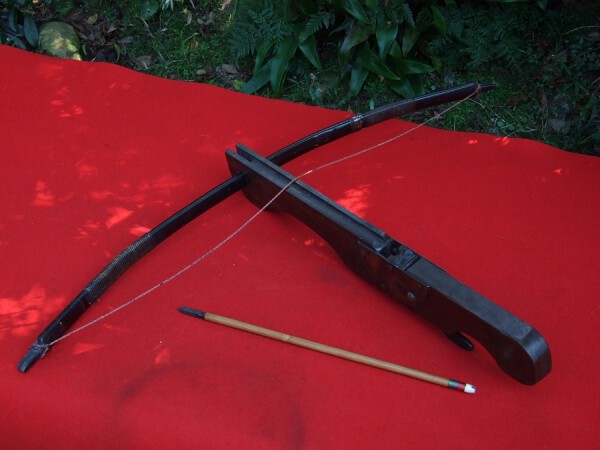
-
Where were the yari?
Carlo Giuseppe Tacchini replied to IanB's topic in General Nihonto Related Discussion
My opinion is that contiuous conflicts were no more in the Edojidai cause the Tokugawa strict control over weapons and wealth, not because people was enlightened about their futility. Mmm...Honestly, I can't remember to have seen bows depicted in Haniwa, only quivers (I can be wrong). This makes me wonder how much the construction of these statues affected the items that the author could have put into their hands. My guess is that (too much) protruding objects couldn't have been modeled back then. BTW also early Naginata are never depicted, AFAIK. But it's interesting (yet again Malcom ). Haniwa help us a lot in understanding other archeological weapons, but again "absence of evidence is not evidence of absence". The fact that many spears were buried in the tombs these Haniwa were guarding make me quiet confident the spears weren't left out of models because of a supposed lesser nature. Could be this one show an early Daisho, Chokuto and O-Tosu that later begun Tachi and Tanto to the final Katana and Wakizashi ? How many of them were equipped this way ? Just high ranks or everybody ? Only comparing it with other archeological material we can get answers. Alone it's not a definitive evidence (thanks to Jo for the outstanding pic). -
Where were the yari?
Carlo Giuseppe Tacchini replied to IanB's topic in General Nihonto Related Discussion
My pic is from Suenaga. Even if some (many?) items depicted there are supposed to have been lost in WWII, I think this crossbow has to be still around in Japan. I've never attempted to trace it down so far. EDIT : W.W.Farris, while largely discussing their use in early Japan, states no example of Japanese early crossbows survives ("Heavenly Warriors", page 114, published 1995) but cites Mishima Jiicombo Kofun Gun pp 22-24 and Iwate-ken Kitakami-shi Saraki cho Hatten Iseki Kinkyu Chosa Hookoku p. 14 as mentioning a wooden artifact found at Hattenho. However, he've already slipped a couple times on swords so my guess is that he might have skipped this one. Or that it no longer exists. -
Where were the yari?
Carlo Giuseppe Tacchini replied to IanB's topic in General Nihonto Related Discussion
Interesting feedbacks, and I would add something to mole a little. The fact that yari were rarely used but that the Samurai were well aware of their (eventual) use and existance in any given period and that the use (or lack of it) in different periods was intentional and (IMHO) related to changes in tactics is illustarted by the emergence of the Jumonji Yari and by the disappearing of the crossbow in Japan. Given that the links with continental China, in one way or another, were always maintained and that continental weaponry often influenced the japaneses we have these two interesting examples : Jumonji Yari, which appearance in Japan occurred *a lot* after her appearance on the continent, only when tactics required it. Crossbow, that totally disappeared *from the battlefield* after the "pacification" of the Tohoku and was never resurrected as fighting weapon. Somebody suggests that crossbows were considered "cheating weapons" by the Samurai because they allowed even a poor peasant to shoot at an high rank Bushi, dooming them to oblivion. My bet is that the difficulty of the production of such crossbows was at the basis of its disappearance. The ratio complexity/efficacy must have plaied a role and, nothwithstanding Japanese could have produced it an easier way later in their history, absence of favourable environment and tactics maintained them into the realm of oddities. Hereafter Han dynasty chinese Jumonji called Sha in the two different types available, dismountable with steel blade and bronze arms type and full bronze type : Japanese war crossbow (Ian can show an example used for game). -
Is that all?
Carlo Giuseppe Tacchini replied to Brian's topic in Auctions and Online Sales or Sellers
Great new glossary. -
Where were the yari?
Carlo Giuseppe Tacchini replied to IanB's topic in General Nihonto Related Discussion
If you've seen them, likely you've seen more than most of the academics out there. Nope. He states (and depitcs) that Yari were *misrepresented as Naginata* and the pics he publish are what *he* feels misrepresentation of Yari. Even Knutsen report sure evidences of the yari being used by lesser soldiers only *after* 1330. My guess is that we are discussing the gap between XII to mid XIV century. Please remember that any source must be cross-referenced with others cause the human nature. Everybody makes mistakes. For example Knutsen has always been a strong supporter of the "Horserider Theory" and is totally wrong about his assumptions (mind, the most common back then) about the reasons of the fault of the two Mongol invasions that he reports to sustain his theory about the presence of yari thoughout the period in topic. Also, his explanation on why the Samurai could have noted the effectiveness of Mongol's spears but *not* the effectiveness of mongol's organized mass formations is weak to say the least. Nanbokucho is out of the period we're considering,however I would *greatly* appreciate the quote, title and author of any source that states such a *massive* use of yari in Nanbokucho. It was on it's way, but still pretty early. Excellent, Malcom, but historical sources are not only painted scrolls. Indeed. Hoko with such a beautiful Masame that some of them are considered at the level of the best Yamato blades of the gold period. This reflects my opinion as well. In other discussions Yari wasn't considered wiped out in the period we're focusing on, but the stigma was about how much it was used. The point of lesser people not depicted in the scrolls or reported in the chronicles cause their social status IMHO doesn't entirely work even if social reasons *are* to be supposed as having plaied a role, but a different one, i.e. the elitary and ritualized nature of fighting in the early period considered. As long as the wars were more a conglomerate of individual fights between ranked horse archers supported by their retainers, the yari wasn't effective enough to be carried by both of these fighters, because Bow and Naginata fit better the situation. Yari being not effective enough wasn't mastered by ranked samurai and lesser retainers, hence left out from the historical sources (both pictorial and written, thing that diminishes the excellent theory of Malcom) that survived until today. Lack of surviving examples support the scarcity of their use NOT the total absence. I usually states "absence of evidence doesn't necessarely mean evidence of absence". With the changes in strategies more and more soldiers were needed. Close formations doomed the Naginata to a lesser role, massive ranks required an asier and cheaper weapon. Yari was the ideal solution. But here we've surpassed the 1330. -
Why are you tempting me ? Still waiting a new shelf for the books not stored yet, and you post this ? :lol:
-
Where were the yari?
Carlo Giuseppe Tacchini replied to IanB's topic in General Nihonto Related Discussion
Hoko. Somebody even has seen them, studied them and took pictures of. It is possible the source mixed (messed?) up something, even if different types of Hoko exists (none with chains attached). Anyway, it's hard to believe no spears at all were present in the period of this topic. Spear is also used for hunt. Would be safe to say that they were few and far between and not well suited for the period's tactics, hence not adopted by high and medium ranks fighters, leaving no traces of their existance in history but survived the oblivion and were resumed when times begun favourable again. Not so for the shield, that was no more a suitable item cause the two-handed swordfighting Japanese developed in their history. -
Where were the yari?
Carlo Giuseppe Tacchini replied to IanB's topic in General Nihonto Related Discussion
I get what you mean, but iron spears were quiet common even in the late Kofun, being not so much precious material involved (literally hundreds buried together for ritual reasons, go figure how many were used effectively). We could suppose that expendible spears were melted down in the centuries, but such an almost total lack of remains (and evidences in painted scrolls and accounts that are supposed to be quiet precise when talking of ancient times) for the period we're talking about suggests differently. If they were effective (for period and tactics) as pointed bamboo shafts, what could have forced them to not put a steel point on them ? This doesn't mean such bamboo spears weren't used. I think they simply were of little consequence especially for the training the useres had, their number and motivation. Edit to add : an interesting exception was rised once elsewhere about the depicting of lesser soldiers in ancient scrolls, i.e. only the middle and high class ones depicted while lesser ones (the ones that supposedly carried spears) were intentionally left out. But if a weapon is effective (again for period and tactics) it is effective for everybody, not only for Ashigaru, and we know that anything effective was adopted as soon as it showed to be so, no matter about its nature.