Curran
-
Posts
4,843 -
Joined
-
Last visited
-
Days Won
27
Content Type
Profiles
Forums
Events
Store
Downloads
Gallery
Everything posted by Curran
-
Myth. A genesis myth in this case. While myths are generally considered stories, stories are not all myths. My mistake was to include his underlyings (generals and others). That I retract. Still, a myth. Don't call it a story. The quickest [but not conclusive] go-to reference on this is the paintings. I'm not sure when the oldest "24 Generals" scroll dates to, but I didn't find a version I could expand to satisfaction. Also, there is doubt an early Japanese painter would go to that level of detail even on a 'group photo' scroll. Probably we won't find any 'Shingen' tsuba there. It would surprise me pleasantly if we did, but I doubt that result. Then we move forward in time and paintings until we see something, if ever. I have seen them before on scrolls, one in particular coming to mind- but I did not purchase it. You quote Joly. I quote Torigoye/Haynes. No reason we cannot stand on the same stage and chose different people. To throw a bone, Torigoye is talking about northern manufacture that sounds rather far from Takeda Shingen's base. That too would further support these are a later development, even if you think more of Joly than Torigoye/Haynes. If you disagree with Torigoye/Haynes on the DIY aspect.... that these are somehow higher forms of art beyond bluecollar.... well, whatever. You are entitled to your opinion. Just like myths as subset of stories, {basket} weaving can be high Art, but not all baskets are Art. Nor do I think most of these tsuba are Art beyond the skillset of a man, or his wife.[per quote]. My host father in Japan made Art out of cigarette package wrappers that is higher art than most of these Shingen tsuba. I have no problem taking a photo of his work and posting it here, if you doubt the ingenuity of an average bluecollar Japanese man to make one of these Shingen tsuba out of a Saotome: given enough time, interest, and possible financial motivation. This is not to say that they were all made this way, but rather to support the Torigoye/Haynes notion that many of them could be DIY jobs.
-
Yes, it does point to the trend starting about 100 years after Shingen as DIY tsuba. [some disagreement there, as late 1600s to mid Edo depending on source] Quote: "the Japan myth". I don't hate the myth. Joly jotted a few of them down. People tend to enjoy them, and some such as those about Takeda Shingen become popular. "The name for this type of tsuba is taken from the famous Daimyo Takeda Shingen (Harunobu)(1521-1573). It is said that he favored this style of tsuba. Unfortunately there is no proof of this and we can find no evidence that he ever wore such a tsuba on any of his swords. It would seem that by the mid Edo period there were many old Saotome wheel tsuba around. Since they were no longer in fashion, why not use them for a new style that could be sold. In the long winters of the North, one could not do the amount of work one wanted and there was time to wrap such a tsuba. All it took was patience. It could be done by any worker or even his wife." Given what is known of Shingen's personality, I am willing to accept the myth as genesis point for these and live with my own opinion. Enough of them do seem to be based upon older Saotome tsuba that I will accept the Torigoye-Haynes writing over the Joly. I shouldn't have written about 'underlyings', as that is my misguided mistake. The crocheting kabuto is nice Ford buffo.
-
http://www.dreamstime.com/royalty-free- ... ge21386376 Of the many observed, I did once come across a unique old tsuba of this sort fascinatingly manic crude but somehow hypnotically pretty. That one almost got me to consider whether just a 'style' or something more with a grain of historical truth to it. I had settled upon thinking Shingen or shingen-style came from Japan myth that Shingen was a bit OCD and would play with weaving wire in and out of tsuba as a habit to keep himself calm while waiting [encampment activity while 'waiting'] sort of like Trench Art of the World War. I never got the sense Shingen's were suppose to be artistic, though underlings picked up on his habit and started pursuing it as Art or some form of minor philosophy. A nervous habit taking on greater significance by other people. I've seen one or two truly astounding WWI works done out of artillery shells, and one or two Shingen tsuba with that level of spirit and workmanship.
-
John, You have me a bit confused. Maybe I am translating the website Japanese wrong. I linked to a Naokatsu tsuba. David linked to two different tsuba both by Naoaki, a student of Naokatsu...and apparently also a student of famed Natsuo [i didn't know that until I just looked it up 2 minutes ago]. Either way, we seem to be hitting a fairly tight grouping on the dart board. Naokatsu had a son named the same, doing similar work, and possible a grandson. I think St. Louis Ron here on the board has a few tsuba from this school, but might be getting my wires crossed.
-
I thought it was one of these when shown to me in Tampa: http://www.touken-sakata.com/%E5%88%80% ... %E4%BD%9C/ Stumbled on this tsuba today and figured I would throw over the link.
-

Signed (Rai) Kuniyuki Tachi - NBTHK
Curran replied to Curran's topic in Auctions and Online Sales or Sellers
Food for thought: Tokubetsu Hozon Rai Kuniyuki at $18,000 or 5% of the cost of the signed one. http://www.e-sword.jp/sale/2014/1410_1050syousai.htm Doesn't do much for me, and the fittings are crap. I'm going back to kodogu. At least that I underastand. -
Shipping Question: Valuable Item to Europe
Curran replied to Curran's topic in General Nihonto Related Discussion
Guys, Thanks. Darcy gave me a clue too. The USPS website says $650 and sticks too it, but turns out that a download and read through the Global Express Mail catalog shows the website is wrong. It depends on the country. Up to $5000 to some, and $2500 to my intended target. That isn't enough, but better than $650. Andreas' recommendation of DHL requires a bit more research by me. See if anything in the fineprint excludes antiques. I will look into Grey's rec of U-PIC for future packages that don't warrant Global Express expense, but are worth more than $650. for the help. -
USPS only allows insurance to $650 now. FedEx and others don't insure antiques. Don't have dealer's insurance. Any ideas or recommendations on how to ship more valuable non-blade items to Europe or Australia? Website is brand spanking new, and I need to solve these issues if handling higher end items. Probably dealer insurance in the long run, but what can be done in the short run?
-
Signed (Rai) Kuniyuki Tachi - NBTHK
Curran replied to Curran's topic in Auctions and Online Sales or Sellers
Yeah, 97.5% fittings too- but there are a few smiths that I would still find the money for the right blade at the right price. Having missed a nice Morimitsu O-tanto there in May/June of 2012, I do stop by once in a blue moon. I thought the price on the Rai Kuniyuki was a typo, then loaded up the photos and accepted I was looking at something clearly beyond my scale of judging fair value. -
How much is that signed 82cm Rai Kuniyuki in the window? http://katananokura.jp/SHOP/1403-TC02.html Oh, only $375,000. I'll just hop down to the ATM with a wheelbarrow. [sha.... more likely a crowbar for the Bronx smash and dash] I thought others might like to see this before it is gone. It seems on Reserve already.
-
John: The left tsuba is [i believe] shakudo. Mike Y.'s photos don't do it justice. Also, the scale is off. It is a fair bit larger than the one on the right. First time I held it, I knew it was Juyo right away. Very rare to find one of that size, in that condition, and the level of workmanship. I picked it up and thought "if this isn't Juyo in the NBTHK's eyes, I don't know what is...." The photo doesn't do it justice. That said, I prefer the one on the right. Several people know I am very partial to tree and nature themes. I tend to avoid the mythological and humans. The tree tsuba is rather "over the top" to the point of severely guady for muromachi work. Yet closer inspection shows the workmanship to be good and consistent attention to detail from top to bottom and front to back. Condition is such that it won't make Juyo.... but it is one of those 'High Tokubetsu Hozon' examples someone like me really enjoys having. I am hunting something else now, but if the owner emailed me and made me a fair offer- I think I'd be writing the check and worry about the bigger game later. In short {sorry Mike}, but the photos suck. They are both excellent pieces, though there was a kogai and a simple red amber colored ko-kinko that would have been my first grabs off the display in Tampa. The display was very extensive and had a few NY Met Museum display level pieces. [i don't know how else to express this. People throw around the term 'museum' too casually, and I won't dare to say what would/wouldn't be worthy of the museum in Ueno Park worthy] I think David's piece is Momoyama Mino. I've seen it and thought it his best buy of the several he did in Tampa. I see the point concerning the nanako of why someone else said ko-kinko. That is some sharp sighted detail, so I need to go back to the books and revisit my opinion.
-
LuLu coupon codes for book lovers
Curran replied to b.hennick's topic in Auctions and Online Sales or Sellers
John, Thank you. That tells me exactly what I needed to know. -
LuLu coupon codes for book lovers
Curran replied to b.hennick's topic in Auctions and Online Sales or Sellers
Thank you for the notifications on this. I have long intended to buy a 2nd copy of Toso-Kinko book because I find it such a good companion that I think it is one of the rare books where I'd like to have a spare 'library' copy and a travel 'beater' copy. Can anyone vouch for the Koto Kantei book? I thought I was 99% fittings now, but recent experience with a sword one of our members bought in Tampa and another o-tanto seen in Japan.... I think I need to up my Koto kantei skills a bit much. This book lists many swords. (1) Does it show on a page basis how to recognize (kantei) the sword? (2) Anyone so kind as to share a sample page of one of the Yamashiro, Bizen, or Yamato examples? Many thanks in advance. -
You did well. You found some answers on your own. Shigenaga = 5th gen of the Shimizu / Jingo line we were talking about. As you noted, shape tends to be a bit oblong. As per the 2nd photo you provided, yours is very round. Also the mimi looks hammered in a very un-5th gen way. I suspect that David is right and that yours is a 19th century copy. Probably early 19th century, but hard to tell from photographs provided so far. Is this a bad thing? Not really. Looks like a good old copy of a particularly good older 18th century design. Definitely better than much of the ebay detritus, but not a national treasure or super high grade desirable. Excellent design and seems a decent level of workmanship. A modern one of even remotely comparable skill would probably cost you more than that one did.
-
On hawley and valuation..
Curran replied to obiwanknabbe's topic in General Nihonto Related Discussion
Hawley: First was the 1966 Blue Volume. Then the almost identical expanded 1967 (blue volumes) that most people consider to be the first printing. The 1966 version might have been a Circle of Friends type thing, like we kodogu/ tosogu screwoffs and the armor nuts-n-bolts guys have done on a few things. Otherwise, +1 to Darcy, George, Chris etc. Hawleys is sort of an oldschool card catalog. -
I said I prefer the bones of hand idea by Ford. To me, it is infinitely more clever and I like to respect that. I have seen some Japanese paintings depicting various skeletons as if they were "living, laughing, loving people" [my own words] and thinks such life/death fine line divides shouldn't be limited to just Japanese paintings. That said , I have also seen this design with two little dots rendered at the 3 places along the joints that would equate with eyes of butterflies. I do believe some of the tsuba smiths intended them as butterflies. Personally I find Japanese negative relief images of butterflies to be a bit freakish. They remind me of the artist who years ago did a painting or work of butterflies and put it on display in a New York museum [or university or art gallery. I am not going to dig around to find it. Made quite the NYC tempest-in-tea-pot over its display and how it was financed]. Only with close inspection did it become apparent that they weren't butterflies but rather cut-outs of various crotch shots of female privates and thighs from porn magazines or elsewhere. To bring it full circle: do I think this tsuba is (a) pornographic design (b) butterflies or © hand bones ? Well, I think most will go with (b) and I would answer that way on an NBTHK pop quiz. Personally I think © is much cooler. We also had a forum member on the old mail lists that would have definitely gone (a), (a), (a)!!!! __________________ Mariusz... I joked before that I thought yours was the top down image of a WWI biplane firing its guns. [i am the Red Baron about to dive down from above...] My more serious answer is I do believe it is from the tea ceremony. I do not know the name of it. I might even have an image of one in use circa 1989. But having been part of tea ceremony a few times in and near Nagoya, nor having forged a few tsuba blanks long ago, makes me particularly an expert in either. Just an appreciative individual who has some understanding.
-
Iconic Higo design usually associated with Shimizu-Jingo line. There are one or two amongst the hundred(s) the Boston Museum and I think one of the NMB members owned a signed 5th gen of this design. Design is debated, but Ford's interesting conjecture was that it mirrors the bones of the hand. "Butterflies" is another. I prefer the bones of the hand. There are also many non Edo period examples around. If you really want our peanut gallery estimation of age, please provide more photos.
-
As John indicated, this one could lead several ways. I thought I might come up with nothing. However, see Haynes 09668.0 (Teruyuki). Cross reference it to the Baur Collection and see the signature for Teruyuki on page 438 of the Baur collection. Lower left hand corner signature example #556 of the fuchi/kashira depicted as D 918 (page 274) The Teruyuki part doesn't help us much, but note the particular strokes of the "Shoryuken". His most rightward downstrokes are particularly long and end in a sharp looking right-thumbed fish hook barb. [i don't know how else to describe it]. I see this in Junichi's signature too, but maybe it is just my eyes. Otherwise, not much else in common. I went through a few pages of other signature references in the B.C. signature photo reference and reviewed the signatures of about 150 other artists. While a few have the right hand downstroke long habit, none put that same sort of small right-hand fishhook barb that Teruyuki does and that I feel I see on Junichi's kozuka. Hardly conclusive, but best I've found in my first pass at it. It is weak, but better than nothing. Will give it another try with further books tomorrow.
-
Was going to hit the 8vol. Wakayama myself, and see if the Baur Collection or some of the other books didn't present a clue.
-
An interesting challenge. Life is wicked busy at the moment, but this is worth stretching and taking a crack at as the week goes along. PM me if you don't get a response in the next few days. We'll see what the library and my current level of reading Japanese can turn out.
-
Tampa 2014 report
Curran replied to Grey Doffin's topic in Sword Shows, Events, Community News and Legislation Issues
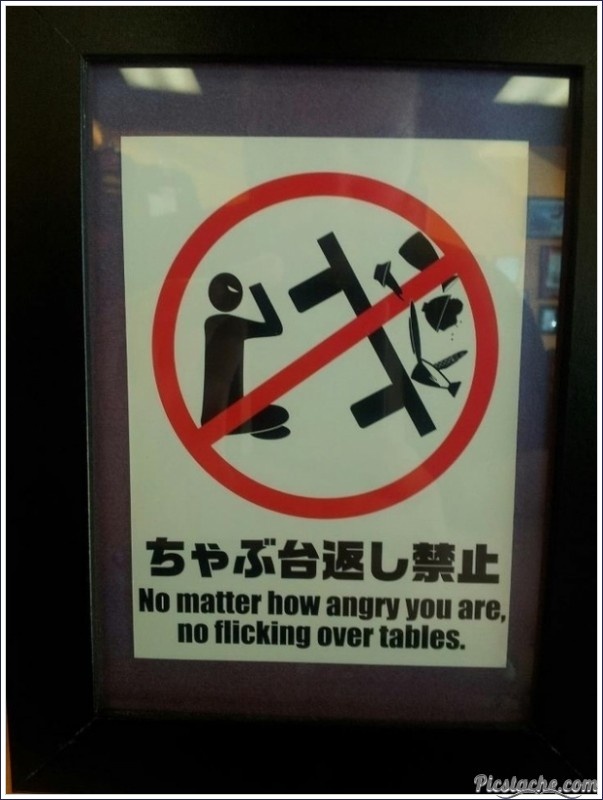
Moderators: No table flipping please. The thread has its merits. G's naming names was just the Captain Obvious. Not having seen the blade, nor really caring to do so, I never asked the polisher of anyone. Didn't need to do so, as it was rather simple fill in the blank.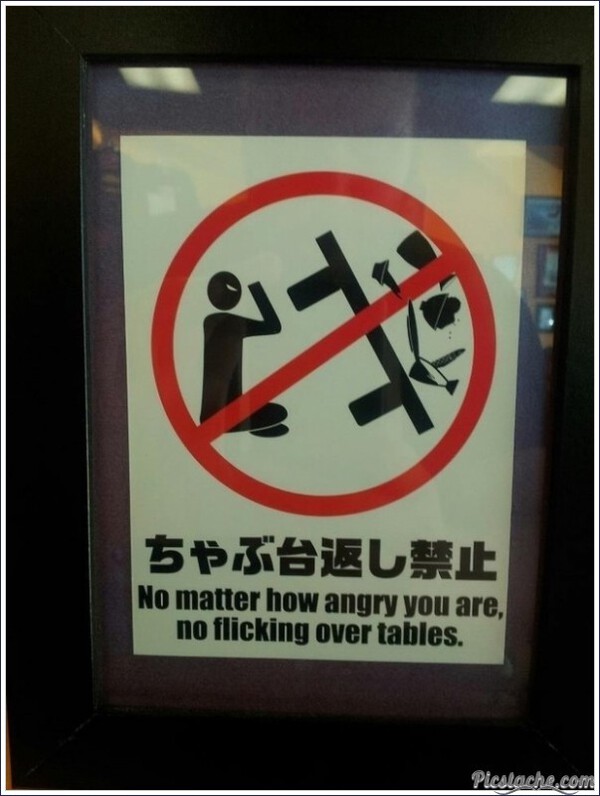

-
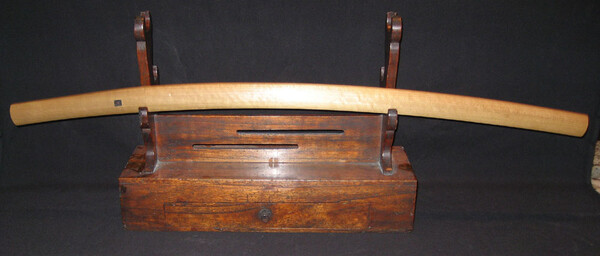
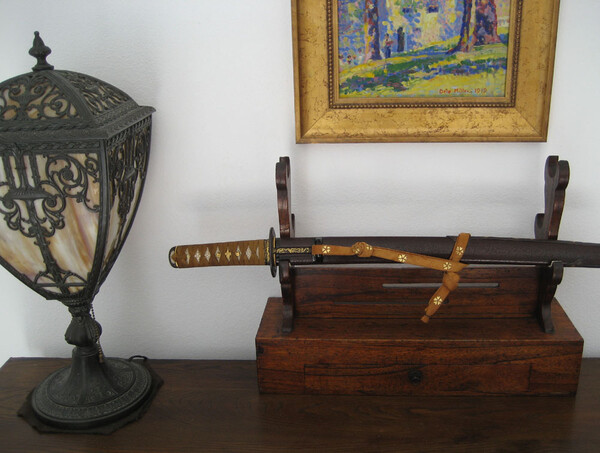
Dating stands is not easy. I bought this one because out of an antiques shop because I liked the wood and the simple lines of the design. Had it a long time and never though to translate the bottom. I just assumed late Edo, though the Japanese red oak was nice strong and light. Turns out it is probably from 1754. Had quite some miles on it, but it wears well as a patina and looks phenomenally better now after wife took special care to research how to clean and care for it.

-
paper, box for iron and mixed metal menuki
Curran replied to b.hennick's topic in Translation Assistance
John, I do too. Always something too learn from this translation section. Thank you Kunitaro-san for the translation. -
The clouds are high above, the ocean wet, and Ed a good individual to deal with. I take it for granted that such things are known. I didn't realize Ed wasn't in the list of names, but I've been guilty of forgetting he is technically a 'dealer' with a legal business entity. It never feels like business with him. I bought a much needed set of menuki off him years ago and am still praying to find another set like it. I've long enjoyed dealing with him. Had a nice conversation with him in Tampa this year and hope to get up to where he lives and visit him some day.
-
Omiya. Definitely. Sometimes you will get a remarkable kozori work, but up close more of the Omiya are remarkable. This is not to say that you wont see some weak Omiya pieces like this one: http://www.tsuruginoya.com/mn1_3/a00280.html More often, you will see Omiya that are stunners and yet affordable. Two or three years ago there was a nice Omiya Bizen Juyo offered up on this board. The kozori are largely the 'also ran', with a few exceptions.