Curran
-
Posts
4,848 -
Joined
-
Last visited
-
Days Won
27
Content Type
Profiles
Forums
Events
Store
Downloads
Gallery
Everything posted by Curran
-
Some nice pieces. I think I like several of the kozuka best. ? Is this one signed or marked on the back: https://www.dropbox.com/sh/8dr4f7s7gq03 ... CN9224.JPG
-
Gimei Shozui (Masayuki). Gomen..., but it is one of those signatures so often seen that I've committed the Wakayama variations to memory. Have done this with about 10 of the big names that are often gimei'd. It saves time. Doesn't mean I can tell an authentic signature just from a look, but means I can out 80% of the gimei. Then hit the books. I've owned two NBTHK Hozon papered 'Shozui' sets, and his workmanship gets easier to know since he seemed to be hyper aware of 3-D perspective (depth). Rule of approach: Look at the work first, signature second, then the work again. Shozui lived a long time and had corresponding evolution in his work and signature. There are some that are very true to his workmanship and the signature is close to the Wakayama ones, but has a particular omission that differ them from all the Wakayama ones. Given how the Wakayama text opinion was assembled and done in the late 1960s through 1970s, I've wondered if the evolved knowledge base of the NBTHK would permit some of these not quite Wakayama dead-on ones, but never been willing to take the chance yet.
-
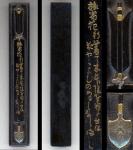
Gents, Look at the koshirae and the curve of the saya. As if the little statuette with the hole in it wasn't interesting enough, this was made either to be worn left side or blade down. Probably blade down? The western blade is interesting, but the koshirae is the culture clash hybrid that has my attention. Please take good care of the koshirae. Namban in form, with the Dutch VOC symbol on both the blade and the saya- this is something I have not seen before. Probably the blade is just a straight skinny western tang without signature. I think the koshirae is of significant historic value, so please be careful with it. I would vote against anyone trying to remove the blade, for fear of damaging the koshirae.
-
"If wishes were horses, I'd be eating steak right now" ~ Jane, from Firefly [Joss Whedon] Probably that joke will confuse all but veteran sci-fi fans. Still, it is spot on how I feel when looking at the Tomonari. What I think is 'steak' is on par with what Jane thinks is steak. Hard to conceptualize higher. Shape just kills me every time I look at it. I have not held many blades this old- may 6 Juyo or above ones. As I once discussed with Darcy a very long time ago (SF 2003 or 2004), something this old with atomic halflife of iron is just going to feel very different. This level of preservation takes on a tactile sort of challenge. Many of us are comfortable holding Nambokuchu blades aplenty, but holding something like always give me a flashback feeling to the first time or two I stood in a sword shop and had something high caliber handed to me as a newbie. These are very rare, and I regret that most here just get to see it in images. They definitely should be held once or twice in a collector's life. I'd love to own one, most likely a ko-bizen, but am resigned to Jane-doms at the moment.
-
Perchance, did one of our NMB members win this tsuba: http://www.ebay.com/itm/Antique-Japanes ... true&rt=nc If so, drop me a line. I stumbled on some significant information about this tsuba design and a famous smith.
-

Bonhams 30th April Knightsbridge, London
Curran replied to Alex A's topic in Auctions and Online Sales or Sellers
I have not had shipping issues with Bonhams, having made special arrangements. However, I can say that Christies UK charged about $1200 to ship a sword from London to FL. Sword was only worth $6000, but they added insurance at something else horrid, like another $232 to cover it. Net shipping cost was $1432 or thereabouts. Quite the bathing. Won't do it again unless I know someone who can handle receiving it and shipping it for me. Even then, reading the legalese of getting them to release it to someone other than you is quite a challenge too. They don't make it easy, do they. -
Connecticut nihontophiles
Curran replied to John A Stuart's topic in General Nihonto Related Discussion
Connecticut: Pete D'I Otherwise- a train ride into NYC for a club meeting. See if arrangement to meet Kunio-san can be done in advance. -
Hmmm. After seeing the backs on these menuki, I thought they were ko-Goto. I say No to 'ko-mino'. Learning Goto is a deep rabbit-hole to go down, and I have much further to go now that I've stuck my neck in the last year or so. Peter has a solid many years more Goto learning than I do. I might challenge his kantei in some other schools, but not in this area. I understand his Kaga Goto call, but am not convinced. I might feel differently after getting out the large o'book of Kaga Kinko Taikan. I had a futakoromono of Maeda mon in a fitted box set. Sent if for shinsa, and they split it on me: gave the menuki a Kaga-kinko paper and the kozuka a Yoshioka paper. To this day I don't undertand and wonder 'Wassup NBTHK?'. I understand the Yoshioka thoughts, but to this day still think it Kaga Goto work. Maybe I will feel differently in a few years. Even among this higher end stuff, opinion changes from decade to decade. Learned opinion may change, or it may simply be the changing of the judges.
-
Paul Martin Video - Keith Austin
Curran replied to Brian's topic in General Nihonto Related Discussion
I started collecting again in 1999. At that time some of the oldtimers in the NYC club would tell stories about him that were rather colorful. One or two of the oldtimers grumbled that there was more to it than 'an accident', I have never heard evidence of it to support their feelings. Just they lost someone they cared about in an undefined way. That Austin tanto was quite the historical discover and I was lucky to get to have it here for a bit. Being very early in his career, it was not a masterpiece- but surprisingly good for a student effort. I wish we saw more of his work. Edit: There was an effort 2004-2007 by the Sacrament group c.2004-2007 to get a publication out of his known works (tanto, tsuba, and a wak or two). Did this ever get achieved? -
From the other site, I too thought a signature had been removed. Since it seems rather obvious, that would affect value- no? There was a gimei Nobukuni up on another dealer's site at a fair price not long ago. Funny thing was that if the signature were removed, I was pretty sure it would go to one of the 3 guys considered the "4th generation" Nobukuni. Interesting sidefact is that one of the Nobukuni smiths was either dyslexic or learned his signature wrong. He would sign the 'Kuni' character backwards. The shape of this one fits with shodai, though a bit small in some ways. Lacks some of the traces of influence I have seen on previous shodai works. In most regards, looks Oei Nobukuni to me. Still, tempting to me. I hope it goes to a good home and I see it again some day.
-
Looking for Translation please, Koto-Shinto peroid?
Curran replied to TreasureHunter's topic in Translation Assistance
I second Sebastion's guess. -
I knew I'd seen this one before. Same blade, different dealer: http://www.samurai-nippon.net/V-1137/index.html It would take selling my Morokage [yakiba.com] and a tsuba or two, but I would buy the Nobukuni. Sorry Tsuruta-san.... have not the liquid cash. Tis IRS season, and the govt takes the wallet now. If anyone can see the section of the papers I posted and tell me at least the verbs after Oei Nobukuni part, I would be appreciative.
-
:D The Japanese have a gift for choosing a near word, ever so slightly misspelled that is often sheer humor. They do it so well, one would think it the subtle intentional.
-
Yes. I fear Tsuruta-san's descriptions very much. Having recently picked up something I wanted for about 6 years, after placing a few things privately to get it- I'm pretty happy with what I have. Yet, were I wealthier, I would try for this at its opening bid.
-
Here is the part I question: "Oei Nobukuni _____ _____ shitte iru." (see image below) Also, what throws me is the suken head is deeper and the gombashi horimono are both typical of Oei Nobukuni. Ron brought up kantei by horimono recently, and normally I'd say this is difficult. However, with Nobukuni there are enough horimono and signatures that some analysis by horimono has been done in the big ole Horimono book (I forget the author's name, but can scan the book later tonight). Though some variation in the early works, the width is a bit narrow for shodai or nidai, and more in keeping with sandai. I'm not questioning the NBTHK at all. I just thought Tsuruta-san might have made a wrong translation in English. The Oei Nobukuni Juyo went off for about $23-25,000 which I thought high. This one seemed to be priced more in keeping with a Juyo Oei Nobukuni. EDIT: The blade is shorter than I thought. The measurements I have on file for Oei Nobukuni O-tanto are all more around 14 inches (+- 1 inch). Length relative to width, I more realize the shape here and understand 'shodai'. From the photos, I had thought it was longer. Still, I appreciate the help on understanding the papers.

-
Jean: ~ Yes. Mumei Oei Nobukuni Juyo was sold by this dealer: http://ginzaseikodo.com/englishhome.html I was surprised, because I too thought Muromachi mumei would not pass Juyo. I have since noted a two or three that have. Each instance, earliest Muromachi and a bigger name + ubu. I thought as you do, but see the gate has not slammed at 1394. It appears a few have gotten their foot in the door. I think the rule holds for 99.9% of mumei muromachi blades.
-
Had to look up the characters for Enbun. Why the mention of Oei Nobukuni? I cannot read (or barely even see) the kanji for the verb after it. Thank you for the translation. I am very surprised that this is Shodai Nobukuni. I would have thought early sandai.
-
Tsuruta-san has this Nobukuni up at a 'too good to be true' price: http://www.aoijapan.com/wakizashi-mumei ... juyo-token He says Shodai. Yet I looked at it and immediately thought Oei Nobukuni (3rd or 4th gen depending upon how you count). I've noted a few mumei ones getting across the Juyo line in the last decades. The papers just say 'Mumei Nobukuni'. Reading through I see bits and pieces of Tsuruta's write-up, but does it not say towards the end that it is Oei period? Ie. Late Nambokuchu / early Muromachi ? 1390-1400.
-
Hi and thanks guys. The ebay items were just meant for a fun way to get some feedback. The menuki and fuchi-kashira boxes were left over from a koshirae restore where the items mounted on a new tsuka. Each time I go to ebay, it seems the filters and rules changed. I was surprised when David ran into a filter problem. Europe: not so much. I run into all sorts of things with various Italian, French, and Spanish items. David: I believe we are technically a 'purple' state, though it is extremely regional and depends upon where the retirees come from. Those down I-95 = democrat. Those down I-75 = republican. Eventually the sun addles them all.
-
Stephen, Not a problem for me. Thanks for bidding.
-
Confounding! No mention of swords, knives, or nihonto. Listed under collectibles.Japan.1900-> now Just a menuki box, f/k box, and a tsuba box each starting at $1. The French need protected from boxes and pillows? Meanwhile, in the place of my youth: http://tinyurl.com/qzhpo68
-
The name and description says it all: #1 http://www.ebay.com/itm/Japanese-wood-b ... 20e236e367 #2 http://www.ebay.com/itm/Japanese-wood-b ... 20e237004e #3 http://www.ebay.com/itm/Japanese-wood-b ... 20e23757f5 and there should be a #4 up soon: http://www.ebay.com/itm/Japanese-Obijim ... 20e23791d4
-
John, thank you. That was fast. The sad thing is I have made this exact same mistake before. I have looked up these guys, and found a Note to Self not to make this mistake again.... and make correct change to my kanji reference. Taking a few minutes to go through the Bonhams NYC Oct 2012 Auction catalog, I see three other tsuba of various renderings of the rain dragon vs tiger, often with a mountain somewhere in the design as a third element.