Curran
-
Posts
4,790 -
Joined
-
Last visited
-
Days Won
25
Content Type
Profiles
Forums
Events
Store
Downloads
Gallery
Everything posted by Curran
-
Anyone ever met Joe Earle?
-

New Tampa show
Curran replied to Stephen's topic in Sword Shows, Events, Community News and Legislation Issues
Paul, Yes. Welcome to bring your swords. Just practice good etiquette. I live in Sarasota part of the year, and there are a few of us within an hour or two of Tampa. Feel free to get in touch with me a month or two before the show. -
I will go see the preview on Oct 12th or 13th. Should be interesting. Yes, many of the estimates seem ambitious while some seem very low. I would like to think that estimates are well thought out. They are not, though Bonhams seems to put considerably more effort into it than Christies. Japanese sales bringing in a million or two are hardly worth the requisite salary of having someone remotely knowledgeable on staff. Why bother when you can sell $500 million of various Euro brick-a-brack to a Hong Kong art market?
-
As DocLiss said, or: http://www.finesword.co.jp/sale/book/11 ... m#kanesada (scroll down a bit)
-
Yes, your kozuka reads Nobukatsu. Post your photos. If a slow day, I'll break out the signature references and take a look.
-
(Kifudo ??? or Kitsufudo ???) and then artist name: Nobukatsu.
-
Hmmm. PM me photos of the koshirae if you feel you have the time. I enjoy yoroi doshi koshirae. But many of them w/ koshirae are shinshinto. Sounds like yours might be a bit different.
-
The hell you say, about the Hizoko that is.... Totally off the original topic, but either tease us with a photo or PM/email one privately. Please!
-
As I hope I made clear, I was trying to find the credible part in the story. What Mike says makes more sense in fitting with the Japenglish version swapped with me. Sounds like it isn't nearly as current as I was told. Old news finally reaching my far end of the grapevine. Endnote: Mike.... awesome Hirata f/k that you sold to a club member. It was great to see that Sunday. The kashira was *much* more educational to study under magnification in person rather than just look at in a book.
-
Sei ichi died c.1875-1900 Haynes 08050.0 Student of Goto Seii H08047 Seii was a student of Goto Seijo school. Nice little tanto tsuba probably made for one of those yoroi doshi which were in vogue c. 1855 to 1870.
-
And Lehman was just one company.... ______________________________________ Just was curious. I doubt the fact is remotely as large as that implied. The source was unusual and much more credible than those usually dickering over NBTHK and NTHK issues.
-
At Sunday's New York Metro Token Club meeting, the Japanese sensei talked to me about having just heard from several friends that a group of Tokyo sword dealers were caught colluding and faking papers/signatures. The gist was that the police were after the gentlemen, at least 5 were now bankrupt, and to expect many sword values to take a hit soon as a few store full of sword come onto the market unless the remaining dealers buy them up like DeBeers. The Japanese gent responsible for this is a good teacher and long time member, but has sometimes delivered some shock-jock whoppers where reality is a supposed mountain out-of-a-molehill of truth. ________________________________________________________________________________________________ Anyone else heard or read anything and care to comment? Any current Nihonto Dealer scandal of merit in Tokyo? The half joke was that mumei Juyo Inchimonji were going to suddenly be even more plentiful. BS, or a grain of truth here? If so, it might make for an interesting Dai Token Ichi.
-
I read it as SadaNori too, but see Morita-san has already beaten me to it. Glad to know the second character is 'Nori'. Wasn't 100% sure.
-
Dr. L and David, John, thank you for that write up. There isn't much more to say other than that I concur. You're a tough act to follow. David, I would advise you don't let go of this tsuba lightly: even if your interests change to other areas. Many people might dismiss it as 'another Namban' and underestimate its value. I am not saying it is a National Treasure, but that it is a fine piece: interesting and rare. Think thrice about ever selling it. If not inconvenient, please bring it to Tampa. _____________________________________ PS. Edit: I think I have seen another of these once before, but the arabesque was rusted through in a point or two with damage making it unappealing. Yours is in much better shape. The kogai ana was added with a fair aesthetic. Flipping through Yoshimura-san's Namban Tsuba book, there are some interesting ones in there including one as large as 9cm and another with a man w/ wings that looks surprisingly like a childish version western rendering of angels, but none that seem as old to me as yours. Close, but not quite.
-
First impression is it isn't even remotely correct. But there was more than one generation. Any photos of the blade, blade shape, etc before I go opening up the big Bizen books.
-
David, I've been waiting for your photos. Thanks for posting that one. Are you able to post a side photo showing the thickness of the tsuba at the nakago ana and the cutting? This one appears thinner and larger than most I have seen. It will be interesting to hear what Dr. L sees. I'll give my own opinion when I've had time to read and think on it a bit more.
-
New Tampa show
Curran replied to Stephen's topic in Sword Shows, Events, Community News and Legislation Issues
Stephen- Saw that yesterday. Also was thinking to check in on you and Mr. Stuart, not having heard from either of you recently. The Tampa show moved back 1 week from Valentine's Day, which means better fro those of us with spouses. Especially with spouses who have b-day two days before v-day. I expect to be there the whole show, though not sure if I will take a table or not. I suspect the show will be better advertised and open to a greater percentage of the public in Florida (locals never seem to know about the show), but it won't have the advantage of a shinsa team as it did last year. ~~~ It was a near stealth shinsa. Would have been better if the Yoshikawa NTHK or their USA caretakers had managed to integrate them more into the show. Seemed quite the ships passing in the night with neither benefiting from the other. Many in the show room didn't know where the shinsa was, nor did the shinsa have any signage to make it easier for walkins. In previous years I've had to represent for individuals visiting from Sarasota in order that they be permitted into the show. That sort of invite-only is logical from a security point of view, but not wise in terms of attracting new collectors. Hope to see you there. Curran -
Mike, I wish it were as easy as to say a particular school. The best I can do is say it tends to fall along enjoyment of very simple nature or religious designs. This has unintentionally led to a concentration of Owari works, but ranges from Haguro tsuba, to Umetada hon zogan (correct term?), and Ezo menuki. The Hirata's Matsukawa mon pine bark element was perfect for my tastes. Among Higo, sometimes the Hirata and Shimizu designs. I envy some of Dr. Dorfman's pieces. Hayashi hasn't been my cup of tea, but the last tsuba I ever purchased was one of the Citrus tree ones. I have no idea what generation. Probably late, if even mainschool. I've been on hiatus from buying while dealing with summer house repair-renovation bills.... and awaiting the return of the project Lorenzo and I discussed. I've been recently studying the aforementioned Nambokuchu tachi tsuba. The weight of it at near 12 ounces for a kinko tsuba, which surprised me. The waves design and 12 of the 16 are various flowers. Boris has a smaller yet similar one: http://www.yamabushiantiques.com/BM%20N ... 0Tsuba.htm Yes Lorenzo, I remember discussing it with you. That will be a milestone when that project is finally finished. Last I heard, it was in round 3 or 4 of lacquerwork. I would like to learn a lot more about traditional Japanese lacquerwork. Maybe the koshirae comes back next month. Maybe next year. or 2014.... I hope late this year or early next year and have been preparing for the bill. We have the long move back to the FL house once the work-repairs are done, so trying to keep it simple and trim down what we must transport at the end of Fall.
-
Oh dear. The X chromosome runs strong in that family. Wonder what the finally tally will be. He once fired a disparaging comment about women and their expensive handbags. The karma payback seems to be enormous. It would be rather evil if he was put on the Hermes mailing list. Cyrus have any interest in collecting shotguns? I seem to be inheriting a few vintage ones, though Cyrus might prefer a sawed off K-Town special.

-
Quote, "We have 3 NBTHK papered Hirata tsuba: 2 Hizokos (I'm guessing the one Mike posted is his and papered Hizoko), and mine which I presume to be a nidai work." Juyo, Tokubetsu Hozon, and Hozon respectively. Lorenzo: I've had a Higo koshirae build stop&starting for nearly 10 years. Largely dealt with Cary Condell, JOhn Tirado, and Brian T on it. We used Higo Kinko taikan, Visual Glossary 2Vol set, and the Uchigatana book for a small catalog of Higo koshirae. The Edo tanto & wakizashi koshiare books also added some value. Also, a few examples culled off the web over years. A New York area collector has a nice Higo koshirae example with only minor restoration, and I also had the chance to study in person the Juyo one Bob Benson had posted. I've had a fair bit of correspondence with the owner of the Juyo koshirae and other Higo collectors. My Hirata came from the owner of that Juyo koshirae, and was sort of a Japanese-style gift that surprised me. My interests in kodogu are primarily not Higo. If you find a single book with a good catalog of Higo koshirae, please let me know. Another New York collector has made the Kowalski library available to us and provided tons of photocopies. The irogane Hirata tsuba - lacquer information isn't really new. Just in Japanese, which I haven't been able to read-translate until recently.
-
4? Wakarimashita. Cyrus has 3? No kids on this end, but largely due to me being eldest surviving son caring for a bunch of family. Never the less, elderly children not nearly the same as younglings. Raymond joined the papa crowd this year, and perhaps we will next year or two.
-
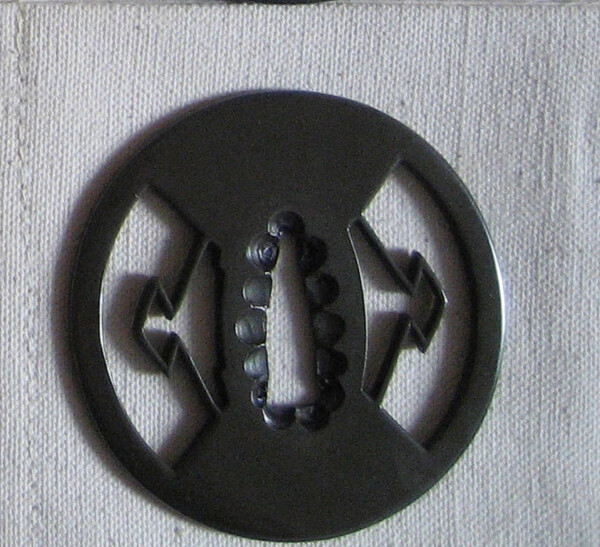
Mike, you have PMs. Well, 20 minutes with a few Higo texts and I had an answer: --Those irogane Hirata with the concentric punch marks often have the ~red under black~ lacquer in or around the concentric punch marks surrounding the nakago ana. Not always. We have 3 NBTHK papered Hirata tsuba: 2 Hizokos (I'm guessing the one Mike posted is his and papered Hizoko), and mine which I presume to be a nidai work. Upon getting the nidai tsuba out and looking at it, mine *does* have the red under black lacquer traces in the concentric punch marks around the nakago ana. I'd only previously remembered Jim Gilbert pointing it out in the sukashi walls. All three have the concentric punch marks around the nakago ana. Two of them have the red under black lacquer in the concentric punch marks around the nakago ana. Peter claims his does not, putting it in the "not always" camp. Nor (if mine is a nidai work as I believe), does it seem that this is particular to the first gen. Conclusion: Presence of the red and black lacquer in association with presence of concentric punch marks on an irogane tsuba, seemingly Hirata, - is a vote in favor of authenticity, though not absolute. Could stand some stat testing, but don't know if we can pull that many papered punch mark Hirata this side of Japan.
-
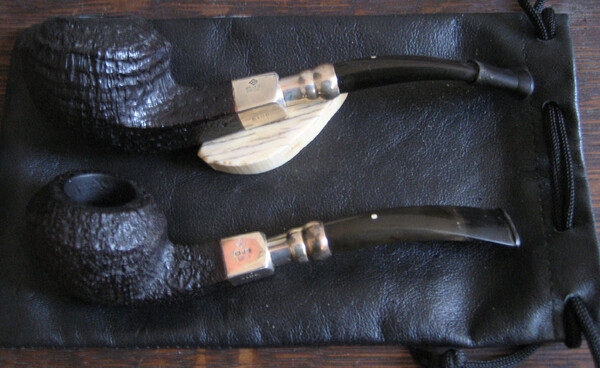
Of course. Christian- No. Don't have that book or much experience in that area. Just raising a topic Brian T. and John Tirado have introduced to me before. Other explanation most welcome. ____________________________ In addition to certain tsuba, seem to share a shellbriar habit. These are the only two I have. Call it a daisho. Petersons' also good for winter. Colonel Dean Hartley was also fond of them too.
-
Red lacquer is not in the seppa dai. Red lacquer is under black lacquer in the sukashi. This is nidai, not shodai. Peter says there is none in his, but reviewing photos from your website- I see what I take to be traces of it in 3 or 4 places, mostly near the nakago ana. Don't ask me to illustrate. I can barely take photos. Darcy and I have both had photos lifted from here, so I need to get a modern photo program to mark them in some way.
-
Hirata: Question to Mike and Peter. On the Hirata tsuba Mike displayed, the classic Hirata cup marks around the nakago have some loss of the black lacquer revealing what looks like red lacquer underneath. On my Hirata, there is the same black lacquer in the sukashi with some loss revealing what appears to be red lacquer underneath. On Peter's the black lacquer seems to not have suffered much loss, so: Peter: (Q1) Do you see any signs of red lacquer underneath the black in the Hirata cup marks around the nakago ana on yours? Mike and Peter: (Q2) Is the use of red lacquer frequent in the works of the first and/or second generation Hirata? Or is it a trait of a specific generation? Or just something seen once in a while?