Curran
-
Posts
4,843 -
Joined
-
Last visited
-
Days Won
27
Content Type
Profiles
Forums
Events
Store
Downloads
Gallery
Everything posted by Curran
-
Totally don't bother trying to understand DEN usage for a while. Or go search NMB for Darcy's epic posts on it. Still, it is something the western scientific mind educated have a hard time getting the right feel. Perhaps like rolling your rrrr(s) in Spanish, certain tonal shifts in Chinese, or even "gli" in Italian -it takes a while. Most westerners make the huge mistake of defining it as negative, when sometimes it means something much greater or better than normal. Some Japanese organizations use DEN for everything. Ex: NTHK papers. What sources are you reading from about Nomura? It is a good school, but not one that people usually start with. If you are near Piedmont Park area, PM me for a visit to my building and we can have an opening discussion. I will bring out a few decent things that I don't usually transport or share.
-
Hi Richard, Midtown ATL here. Ironically, I had thought of starting up an Atlanta group that might include Eastern Tenn and Western NC. Please share what you feel like sharing.
-

Shodai Tadayoshi sayagaki translation request
Curran replied to Takezo's topic in Translation Assistance
Tadahiro instead of Tadayoshi. There is a lot there. -
Very sound advice. " focus on items that you really love, decide what you want to pay for them, and don’t go past that." Long ago, I collected wine before I really got into tosogu. Luckily, the wine markets taught me Justyn's advice. You may not get what you most want at a moment in time, but you will probably end up with what makes you happy.
-
And SOLD. Sales section Mod: please leave it up a day or two until I get it shipped off.
-
Also, somewhat choppy chisel marks along the northwest edge of the front seppa dai. Who'd bother to fake that? I don't think they'd have come out so choppy if it were a cast job.
-
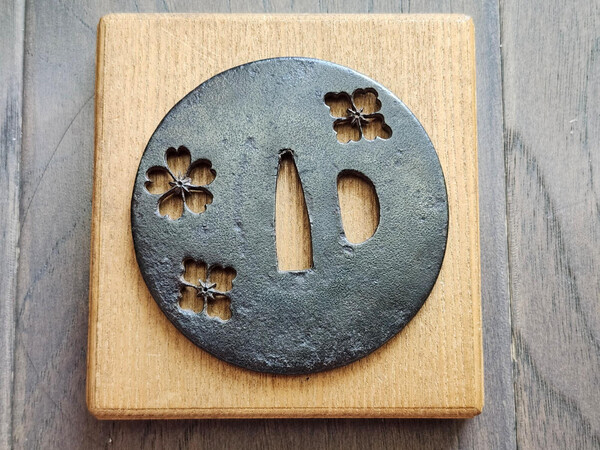
ALSO: Will include a basic tsuba box

-
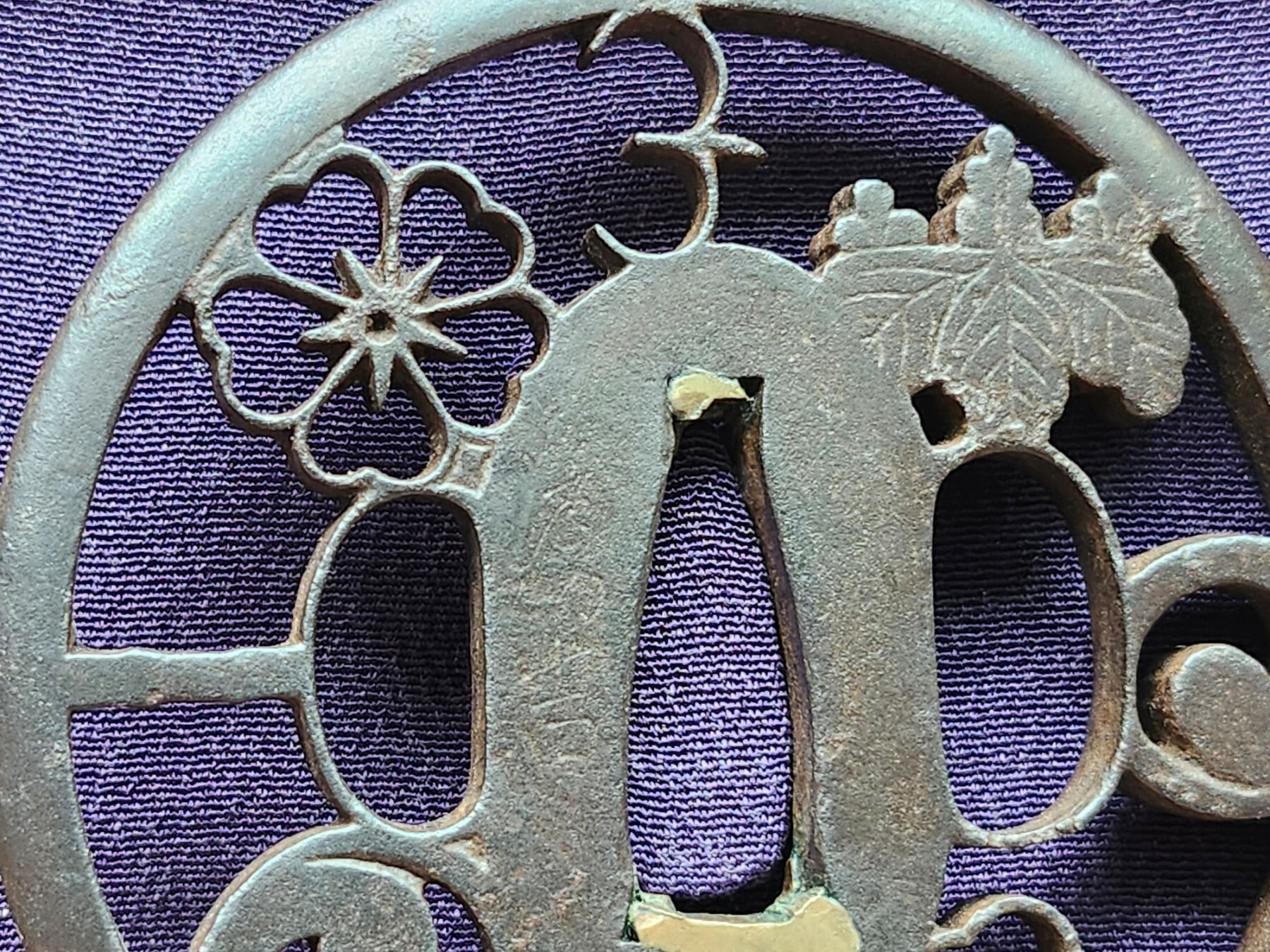
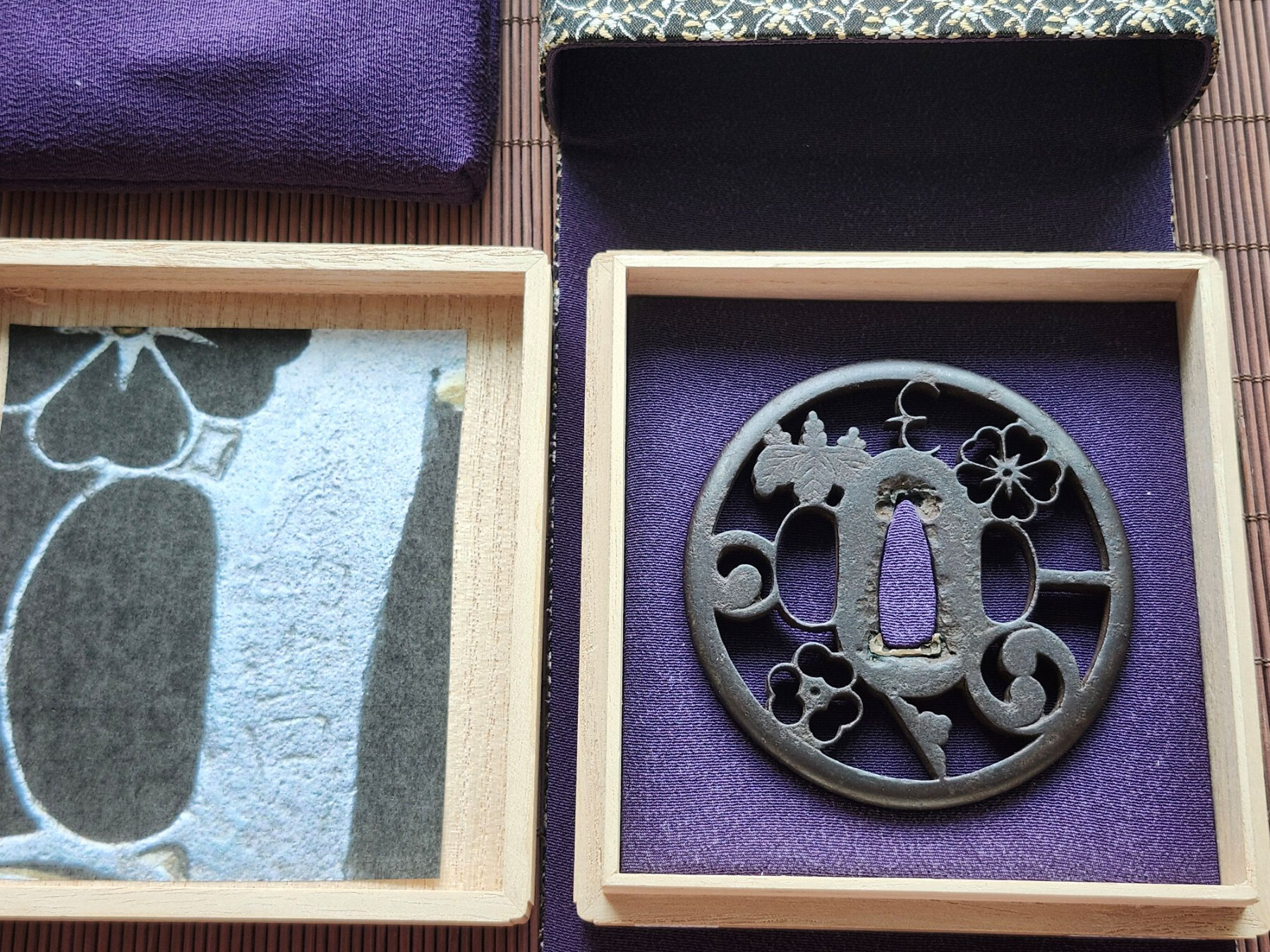
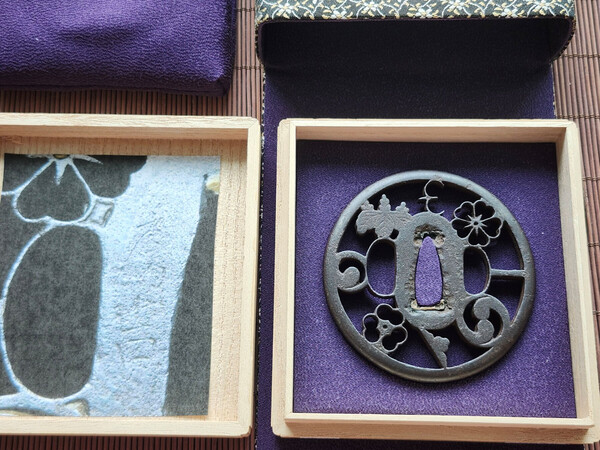
$90 + shipping. Proceeds will 100% go towards supporting NMB and another Nihonto related non-profit group. I picked this tsuba up 1.5 to 2.5 years ago, as part of a package deal. It was the surprise sleeper of the group, being much nicer in hand than I could perceive from the photos. Nice iron. Fine sukashi. Good seppa zukuri from having been mounted. Anyone interested, PM me.


-
Thank you Victor for the well written breakdown. I think the OP's question has been answered. Like Mr. Sinclair, I worry that we freak people out too much with rapid fire dismissals.
-
Antiquities are now excluded from tariffs. [However, my new expensive Shimano fishing reel is not.] Without even looking up the specific maker, I assume it is a Tanaka tsuba. The fan-base is quite rabid. Given size, condition, and authentication papers, -I am surprised it did not go for more. To some people, including a few members here, this is really cheap. Welcome to the K-shaped economy.
-
$500 Gold pair of daisho menuki God of Fortune set
Curran replied to Curran's topic in Fittings/Tosogu/Kodogu/Koshirae
I am going to reduce the price to $350 for the daisho pair (4 menuki) for 1 week. The local experts with the XRF machine and a lot of knowledge say: "Gold plate or foil over base material" They seem to think the base is some sort of brass. So probably: cast+finished+ gold foil or such over the front I am going to reduce the price to $350 for the daisho pair (4 menuki) for 1 week. If they cannot sell at that price, I will keep them ad infinitum for a koshirae project or tsuka project. Interested people PM me. -
Hey..... Otsuki Mitsuoki was quite the grandmaster known to have liked his sake and worked during his enjoyment of sake. His carving style certainly has a sure -why the f**k not- madness about it whereby I think I could recognize his work by the mad drunk genius carving style. Given that he was a popular target of gimei signatures, anything I see with his supposed signature- I look to the workmanship for the mad drunk style before bothering to check the signature. I doubt I could imitate it if I didn't have half a bottle of sake in me. There is a certain looseness to it that you'd have to be very very relaxed to pull off. Of course, I might not recognize the work from one of his more sober AA periods.
-
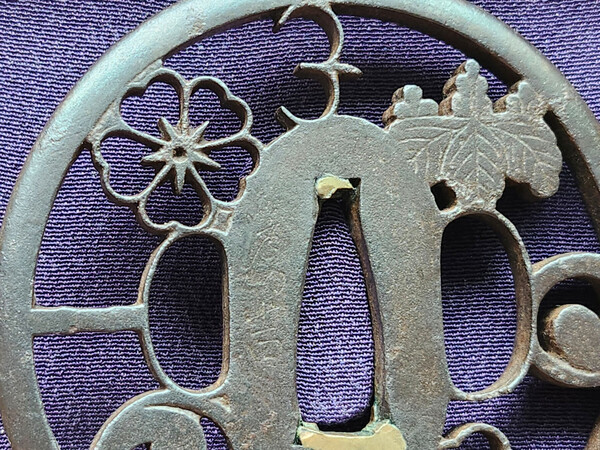
It is signed with his teenager name, before he became the 3rd gen of the school. Not bad for a teenager. Still, not at the level he'd reach in only a few year. Not sure if I have any other pics. Above and below the hitsu ana here, see the slight carving into the tsuba near the sakura and the tomoe. Only the nidai Shigemitsu really did that on a consistent basis, so it is considered a kantei point. Here you have a dad double checking junior's work, like my own dad spell checking my middle school projects. Spellcheck didn't quite exist yet.
-
Of the Hayashi Tohachi?
-
Rohan isn't far from the truth. I've seen early work by the nidai Kanshiro, and I own one of the 4 signed Hayashi Tohachi [NBTHK Hozon] in existence. The Hayashi Tohachi is from his teenage years and got some goofy crudeness to it from before he mastered his trade. In one or two spots, it has certain traits that I associate with his father. I assume Dad was trying to help?
-
Best way to clean and/or degrease habaki and koshirae
Curran replied to Cookie_Monstah's topic in Tosogu
@ROKUJURO and @eternal_newbie Thanks for handling this post so well. The Jim Gilbert writeup is a classic that I used back in 2002-2003, but I don't really agree with boiling tsuba unless it is a last resort on a lower end iron tsuba. If that far gone, it might just deserve to die. Still, nothing beats developing an understanding of rust as much as getting a piece of ivory or deer horn to work a near dead rusty clunker off of ebay or from the rare yard sale. -
#1: https://auctions.yahoo.co.jp/jp/auction/n1240602732 If shipping for a glass framed 135cms wouldn't be such a killer, I'd probably buy this myself. This might be a good buy for one of our Japan members. #2: https://auctions.yahoo.co.jp/jp/auction/h1240772755 I don't know if this is a common painting or not, but I figured someone here would like the Miyamoto Musashi scroll.
-
I've administratively worked NTHK shinsa in the '00s about [20 to 25 years ago], so I could get to see several hundred work sheets and view over their shoulders the sort of question you are asking. The Yoshikawa group definitely uses work-sheets with a list of informational choices that they circle, but I don't think those will specifically get you to the conclusions they reach. They do use books, including Haynes, and the panel of judges at any one time do discuss the fittings to reach a conclusion. The conclusion is only as strong as the judges. I have seen some very strong NTHK shinsa with Hagihara-san [I'm probably mispelling], Mr. Jim Gilbert, and Mr. G. Robinson switch hitting between the swords (75%) and the fittings (25%) in my time observing. I've also seen one Yoshikawa NTHK shinsa where I felt the fittings judges without Hagihara-san and Mr. Gilbert were not that strong. At that particular shinsa, someone I had sold a tsuba to earlier in the day had taken it to the shinsa team and had it bounced as "modern" and came back to me. I felt bad... -because I had forgotten to mention or give him the Hozon NBTHK papers. I cringed a bit at that particular shinsa, and asked him if he wanted to return the tsuba. He took the papers. --Ironically, that is one of the tsuba I've sold over the years that I wish I could buy back. To this day I scratch my head why that particular shinsa panel thought "modern"-- The same goes for the current NBTHK. Since Jan 2014, I've seen the rise of a lot of 'bad attributions'. Pre-Tariffs, I'd sometimes buy some of these crap Hozon and resubmit. Often round 2 was much better (correct?) papers. Current NBTHK shinsa seems luck of the draw. One shinsa might be crap and the next one might have a strong judge or two. What bothers me most is the rise of Horyu at shinsa. So many good tsuba get that now. You have to submit them a second time, and just hope the shinsa team is better. My best Yagyu (previously NBTHK published!) got Horyu the first time, and then correct TH to Yagyu the second time. I hate that. So, as @Hector noted, I am less and less likely to submit anything to shinsa that isn't at least at the $2000 or higher value level. Even then, those horyu still manage to make me angry.
-
Think of it as a bumpy bell-curve of knowledge. Personally, I highly respect the NBTHK papers from 1983 to Dec 2013. Most opinions from there, I have to revisit my own opinion. Often they saw something I didn't. I learned from it. Before and after that period are hit or miss.
-
For me, this is the best answer. I share similar views with Glen. I have openly questioned if the NBTHK started using database image matching software for their opinions in the last 10 to 12 years. I've seen too many errors where I can understand the attribution to [ABC] from a top down digital photo that might help speed up the shinsa process, --- but anyone handling it will realize iron, patina, small tell-tales of manufacture, etc.--> all point to [XYZ] a different school. The topic of AI trying to do tosogu shinsa is a very complex one. A lot of the data it would use is very conflicting or corrupted. Ex: I have mumei tsuba with 2 or more NBTHK papers giving very different attributions: sometimes decades apart, but often only a few years apart. If both sets of papers are in the dataset? Also: Unless able to deep dive 3-D study a piece of tosogu, I am more of the opinion AI will get lost in its own righteous convictions.
-
$500 Gold pair of daisho menuki God of Fortune set
Curran replied to Curran's topic in Fittings/Tosogu/Kodogu/Koshirae
Not so many pawn shops in our area. It is a bit different from Florida. I will check with some of the higher end watch shops, and a custom work shop I knew as a kid. Mother was a bench jeweler long long ago, and one of the higher end custom shops for which she worked is still in business. --[Maybe try on a Girard Perregaux or two and try to tell myself that I have need of such a watch] Thanks for the info. I'd not known of XRF. My knowledge of metals and gems is very dated to the prior century. -
$500 Gold pair of daisho menuki God of Fortune set
Curran replied to Curran's topic in Fittings/Tosogu/Kodogu/Koshirae
Interesting. I was unaware of XRF testing. For my own knowledge, I will try and have them tested. I have to admit that I thought these would only be up for a few hours. They might be 20th century work, but I was fairly certain they were lower gold content. Aka. Like my brother's gold necklace from back in the 1970s-1980s. I've had these for years. I be embarrassed if Mark is right and they are only a very gold-like shiny brass. Don't think so, but I wouldn't bet my life on it. -
I know Herr Kremers and his son Paul to a lesser extent. I never knew Sasano-sensei, as he passed slightly before I got serious about collecting. I was not yet into Tosogu. That came later. Hindsight is that it would have been better to keep the sword and toss the house. The Great Recession was a tough one where I lived. While I don't believe in going All In on Art, it would have been better if I had. Buy that small Modigliani back when I could have. Get the smaller Warhol painting with my family name on it. Again, hindsight. David Rockefeller quote, "I think of art as the highest level of creativity. To me, it is one of the greatest sources of enjoyment" I envy those willing to go All In on Art.