Bugyotsuji
-
Posts
15,187 -
Joined
-
Last visited
-
Days Won
325
Content Type
Profiles
Forums
Events
Store
Downloads
Gallery
Everything posted by Bugyotsuji
-
三つ柏 check out the famous Makino Daimyo family ‘Mitsu-gashiwa’ mon. https://www.google.com/search?q=牧野氏 家紋&client=safari&sca_esv=a9f1afb3224ba41e&hl=en-gb&ei=2b1baIz3IPbq1e8P9rn0gQs&oq=牧野氏 家紋&gs_lp=EhNtb2JpbGUtZ3dzLXdpei1zZXJwIhLniafph47msI_jgIDlrrbntIsyBRAAGIAEMgUQABjvBTIIEAAYgAQYogQyCBAAGIAEGKIEMggQABiABBiiBEiv3gJQqgpYuNoCcAh4AZABBJgBvgGgAYQdqgEEMS4zMLgBA8gBAPgBAZgCHKAC4RWoAgDCAgoQABiwAxjWBBhHwgILEAAYgAQYkQIYigXCAgUQLhiABMICCBAuGIAEGNQCwgINEAAYgAQYsQMYgwEYBMICChAAGIAEGLEDGATCAgcQABiABBgEwgILEAAYgAQYsQMYgwHCAgoQABiABBhDGIoFwgINEAAYgAQYsQMYQxiKBcICCBAAGIAEGLEDwgIKEAAYgAQYsQMYF8ICBxAAGIAEGBfCAg0QABiABBixAxiDARgXwgIJEAAYgAQYBBglwgIMEAAYgAQYsQMYFxgKwgIJEAAYgAQYFxgKwgIEEAAYHsICBhAAGAUYHsICBRAhGKABmAMC8QVNcKR2ViASe4gGAZAGCpIHBDYuMjKgB9Z1sgcEMC4yMrgHwhXCBwgwLjQuMjMuMcgHiAE&sclient=mobile-gws-wiz-serp
-
Ah, ok, then in that case, as others have said above, go for it!!! (The wait will be exciting, and don't forget to let us know the result! )
-
The best 'they' have. So you don't actually have it? Is it in Japan, and would you be able to ask them to submit it for NBTHK shinsa for you? If you have the patience, time and money, then sure, why not submit it to the NBTHK? If the same attribution comes back, that would make the attribution super solid. (Sometimes an unexpected result comes back, but in this case you don't think it will.) As Jussi says, you could always throw away the result if you don't like it. Ultimately 'gold standard' NBTHK papers tend to hold a little more weight amongst potential buyers, if resale is what you are worrying about. If you are confident in the blade, though, that is the most important thing.
-
Shoami perhaps, though that last kanji… 正阿弥
-
Does a magnet stick to it?
-
That’s the reverse of the tsuba!
-
The Hachisuka family of Awa, Tokushima, were famous for this Kamon. One branch of the Hachisuka family used it in reverse. You can see examples of both in the Tokushima Prefectural Museum.
-
 Next time around it’s a deal, Jussi. Great that you are able to travel on your own initiative like this. A mixed bag, but altogether worth it I am sure. Drop in for one of the local branch meetings of the NBTHK; Mr Koike always has special blades lined up for viewing.
 -
Bishu Osafune Sukesada - August 1581
Bugyotsuji replied to Bosco's topic in General Nihonto Related Discussion
You have to guess what Jacques above means by “should be”… -
ChatGPT being diplomatic I see. Did you see where it found the information? (This NMB site is quoted as reference.)
-
Are they still running that chūmon-uchi exhibition at the Okayama Prefectural Museum? (With that Naginata; I also know where the other one is!) Wish I’d known you were going to be in Osafuné today, but it sounds as if you got along just fine anyway…
-
can anyone help identifying this blade
Bugyotsuji replied to daleanson's topic in Translation Assistance
Blade overall shape. (Shapes of blades generally followed fashions down the centuries). Dale, if you can remove the hilt easily, please lay out the whole blade left to right and/or right to left for an overall balanced shot of it, including the tip of the blade and the bottom end of the nakago tang. PS When you handle it, use your fingers freely on the blackened tang, but do not touch the steel of the blade itself. -
Translation assistance for short mei on Tsuba
Bugyotsuji replied to Kantaro's topic in Translation Assistance
So strange. Never seen these before but there are three examples above so there must be more! Interesting… -
Translation assistance for short mei on Tsuba
Bugyotsuji replied to Kantaro's topic in Translation Assistance
Do you not see a hairline surface crack, Jean, propagating from NW to SE? If it was originally wider and more noticeable, then a hit below and a hit above might have closed it to almost invisible, i.e. Tagane usage for a different purpose, no? Gently squishing together. PS If you can’t see it, then maybe that proves it worked!!!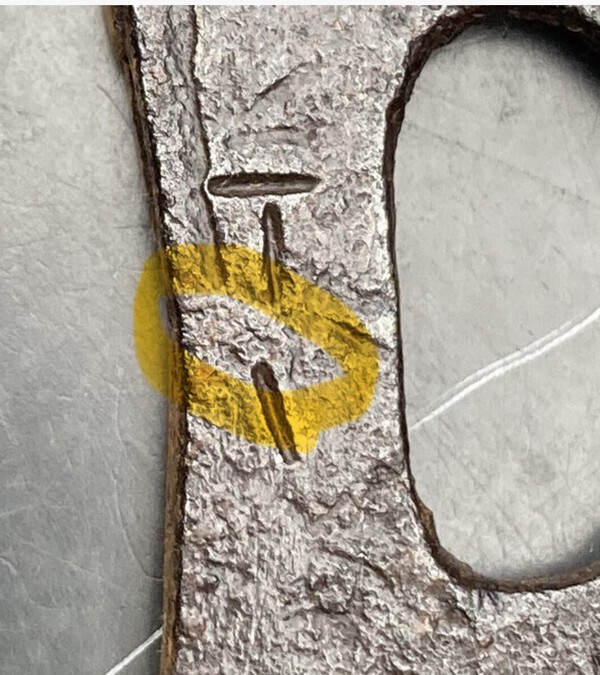
-
Translation assistance for short mei on Tsuba
Bugyotsuji replied to Kantaro's topic in Translation Assistance
Looking again at that top photo, Paris, I wonder if those hits might have been to help close that spidery crack from the left edge? -
Fuchi-kashira character interpretation?
Bugyotsuji replied to Jonathan Frances's topic in Translation Assistance
Not my forte, but ‘attaining’ possibly? 福成? Fuku nari And this artisan for the Fuchi? Atsu- or Toku- oki??? (See Sasayama Tokuoki)
-
Remains of a 三五桐紋 3/5 paulownia crest mon top right, but heavily filed with rough rasp. Fairly generic tsuba, imho. Can it be narrowed down at all? I wonder…
-
Sadly Curran, that exhibition ended in April. It's Akabane blades now, till 13 July.
-
Not Kanezane, not Kanemichi - Who?
Bugyotsuji replied to Bruce Pennington's topic in Translation Assistance
兼直 Kanenao 作 saku, but quickly and for that period somewhat fashionably cut. -
Translation Assistance Tsuba mei wanted.
Bugyotsuji replied to Kantaro's topic in Translation Assistance
久 vs 之 Well it could be read Nobuhisa (?) but the Mei is so corrupted. It gives me a stronger vibe of Nobuyuki 信之. -
Translation Assistance Tsuba mei wanted.
Bugyotsuji replied to Kantaro's topic in Translation Assistance
江州住信之 but that last kanji (?)造(?) -
Rōgan Ookami Maru 狼丸? Or 狼九? The second kanji deliberately mixes 丸and 九. (?) There’s a message here that I’m missing Maybe a play on 鬼丸国綱?
- 1 reply
-
- 1
-

-
In case you missed the comments helping you to date it, here is what Ray said: “o-suriage mumei katana (Shinto or earlier”… What does that tell you? = Possibly earlier than c1600~1775(?) (My question is what kind of katana has such a long Nakago?)
-
There is a theory that well-worn (rubbed down) surface elements of kozuka are a precious indication of usage and age. The missing gilt on the exposed chrysanthemum surfaces for example, could actually be a positive, rather than a negative. The word 小柄 kozuka strictly means only the oblong handle itself, but by extension it has come to include the blade when/if one is present. You can build up a collection of blades until you find one or two that fit comfortably into the kozuka you have bought. As to the Mei. What you say about "a kind of homage at best" applies more to those that you commonly find on the blades. The handle/sheath itself when signed will either be the original artist or a fake. Splits in the kozuka occur when a different blade is forced in, or the blade is pushed too far into the handle/sheath. It is said the there should be a visible gap between the end of the blade machi and the edge of the receiving sheath, in order to prevent damage to the most important piece of artwork, the kozuka hilt.
-
Mmmm… very nice! 😊 Congratulations.