Bugyotsuji
-
Posts
14,235 -
Joined
-
Last visited
-
Days Won
271
Content Type
Profiles
Forums
Events
Store
Downloads
Gallery
Everything posted by Bugyotsuji
-
Need some help with this mei on a tanto
Bugyotsuji replied to Flak41's topic in Translation Assistance
Henk-Jan, we have to get our readings correct, regardless of the subject matter! (Although Fabian pretty much had the reading to begin with.) -
Need some help with this mei on a tanto
Bugyotsuji replied to Flak41's topic in Translation Assistance
-
This Week's Edo Period Corner
Bugyotsuji replied to Bugyotsuji's topic in General Nihonto Related Discussion
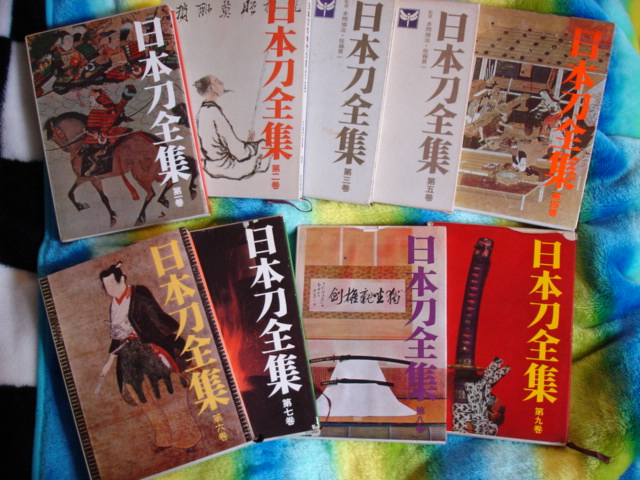
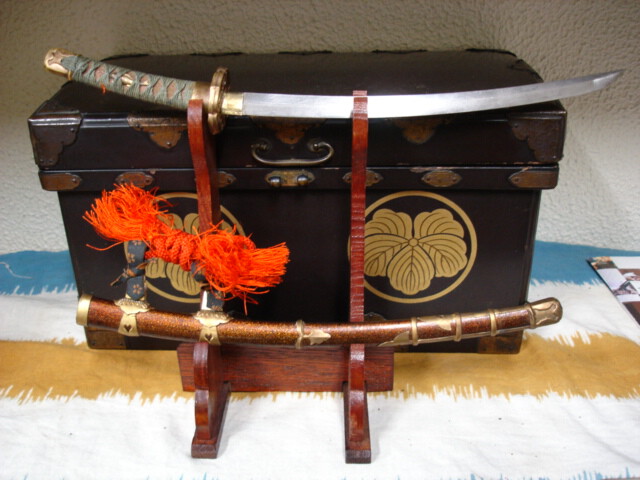
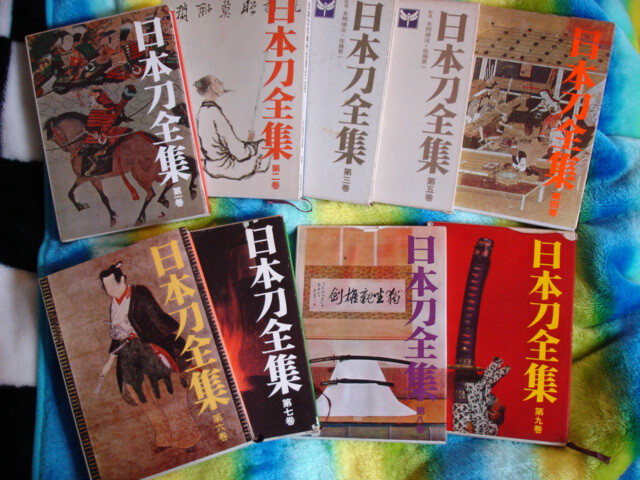
Well, not a lot to report. When Brian was over we went to the antiques fair in Ako, and at one booth spent some time haggling with a huge suntanned chap in a blue tracksuit whose wife kept an eagle eye on him from the tent next door. Brian may have picked up a tsuba there. Anyway I went back and said hello to the guy and bought a toy Tachi that he had in his glass box. He threw in another toy katana as a sweetener for the deal. See piccies. Yesterday I was visiting a 'sword' friend and he said that all beginners would benefit from this series of books on Japanese swords. Nihonto Zenshu, by Honma and Sato. These sets occasionally come up second-hand at auction, and he tries to snap them up for acquaintances, so I bought this lot. to him.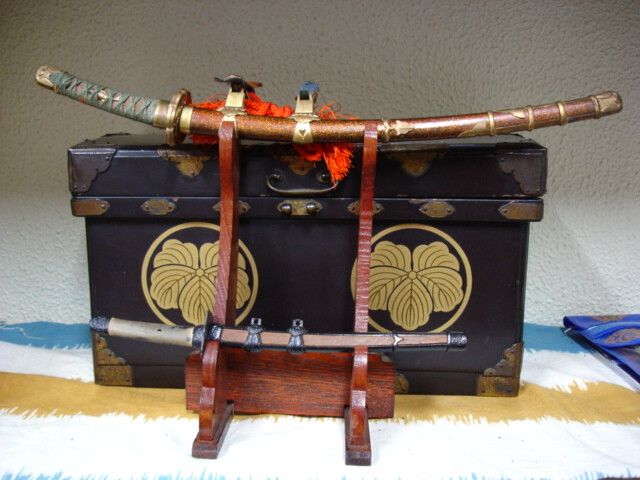
-
Bunka Shirya Certificates
Bugyotsuji replied to Aloof Pegasus's topic in General Nihonto Related Discussion
Bunka... shirya? shiryo? -
No..not copper. Iron usually, but I have seen lead used, and this is the route I would go here. I have a lead-filled mekugi ana on one of my swords. Brian Unclarity rules again. Sorry... "did he say?"... "He" being the bloke who is going to do it. I could have sworn he said 'Do' (copper), but it was in passing, so I'll check on that in due course. Could he have meant Shaku-do, I wonder?
-
Just a quick follow-up on this tanto. The whole Koshirae is typical of Higo, including the iron fuchi and kashira with spiral gold Zougan, and would have been made around the Bakumatsu period. The widened saya jiri is also typical of the period and of Higo. As if to back this up, I was also shown a short very similar Bashin also from Higo, the tsuka of that one elaborately decorated in gold zougan with Kuyo-Mon. As to the Tsuba, it was probably made of black water buffalo horn which perished or was eaten by something. The two Suigyu sections of the Saya presented this suggestion. To have a new one made would be more trouble than it is worth; the stuff stinks and no-one likes to work in it, as with ivory. The blade is typical of work done between the Bakumatsu and before Showa 30, I was told. Probably Taisho, with Yaki. The brown spot was where the blade would have been in contact with a saya internally but could be removed easily with Togi. I have not asked for the Togi. Unfortunately this is exactly the wrong time of year for generating the right kind of rust. For this reason it will take time. March would be better humidity. The Nakago will be tidied up in the way that Brian suggested, ie reshaping, piercing of a new hole and blockage (in copper, did he say?) of the old, application of Yasurime and aging, but it will take not days but months. Please forget you ever read this thread, until maybe April.
-
The Japanese Language Proficiency Test
Bugyotsuji replied to Henry Wilson's topic in General Nihonto Related Discussion
The first one of the two above (iknow) seems to be designed mainly for Japanese people to learn other languages. After years and years of learning Japanese I would say that you need to attack from every angle that presents itself. Linear people can work linearly, but some of us are not so disciplined. Drop anything that doesn't feel right, IMHO. Try and collect stuff that absorbs you. If you need artificial targets to motivate you, go for something like Heny's Japanese Proficiency Test above and take it year after year, level by level. Short sharp bursts of concentrated study beforehand are also good for the pot. In the past I spent some time learning Jukugo (compound words) from a 1,000 word list in a little handbook. Night after night, I would learn 10 at a time before going to sleep, until after about 500 I found that I was starting to be able to read newspapers. There was also an early Kanji electronic dictionary with a word test function that I used over and over until I was getting 100% on the easier tests and could recognize different readings in different Kanji combinations. In the end I was attacking the most difficult level. I now carry a newer electronic dictionary at all times. It gives me so much information at the touch of a button, and whenever I see an interesting Kanji I look it up and read about it, as for example while invigilating a university exam yesterday. (The meanings of the Kanji for Tsuba) Living in Japan helps, but not everyone benefits from the chance. Tokyo positively discourages non-Japanese from learning the language, in my experience. Japanese will want to practice their English on you, and will give you little or no chance to use your Japanese!!! -
Japanese culture
Bugyotsuji replied to John A Stuart's topic in Sword Shows, Events, Community News and Legislation Issues
Just the one night? Unfortunately, not going to be in London then. Amazing what people dream up nowadays! -
With pleasure, Philip. Watch this space!
-
Probably not if I just sell it on as is, Jean, but I want to keep it for a bit, and I know the Shokunin who would do this for me; it would not cost much and would only take a few days. He would make a tsunagi for me at the same time. I might even have a search around for a little iron tsuba for it... some small project to keep me busy these cold winter days! Oh, and I sorted out the natural order of the seppa at last! They look better now...
-
Looks more like fune! 舟
-
Thanks for the thoughts, Brian. Yes, I think I will go down that road. It makes sense and it feels right.
-
Beautiful work over on the right.
-
The guy I got it from suggested I could throw the blade away and get a Tsunagi made instead. It seems a bit of a waste to chuck it. As you 'gentlemen' ( and ladies) were discussing it here I began to feel the faint hope that it might be a long-lost masterpiece.... sniff... 'nuff said. The Habaki tends to get stuck in the Koikuchi; as you withdraw the blade from the saya the Mekugi does not hold the Tsuka, tsuba and seppa tight, possibly because of that double-yoker hole. I may ask an acquaintance to create a proper Mekugi-ana for it. Many thanks everyone for your comments. You have stimulated the synapses enormously! I really am grateful. PS Further random thoughts. In the case of this 'wooden' Tsuba, it looks the part, appearing to all the world like iron. Appearance box, check. It would also play a part, if the part was to stop slippage, as the surface is rough and chunky. It must have taken some time to create. Pehaps the original was lost and it was easier to make a close-looking replacement than to find a metal one exactly right. Or maybe the owner needed to sell the tsuba to make some money? Slip prevention box, check. PPS When things became too bloody, bandages were wrapped around either the hand or the object to increase grip. (I'm thinking spears as well.) PPPS It should be said that the purpose of the tsuba will tend to differ depending on whether the blade is primarily for stabbing or for slashing, I can imagine. My dictionary says that a tsuba is to 'protect' the hand but this must be mainly for katana and wakizashi, to stop an attacking blade travelling down your own blade, for example, whereas with tanto it must be more for grip, aided by a pushing palm heel behind. Interesting to note that there are two distinct Kanji for Tsuba, each meaning slightly different things!
-
Thanks for the feedback. Yes, I have been struggling to match the hamon with something known. Uma no ha is perhaps the closest. Everything becomes quite indistinct towards the kissaki. The boshi looks, jizo? kaeri katai? The ha is Nioideki. I can see some sections of mokume in the hada, and the hamon is kuichigaiba at one point. That's about the limit of my timorous adventure. The best thing is if I take it to the sensei this weekend and ask him (if it does not offend him) to tell me what he sees and to follow his eyes. Might write it down as he talks so that I can go back and ponder... :|
-
Piers, that is an interesting interpreation, but doesn't it go too far? This reminds me of calling bo-hi blood-groves, while they were made to reduce weight, balance the blade, but not with running blood in mind. I think a tsuba is a guard, which keeps your hand from being cut or slide down the blade, and that is all there is to it.... I'm living and listening, & occasionally learning! Thanks. Oh, yes. Another question. I know that tanto were not really produced in the Shinto Period, so we are looking at either a Shinshin-to blade, or something from Muromachi times. My gut feeling inclines me to the latter, older period. How would you lay your money, gentlemen?
-
Added to the function of stopping your hands slipping forwards, must be the function of the tsuba as a lip, to deflect/guide blood to run off before reaching your hands. Mariusz, the total external length is 29cm. The naked blade edge is 13.6 cm from the habaki to blade tip. From Nakago jiri to kissaki tip is 21 cm. The Nakago is tiny, 6 cm up to the new Machi. The Kami, starting under the Habaki is... wait for it... 14.9 cm, LOL. What a coincidence! :lol:
-
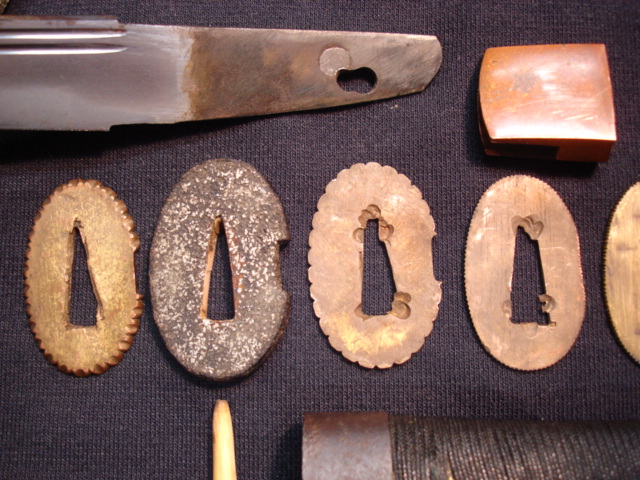
Sorry Brian, promise to stop with these!!! You are welcome to crop them as I don't know how! (The picture function is working for me today! ) Nakago up close both sides. Notice Munemachi and Hamachi movement.


-
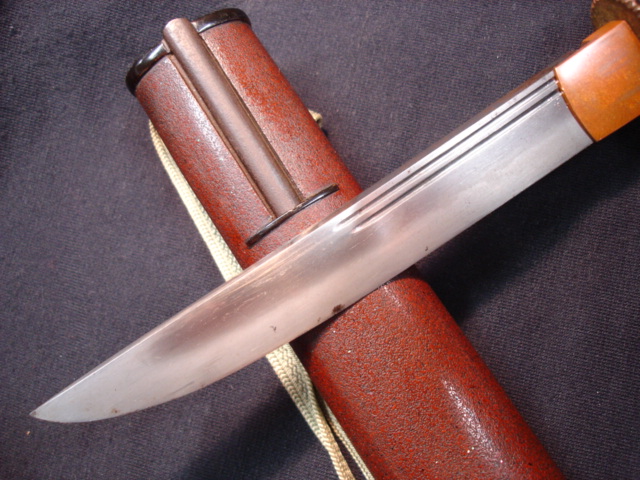
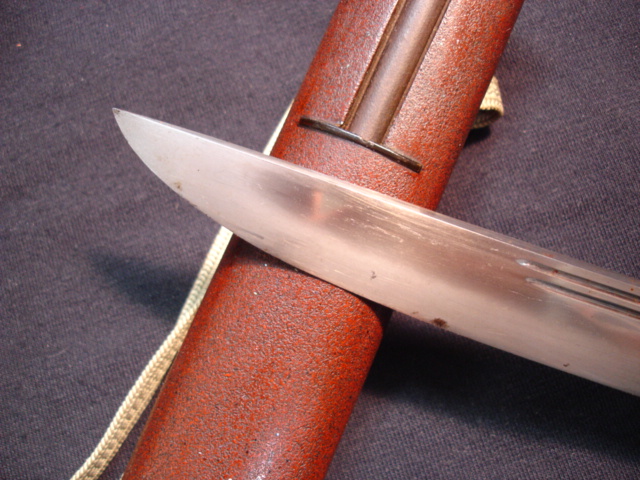
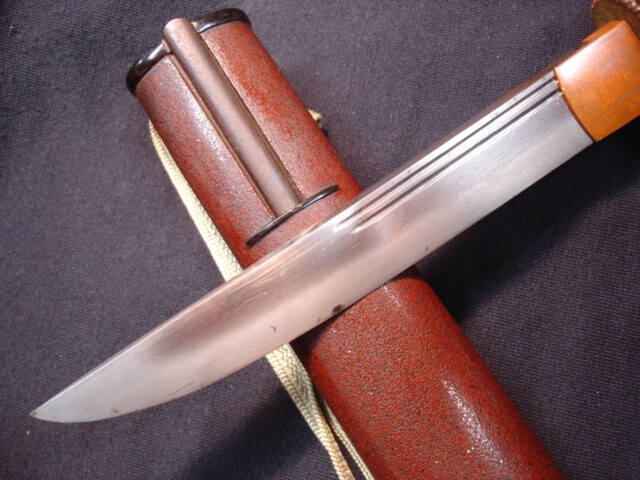
Overall shots of the blade, and some closer inspection




-
General overall shots of the koshirae, showing the little solid iron Bashin.


-
Thanks for that, Mariusz. What you say fits in quite neatly with this blade. Here are some shots of the Tsuba, to start with. Notice the chunky iron-looking edge. (Edit, thanks for the comment, John)


-
Bought a tanto in koshirae the other day for a song, mainly as a study piece. Cursory examination shows it to be a collection of both good and bad, but I would be grateful for anything you notice about it. The blade has a single Koshi-bi Hi on one side and narrower parallel Futasuji-bi on the other. Pics to follow when I get a minute. Preliminary questions. 1. The little tsuba, so small that you'd think the tanto was Aikuchi, seems to be made of wood, black and speckled with something? It is sandwiched between a collection of Seppa, not doing their job very well. Were/are wooden tsuba common? 2. There is little evidence of rust on the Nakago, despite the blade looking old to my untrained eye. Is it possible for an old blade to have a young-looking Nakago? 3. The machi has been moved up, (with a grinder?) in order to...? get the tanto blade legally under 15 cm and therefore not needing Toroku, perhaps? Is this common? Evidence of three holes having been made in the Nakago. I know that much Suri-age took place to fall in line with Edo etc. edicts, but here we may have a different example of a blade being altered in modern times in order to come back within the contemporary laws. In a rush!
-
Art in the Edo Period
Bugyotsuji replied to John A Stuart's topic in General Nihonto Related Discussion
Great site, John. Thanks for the link. -
can you help with transalation information please
Bugyotsuji replied to gumanthon's topic in Translation Assistance
There is a 'Translation' section here, John! -
Correct. http://www.amazon.co.jp/%E6%97%A5%E6%9C ... 369&sr=1-2