Jussi Ekholm
-
Posts
2,251 -
Joined
-
Last visited
-
Days Won
44
Content Type
Profiles
Forums
Events
Store
Downloads
Gallery
Everything posted by Jussi Ekholm
-
@Rayhan I know I used to be very fixated on terminology but as years have passed, I have become extremely relaxed on terminology. The polearm by Kunimichi has actually incredibly rare term (長刀) nagatō on the NBTHK paper. I think I cannot remember another one having that particular term on NBTHK paper. However from my research on surviving examples, I believe this type of polearm was popular during Muromachi spanning into early Edo period. They range from absolutely massive into smaller lengths of c. 60 cm like the Kunimichi example. I think the terms can be somewhat switched based on feeling (I have never seen any clear definitions anywhere), as there are for example some quite similar polearm koshirae at Jūyō some are classified as nagamaki koshirae some as nagatō koshirae. As far as naginata and their shape in general go there is a lot of variation, so I would avoid making any definitive conclusions as Michael suggested above. So far I have data of 124 surviving pre-Mid Muromachi naginata, and 552 naoshi blades presumably all from same period range. In comparison I have data on 154 naginata from Mid Muromachi to early Edo. In order to try to understand the variations in naoshi blades I think it is very important to research the intact original historical naginata examples, and as they are incredibly rare in general that makes it difficult.
-
@Bugyotsuji Was it perhaps this big naginata by Jirōzaemon Katsumitsu & Yosōzaemon Sukesada made in 1522 that you saw. For this I could understand the asking price, it has Date family provenance. I believe this one is privately owned around Okayama area. If it wasn't this one then there is another great item that is still hiding away from my data collection.

-
 With the risk of sounding rude, I think it was very good that you missed the sword Lukrez. This is just my personal opinion but I think that sword is very undesirable in my own collecting view, and I feel Ko-Bizen attribution was the only reason it got so high. I wouldn't have even gone for even near the 1,500,000 yen on it but because it was judged as Ko-Bizen by NBTHK the price got high, that is just how the world goes. As the condition is so compromised I think attributing items gets very tricky. I personally do not have knowledge to judge such items.
 -
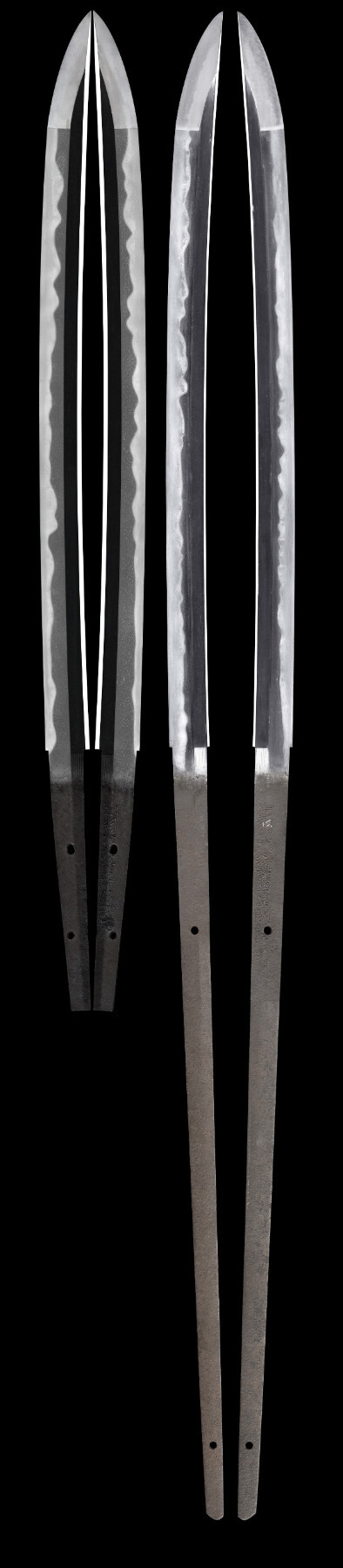
There has been solid advice there above by every member. My love in Japanese swords are ōdachi and big naginata. However even after all the years of focusing on them I still think it can often be very difficult to say how much a sword has been altered. Sometimes it is easy to say that a sword has been shortened or it has been shaved down from the top part. However there are times when I often am left scratching my head when trying to figure out the original shape of the item. The tricky thing is that there are lots of variations in naginata. In order to fully understand the variations and their specific features you will need to devote quite a bit of time into researching naginata. However people in general do not appreciate them, and common reference books do not have info on them, as they are not thought highly of in Japanese sword appreciation circle. Some forms of naginata require quite extreme measures to be cut down to be used as sword (sometimes it might not even be feasible) while some forms require very little adjusting. Here I present 2 items by Dewa Daijō Kunimichi (an excellent smith), both items are Tokubetsu Hozon. Left one has been judged as wakizashi by NBTHK, I think originally it was similar to the polearm on the right. The picture is in scale, I just photoshopped the items side by side for my own fun. Of course I might be wrong in my assumption but I am fairly confident in my belief on this particular piece. I think not many might have seen this type of naginata blade before, as this variation is bit different compared to more common surviving intact naginata.

- 157 replies
-
- 12
-

-

-

-
Just finished reading it and it is amazing Thank you for putting everything together,
-
I have looked at that Ko-Naminohira they have for a long time. I have never dared to ask their price as I knew I couldn't afford it. I think their price is reasonable but I cannot afford it. It is in my opinion very nice sword and the best Ko-Naminohira tachi that is currently available in the open market. Just remembered that here is one available Ko-Naminohira tachi that might fit your criteria (if you can live with mumei): https://toyuukai.jp/products/太刀-無銘-古波平-保存刀剣鑑定書-tachi-no-signature-ko-naminohira-nbthk-hozon-品番-ka068 Now I think I have collected one of the largest private databases in the last 10+ years, currently 14,000+ pre-Middle Muromachi swords. I did some digging to show people how rare the very long old 80-90cm tachi are. I did not include ōdachi into this count, only long tachi that are pre-Muromachi period. In total I found 297 tachi in length range of 80 to 90 cm in my data. However I believe 171 of these are 100% locked in Japan (due to shrine/museum/temple ownage, designation level that keeps them in Japan etc.). I found 126 of them that would be perhaps possible to own outside of Japan, however I would assume large portion of these would also be locked in collections in Japan and around the world, I just haven't confirmed their current location/ownership for majority of them. Of course the total number of them is bit higher than the c.300 I have in my data. However as I have gone through all Nation and Province wide designations, the majority of NBTHK Jūyō, the collections of multiple major sword owning shrines and museums etc. I just cannot think there would be thousands of these hiding away. Some hundreds of quite unknown old long tachi I can understand but they are incredibly rare in overall. Probably crunched the numbers just to give an idea how rare these old long tachi actually are.
-
I can recommend Ray from the bottom of my heart, amazing guy to deal with. I might personally recommend dropping the length criteria to 75cm+. I totally understand wanting an 80cm+ blade as my own collecting attitude is purely based on size and shape, I don't stress about quality or condition that much. However pre-Muromachi 80cm+ tachi are just really tough to find in general. When thy pop up you are most likely required to go for items attributed to schools that are not highly appreciated by sword connoisseurs in general but I personally like them. Here are some examples that I have found to be extremely interesting over the years. Prices will fluctuate. Unfortunately I was not in buying position when these were sold, just note that few of these were sold long long time ago and would most likely priced totally different today. Ko-Naminohira tachi 87,8 cm (this was an amazing sword, I am thinking it could pass Jūyō some day as to me this is historically very interesting sword) > https://www.aoijapan.net/tachi-mumei-ko-naminohira-2/ Hōju tachi 82,5 cm (this has been sold few times in Japan, unfortunately neither was possible for me)> https://sanmei.com/contents/media/O111235_S1300_PUP_E.html Hōju tachi 82,9 cm > https://web.archive.org/web/20200811025600/https://www.samurai-nippon.net/SHOP/N-187.html Aoi Art had this unknown Nanbokuchō Motoshige tachi 87,9 cm for sale two years ago, unfortunately buying it was not possiblte for me > https://web.archive.org/web/20230812005640/https://www.aoijapan.com/tachi-motoshigenbthk-tokubetsu-hozon-token/
-
How accurate is this certificate ?
Jussi Ekholm replied to Bosco's topic in General Nihonto Related Discussion
Unfortunately I don't have time to write a long post. I personally have no reason to doubt the old NBTHK paper. I think it could be very likely that the sword is genuine sword by late Muromachi Buzen Nobukuni. About the tantō signed similarily, it is actually not owned by either of the shrines you mentioned in the post. It is actually Beppu City Bunkazai (City level is the lowest Bunkazai level), it is in private collection and located in Ishigakinishi in Beppu. And it was designated as City Bunkazai in 1972. -
Nice to see you again Rayhan. Unfortunately I am pretty much clueless when it comes to these finer details in sword appreciation. I just like the huge swords that can be appreciated even from far away. I would think like Reinhard that perhaps polishers (or swordsmiths) could offer best insight on this subject. At what stage the utsuri becomes visible in steel?
-
Do you have pictures of the sword? 3,15 to 2,7 cm tells that sword is still very wide at kissaki. The thickness being uniform is bit puzzling I would expect usually some taper in each plane. Also to me 900 grams in koshirae sound very light for blade with such little profile taper. Of course my view might be skewed as I am not a swordsman and I prefer very large swords.
-
How accurate is this certificate ?
Jussi Ekholm replied to Bosco's topic in General Nihonto Related Discussion
I wouldn't necessarily think too negatively about the sword. It is not "THE" Nobukuni lineage but instead quite unknown Buzen Nobukuni. As the signature would be 宇佐住信国 - Usa jū Nobukuni. -
I think Giordy is spot on. The smith 盛国 Morikuni from Bungo province is not listed anywhere that I am aware of (Bungo book, Nihontō Meikan). So most likely unlisted smith or forged signature. There is smith 守国 Morikuni from Bungo province. I believe this is the one that Sho-shin site features. It is often difficult when only romanization of the name is featured without the kanji as there are some times several possibilities. 盛国 Morikuni as a name is most commonly associated to Kongōbyōe smith from Chikuzen province.
-
Nihonto Substack: The Falling Leaf Sadamune
Jussi Ekholm replied to Hoshi's topic in General Nihonto Related Discussion
That is wonderful item and wonderful article. On another note for the discussion about Tametsugu in this thread, there is actually a Tametsugu tachi dated 1357 signed with Echizen - 越前国藤原為継. However I understand different experts in Japan have varying opinions on various swords, so opinions on authencity may vary from who you ask. -
The 癸巳 is year in the 60 year Zodiac cycle. As we had good posts on tsuba age and dates, I think these might be plausible ones. 1593, 1653, 1713, 1773. 十月 would be 10th month. Unfortunately I am pretty much clueless when it comes to tsuba makers so cannot help on actual maker or even school.
-
My condolences to family & friends. He was a good hearted guy and enthusiastic collector.
-
Thank you Piers, that ōdachi koshirae is wonderful. While not maybe on par in craftsmanship with others, to me it takes the cake in historical importance.
-
Muramasa Tanto on Auction
Jussi Ekholm replied to Yumso's topic in Auctions and Online Sales or Sellers
I think most of items in Aoi auctions end without any bids and the items will be in the inventory of their regular site. https://www.aoijapan.com/tantomuramasanbthk-tokubetsu-hozon-token/ -
For me collecting is unfortunately a spectator sport. I cannot really afford the things I would like. I hope the Mikazuki would by a miracle land to Nagoya Tōken World or NBTHK, or other Japanese museum that would display it in public occasionally, if it goes to private collector I think I and most of the public will never see that spectacular sword. To me more reasonable thing to collect would be Tomomitsu - Sadamitsu - Morimitsu - Norimitsu short sword combo. Out of those 4 I would feel the Morimitsu might be the best sword but personally I would have most desire to Tomomitsu as I like the smith. Unfortunately spending 30,000$ just at the opening bid is totally unrealistic for me. Then you need to add the very high Buyers premium that auction houses have (seems like Sothebys has 27%?)... I feel buying swords from auction houses is a rich mans sport. Will be checking the auction and see what happens. I just personally feel all the swords have higher starting price than I would be willing to pay for the item (aside from the 4 above mentioned short swords [However they would still have the buyers premium added to price which at these prices is a lot of money]). As an average guy spectating is pretty much all we can do on auctions like these, I feel level of items is just too high for your average collector.
-
Bart I think Jacques is thinking bit like myself, I am usually very hesitant to state anything, however Jacques has guts to say things straight. I think one thing to consider is that smiths that earned titles are mostly recorded to my understanding. And there isn't Ujishige smith to be found with this title but there is an Ujikumo smith with the title. So I think more research would be needed to judge the authencity. As a collector I am extremely small collector with tiny collection. Maybe that is reason why I keep good care of things. I cannot understand how someone would lose a certificate etc. I would expect in this modern world people would have pictures of the certificates saved on computers and phones, I know I have taken pictures of every one I have ever owned. So it would be very easy to present a picture of the lost certificate. The unfortunate thing is that there are lots of bad things happening in this hobby and I don't want to say anything negative as I do not know who the dealers have been for this sword or how the transactions have been. In general the buyer needs to beware when doing deals. Trust is a difficult thing, it can amount a lot in this hobby but it can be difficult to know who to trust.
-
A friend sent me these magazines so I have been able to complete an awesome set. I guess I will be posting the duplicate magazines for sale in the future. Just need to figure out reasonable batch sizes.
-
Thank you for the follow up Jedediah. It does look like a truely rare blade. Congratulations
-
I was about to write same thing as Jacques above. It is sometimes difficult as the romanization can feature lots of various names. I also think the English translation of Fujishiro possibly has a mistranslation in this case, I believe the smith 鎮盛 is read as Shizumori as swordsmith name. Blade that Lex posted is Shigemori 重盛 - however while I cannot find that particular smith anywhere I think the name is plausible as both 盛 Mori and 重 Shige are very common in Bungo signatures. I have lots of books including the Bungo book & Nihontō Meikan, however this particular Shigemori is not found in either.
-
Ujikumo seems to be very rare smith. Unfortunately I can only find this one from my books fast, this is in the collection of Atsuta Jingū and it is Aichi Prefecture Bunkazai. It was dedicated to Atsuta Jingū in 1608. I believe Owari province is written with 尾張 and it turns as Bishū 尾州. Personally I would be cautious about the signature of the blade in the opening post.

-
Nagato no Kami is a very rare title. I would assume the smith here should have been Owari province smith Ujikumo (氏雲), as he is one of the very few smiths that had this title.
-
Colo(u)rs of lacquered samekawa for tsuka hilt, historical, regional?
Jussi Ekholm replied to Bugyotsuji's topic in Tosogu
I believe the research paper is correct. I am away from my books and while I dont have that many on koshirae I think they have the same information that most pre-Edo koshirae will have black lacquered samekawa, on top of my head I remember that it was stated that it also offered extra protection against elements as it was lacquered. There are few historical koshirae with red lacquered samekawa if I remember correctly. I can check the info from my books in few days time.