Jussi Ekholm
-
Posts
2,204 -
Joined
-
Last visited
-
Days Won
40









About Jussi Ekholm

- Birthday 12/29/1988
Recent Profile Visitors
7,734 profile views


Jussi Ekholm's Achievements






-
Well I admit years ago I used to think that in order for one of the great sword teachers to write a sayagaki the sword would have to be absolutely spectacular. Now with more years under my belt I've understood that is not the correct view as there are blades of varying quality that have their sayagaki. Well of course the top and higher class swords are better represented as they are the swords people most likely would want to show to the teachers. Few years ago I started putting a note if the sword has a sayagaki for my data. However that is just for swords until roughly to mid-Muromachi. So everything that is Middle Muromachi period or later I have skipped, which means a lot of sayagaki that I have seen for example in very good late Muromachi and Edo period swords. Still I am bit surprised the numbers I have even gotten so far, as I think I have just small amount of their sayagaki and they have written so many more (I am just scratching the surface of Kunzans Kantō Hibishō series and I do think the series has 2,500+ swords in total). Tanobe - 481 sayagaki Kunzan - 439 sayagaki Kanzan - 167 sayagaki While there was really not a specific point for the thread I am just curious if for example someone would have asked from Tanobe or if he even knows how many sayagaki he has written, as it must be quite large number. I do think having sayagaki from them would be extremely valuable addon to the sword. Of course that value aspect can also introduce some shenanigans like Rohan said fitting a different sword to the shirasaya, or then faking the sayagaki, and other stuff too like alterations. In Kantō Hibishō Kunzan writes in 1969 for a Tegai Kanenaga tachi that last year he wrote a sayagaki for it and in it mentioned it was saiha but seeing it again someone had erased those letters from sayagaki.
-
I think one bit difficult thing to grasp is that Japanese experts often identify unsigned work towards a specific maker. I am not a huge fan of that but after being in the hobby for so long I have learned to live with it. It gets often very difficult when the smiths are rare to find. Sometimes it is relatively easy to find say 25+ signed items by the smith and do some comparisons etc. I do have massive reference library at home (Although I do focus on old swords) and of course Internet in use too. However in my books I can only find that 1 Jūyō example in few books and then this from online as verified item with quick search: https://ginza.choshuya.co.jp/sale/gj/r6/012/14_yoshikuni.php When it is difficult to find reference items it always makes me wonder how the experts can arrive to the attributions they give. Of course they have seen and handled thousands and thousands of swords and have the expertise. To me it would look attribution to Horikawa school in general would be totally plausible one. Well I think the Japanese experts don't give out such a broad and general attribution, and it will always be much more specific. In this case towards Horikawa Yoshikuni. However I think you got nice and big hirazukuri wakizashi. Please post more pictures when you have time, of the blade and sayagaki too (would be nice to see the date of it).
-
 Welcome to the forum Richard. I think your photography looks very good, however I think for identification purposes I think you would need to post several of your pictures in higher resolution pictures so details can be seen. Many members of forum are very good at identifying fine details in blades and can offer assistance on that. I am not that good at that but my focus is on blade size and shape. Your sword is extremely shallow in curvature, it being 0,8 cm. To me in overall I might go more towards possibly Muromachi period just looking at the shape of the sword. There are few late Kamakura shortened blades that have under 1 cm of curvature remaining but they are very few in number. Posting lot more pictures would be very important for identification and guess the possible origin. There seems to be good looking hada on the middle blade picture for example, and seeing better pictures like that would be great.
 -
Thoughts on a promising blade with soshu-den influence
Jussi Ekholm replied to BjornLundin's topic in Nihonto
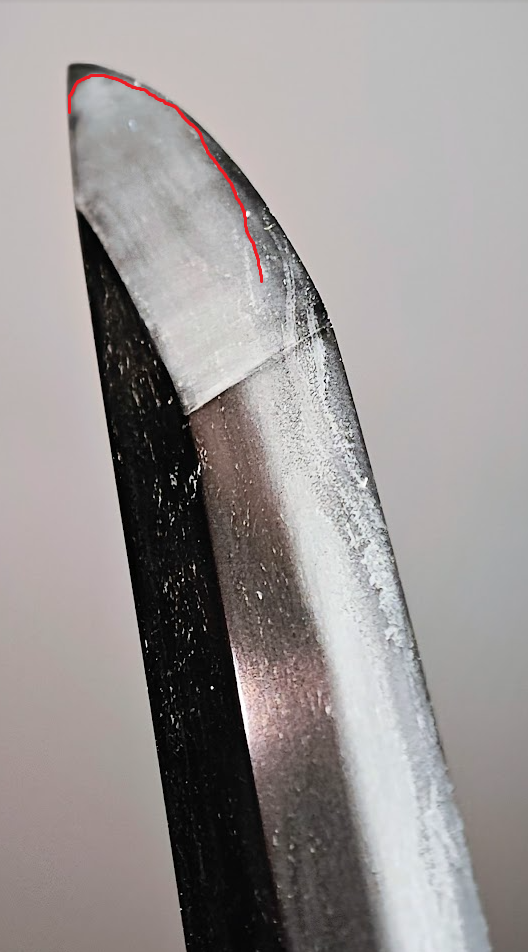
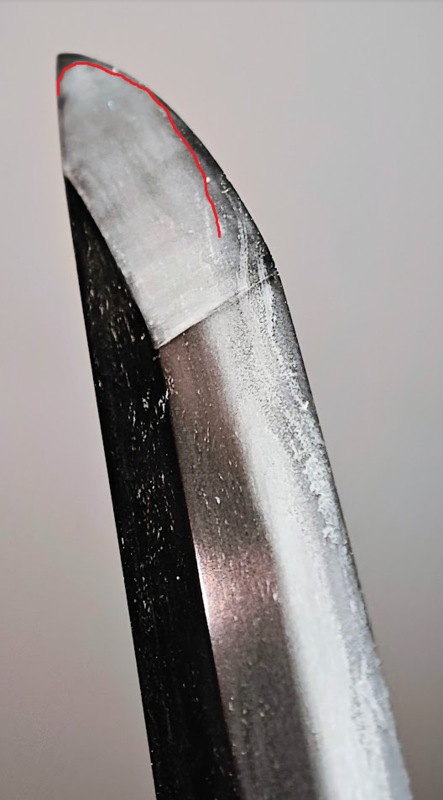
Here is what I would see in two kissaki pictures, I tried to put in a red line to highlight what I am seeing. Not sure that is what actually is happening on the sword but I would see kissaki been repaired and there is a portion where hamon gets very close to edge. Have you measured the sori, motohaba, sakihaba and nakago length? I am not that good on identifying the fine details in blades but I think I can do decently with numerical measurements. It looks to me there are good looking portions of the blade and some portions are looking bit weaker but in overall there seems to be lot of interesting activity on the blade.
-
A little "kantei" game
Jussi Ekholm replied to Laurian's topic in General Nihonto Related Discussion
It is very difficult to say as I am often struggling to understand the fine differences. I would think these both are Yamato style swords and would be from late Kamakura - Nanbokuchō period. For the first sword I would guess Tegai. My reasoning for that is that the 5 mainline Yamato seem to have their own small differences. To me Tegai would seem logical as for Taima I would expect tighter and "finer" jigane. Shikkake I would expect to see bit different hamon activity. Senjuin would have more "rougher" feeling to me personally and for Hoshō there would be so strong masame. For the second sword I would guess Ko-Mihara. This one maybe does have bit tighter hada to my eye, however it does not seem like Taima level quality in overall as it seems bit weaker in presence than the first sword. My explanation of my thoughts might be difficult to grasp as it is difficult to put it in words. So I will go for Ko-Mihara on this. Honestly I could throw the same Tegai guess for this one too. I would not have guessed that either of these swords are Jūyō but if one is then I think it is the 1st sword. -
Congratulations of the purchase. As I wrote in the other thread I think the Kanzan sayagaki can very well be plausible. As a reference here is a sword from Jūyō 21 by this smith. Of course with searching you can find other examples as well. And then see how and why the attribution to this smith might have been made. Or just end up scratching your head like happens to me often

-
I think there are few very skilled artisans in Japan that can fit very high quality blades & koshirae together and it would be very difficult to understand that they were not originally paired. Then there is the second class of joining old koshirae with an old sword and then it is pretty obvious. I think this is done by many dealers in Japan, and I am bit neutral on it. I can well understand this matching as the dealers and some people probably have lots of lower end antique koshirae laying around, and fitting them to blades makes them a package. I recently got a sword that has this kind of refitment done, you can see filled up old hole in tsuka, and feel the tsuka being bit "loose", however as I was only after this bit unique blade size it did not matter to me at all. With these lower end antique koshirae their parts wouldn't really make money selling them off in piece by piece. Sometimes there is a good sword with good koshirae, however they might get split as someone wants just the blade and someone just wants the high quality koshirae I can of course understand that too but it is sad when it happens.
-
Semi hitatsura or a failed yakiire?
Jussi Ekholm replied to Hector's topic in General Nihonto Related Discussion
As Jean mentioned above, I think the hamon execution is deliberate. As you can see the hamon stays low on the first part with horimono, then the second part is the wild one and it remains to more calm impression on the top portion. My first impression for the signature would be gimei. However to me the sword in overall is an interesting one The Tsunahiro lineage continues to this day in Kamakura, few years ago I briefly visited their shop in Kamakura with fellow NMB member. Here is a wonderful article of the smiths from Sōshū den Museum: https://nihonto-museum.com/blog/soshu-tsunahiro -
Well I got an idea for this from another thread that I replied recently. I was mostly wondering if there has ever been mention about how many sayagaki some of the great Japanese sword persons have written, mostly I have Kanzan,Kunzan and Tanobe (maybe Honami in general) in mind. I know many members of this forum have talked lots of things with Tanobe and have sayagaki written by him. I was wondering if someone has ever asked how many sayagaki he has written? I have been trying to keep track of the old swords that have their sayagaki and I have found great numbers of them. However they have of course written sayagaki to swords of all ages and so I have skipped a lot of their sayagaki.
-
I could very well see it as a genuine one. The style, formatting etc. seem to fit, well of course I am totally clueless about calligraphy in general. However in my own research, Kanzan, Kunzan and Tanobe all have written probably thousands of sayagaki so encountering them is somewhat common, especially the higher up you go in quality.
-
Congratulations, that seems like a nice addition to the collection.
-
Thank you, in session 35 I am not sure what item I was missing back then, as I got the book it has bit different numbering that I have adjusted for the current version. It is so much easier with the books as I can always look at the item. For session 61 I had actually skipped a den Unjū blade by accident later on, so big thanks for noticing this. Going just through hundreds of lines of text without any pictures is where I had made most of mistakes. I just have some Jūyō books that are very delayed because of Finnish post waiting inline for customs for 2 weeks now. I think I can do a full updated version of this early next year where I have corrected most of my mistakes.
-
That is very nice comparison. As I am quite clueless when it comes to photography it feels like very large difference by just different type of light. To me both pictures look really good even though the result is different.
-
Help With Mei (two smith sword)
Jussi Ekholm replied to cookiemonstah47's topic in Translation Assistance
I am just on my phone so I cant help that much now but it seems to me that the smiths are 綱広 Tsunahiro & 則広 Norihiro (they use this old style Hiro 廣) -
It is very nice sword. Sometimes it can be tricky what is seen as ubu nakago. NBTHK states also in Jūyō that nakago is ubu. In my understanding if machi is in original position the nakago end can be cut and sword is still seen as ubu. There are few extreme examples of this in naginata, where I believe the nakago is cut for 50cm and it is still seen as ubu. Also sword can still be ubu even though there is machiokuri. In these cases I would assume that nakago needs to be original form other than machiokuri. Otherwise it will just fall under suriage.