Spartancrest
-
Posts
4,059 -
Joined
-
Last visited
-
Days Won
109
Content Type
Profiles
Forums
Events
Store
Downloads
Gallery
Everything posted by Spartancrest
-
but I forgot to show the padded cushion to stop contact between the lid and base tsuba. It makes a good handling sheet as well, all my own work. [You can tell I am no great seamstress!] The fabric was sent to me by my son's fiancé from Japan.

-
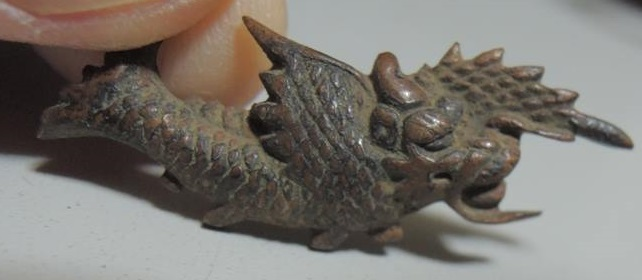
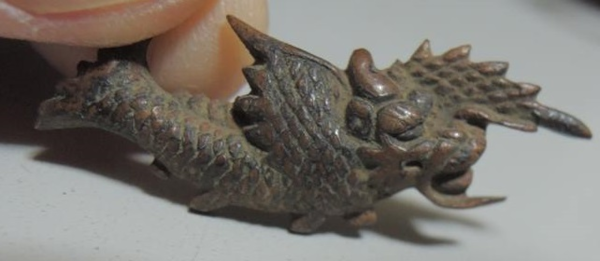
Back to the beginning of Barry's post - Shachi menuki. [or at the least a kata-menuki] https://www.jauce.com/auction/h288259783 It says that it is in Shakudo but from the colour it looks like bronze.
-
 If there is one thing I have yet to work out, it is why some pieces sell for such high prices and another virtually identical will sell for next to nothing. From similar examples selling at the moment you paid a little under the market but it is very subjective. In an open auction two or more people can get carried away but a fixed price sale is a little different - the market will like the price or it will still be for sale years into the future, I can show you examples of over priced pieces sitting in a dealers shop for over ten years! Ebay has a few namban dragons - https://www.ebay.com.au/itm/275198438438 not too far off your price. But in my opinion this one is not as good as yours. These almost identical namban [cast at that!] have a big difference in price, you would be hard pressed to work out why! [especially when they are available from Japan for around $30! https://www.jauce.com/auction/f1036357306 ] But your example is far better than these.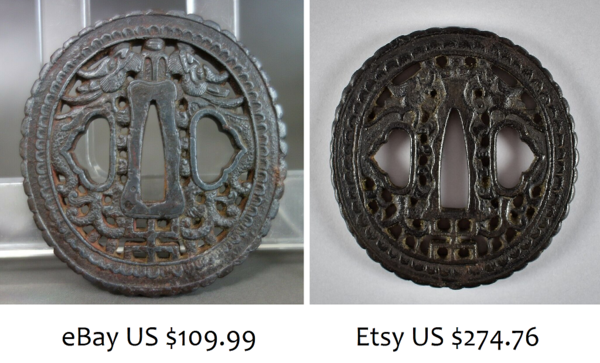
-
Great Pietro it is a handy go-to. I bought a facsimile book version a few years back from India it is not too bad to look through - its one major drawback was the transparency pages with the guard numbers were not printed, so it was very difficult to work out which attribution applied to each picture. The PDF at least has these numbers. The cheapest copy is around $30 [you can than insert the image numbers]- The original book is getting close to $1,000. US. at that price I would be afraid to open the cover. https://www.abebooks.com/servlet/SearchResults?isbn=&an=joly henri&tn=Japanese sword-mounts collection hawkshaw&n=100121501&cm_sp=mbc-_-ats-_-new
-
Well Brian for $100 - you got a great piece! Anything really worth while these days are much more expensive - I keep saying even Chinese fakes are more expensive than that. I see it had been fitted at one time with sekigane, now gone, so to my mind it says it has been mounted at least twice - might help explain the heavy tagane both sides.
-
Well I think you got a bargain! Undercutting of the tendrils, scales of the dragon are very fine. It does look late and Japanese - the design has formed the hitsu, they were not cut through later like a lot of namban made in China were. If you look at some of the fakes getting sold you really did well! [I would have liked a bit more focus on the images - they make my eyes water ] I am not sure what the little line on the mimi tells us, is it a casting fault, a later scratch or a slip of the chisel?

-
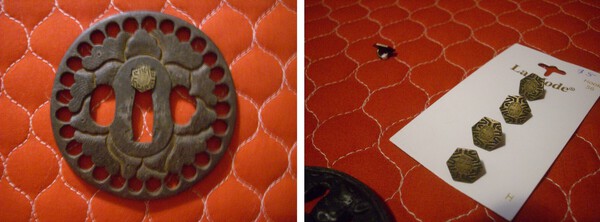
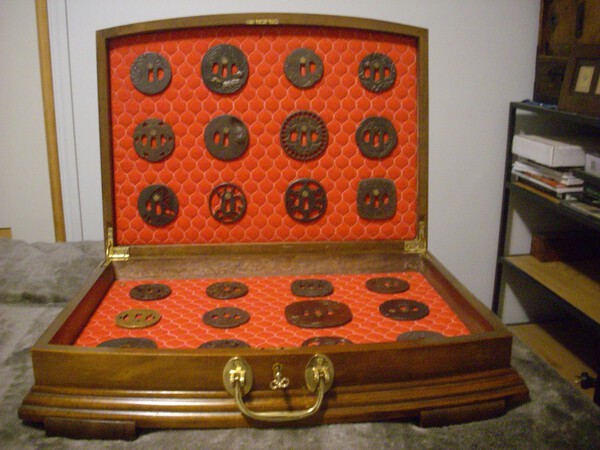
I used soft brass flat buttons and a thick string to secure the buttons to the padded backing board, the buttons pass through the wide base of the nakago-ana then slide up to the top - when the box is moved I have a thick pillow between the lid and base to stop any contact. The guards on the base are mounted so that they hang down when the box is lifted by the handle so basically their own weight holds them in place. I bought a brass handle to match the box fittings so it can be carried like a suitcase. It was a very well made cutlery canteen with torn interior so it was good to give it another use. I don't expect to use it for long term storage it is more for a portable display rather than taking two dozen kiri boxes to a fair or exhibition.
-
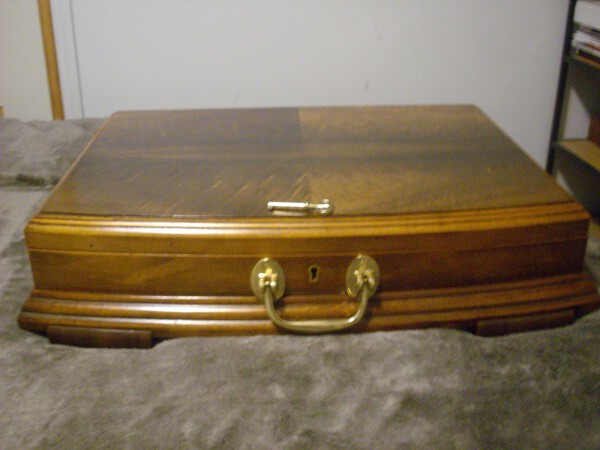
You can always make your own boxes or at least recycle something suitable. I just up-dated an old [1937] cutlery canteen into a display/transport box- I found there is a weight limit to what you can comfortably carry - even 24 iron guards starts to add up the weight [box and guards 7.5 kg / 16.5 lbs]
-
There looks to be at least two types of Tagane-ato possibly three - so this would point to a considerable time span between each adjustment - I have never seen this many different punch tools used and decorative ones at that.

-
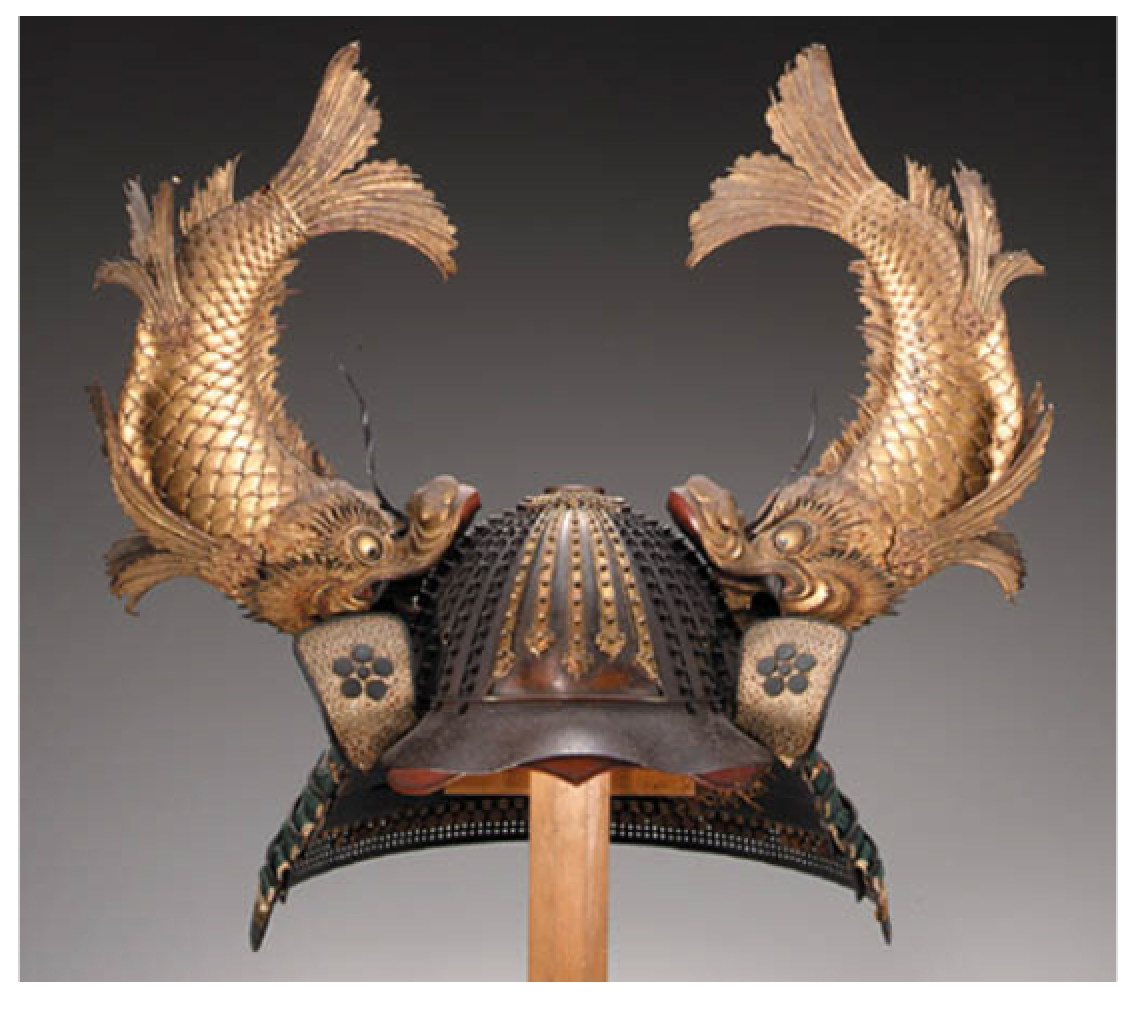
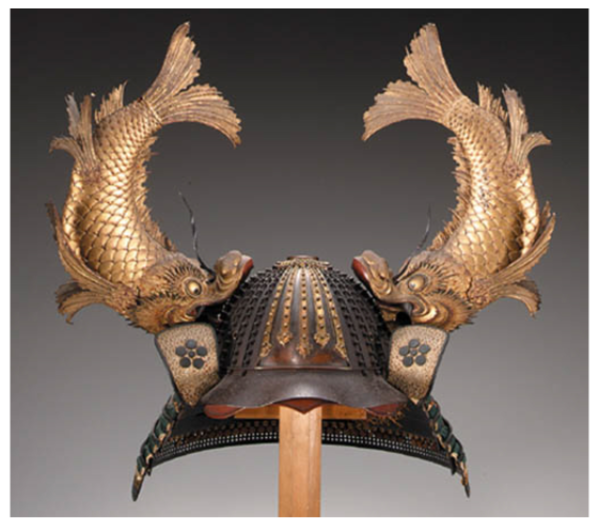
At the beginning of this thread TETSUGENDO posted a great helmet of a single Shachi, well here is a double version from a Christies auction 1998. https://www.christies.com/lot/an-iron-hoshi-bachi-helmet-the-bowl-early-1339209/?intObjectID=1339209&lid=1
-
Piers could your example be Suruga? The Kuchibeni would fit. An example here with scroll sukashi pattern so not too far away from your design. Just a guess.

-
Don't use a metal umbrella in a thunderstorm.
-
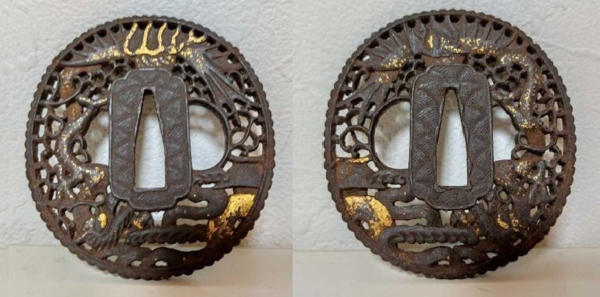
That is very nice of you to say Roger - [here I was thinking I was just being annoying!] I found yet another namban based design. https://www.jauce.com/auction/q1015069655 These critters are starting to add up!
-
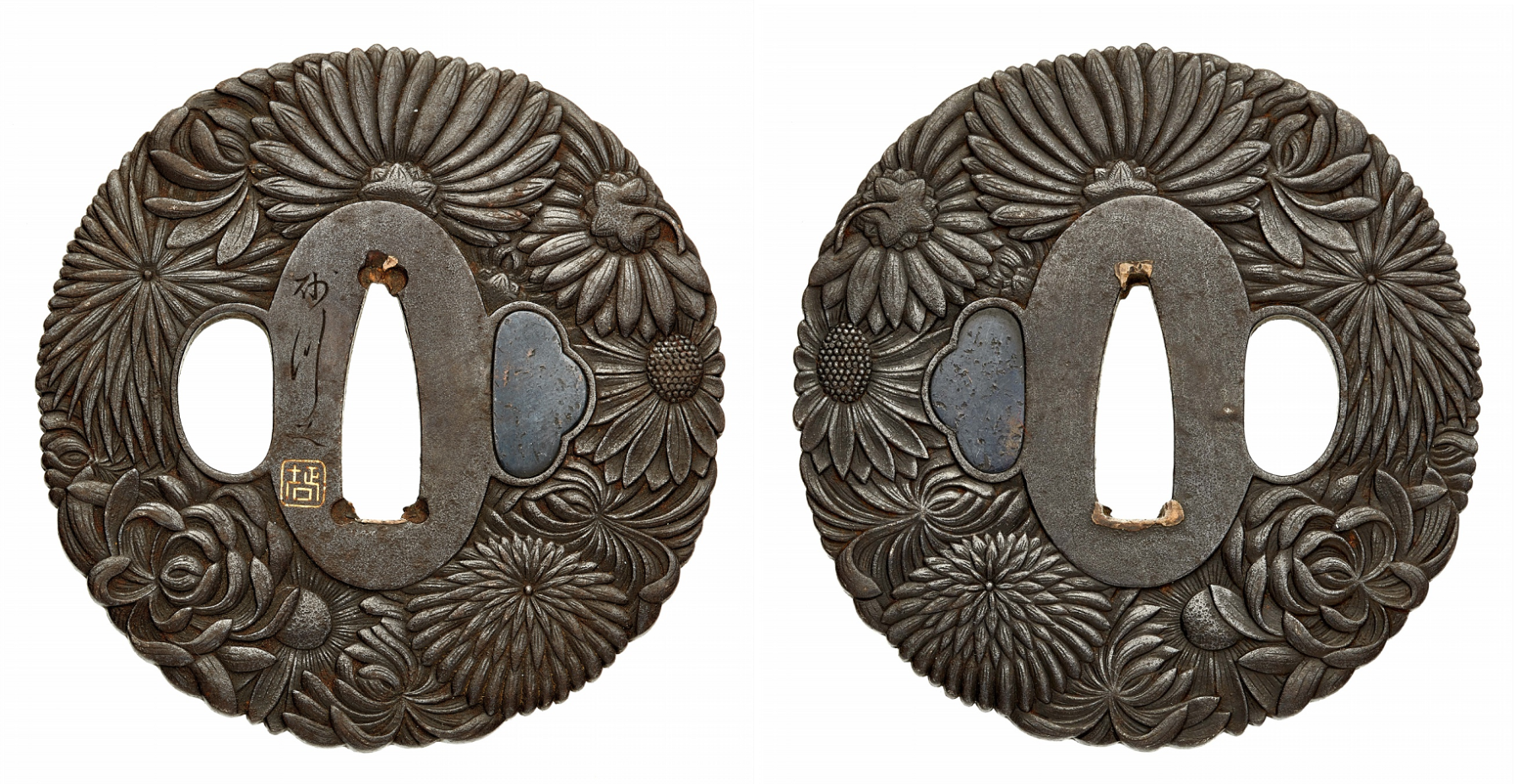
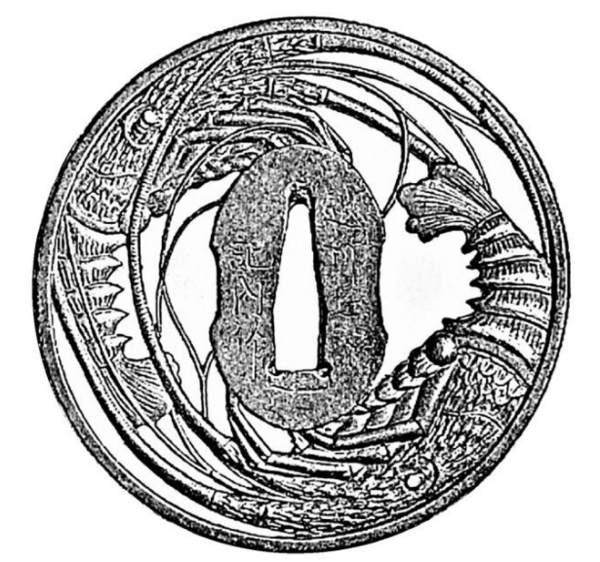
I found some of the early quotes about how the Japanese can make metal appear like molded clay. Japanese ART by Louis Gonse translated from French by M. P. Nickerson. (1891) SWORD MOUNTINGS. ----"I know certain sword-guards of Kinai's, which produce the impression of a work moulded in wax. I know some large lobsters, in open wrought iron, signed by Kinai, which are so life like and natural that one can hardly realize the difficulties overcome by the artist. The great difficulty is not in producing the open work, in the microscopic details of the model, whose fineness astonishes us, but in preserving, in a metal which can be wrought only slowly and by little strokes, the appearance of a sketch freely executed, and in attaining, by patient efforts, freedom and power in the result. One can, in thought, enlarge these lobsters. They are themselves of monumental proportions; but the appearance is so true to life that one sees them, as it were of natural size. It seems as if the artist had modeled them with his thumb in clay."- - The guard referred to is this one - not at all like your Shoami but yours could certainly be thought of as "molded in wax" from its appearance. "THE DECORATION of SWORDS and SWORD FURNITURE" by Edward Gilbertson, M.J.S. [Member of Japan Society] NOVEMBER 14 l894. - - "Not less striking is the way in which the surface has been varied and undulated, the edges shaped and the borders rolled, with their corners turned back, showing nevertheless no trace of the hammer. In some of these tsubas the curves obtained seem almost the result of rolling some soft metal with the hand." -- You might notice "tsubas" which is incorrect - tsuba is used both as singular and plural.
-
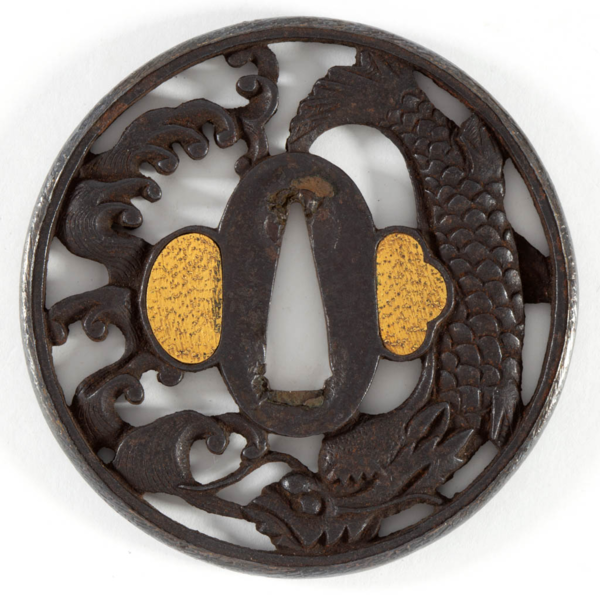
Well here is another guard - seems it sold fairly cheaply back in 2019 Kinai school. [mei looks weak] https://www.jeffreysevans.com/auction/Japanese-edo-period-kinai-school-iron-tsuba/
-
Well Bruno that just goes to show how eBay is the 'Don't Go To' for tsuba - they are charging twice the price you can buy it from Yahoo Japan, Buyee etc. The Buy it now price is $544.43 USD on Jauce not $1,287.13 !! https://www.jauce.com/auction/e1048605936 I firmly believe there is one price for people who buy direct from Japanese auction sites and Gaijin prices on eBay. Brian I think you are absolutely correct. All the bent angle guards can stay upright and not roll around. [not the first 'wave' example unfortunately] Handy if you are out and about without a Kake !
-
I am no expert on Saya but I do like the iron fittings on yours. Do you think the white circles are inlay of shell? I saw a similar effect on a knife handle where they used boar teeth in resin [not something you would expect to see] it turned out spectacular - on a "forged in fire" episode.
-
First guess would be Shoami - "style". Its not signed and a pretty conventional design based I think on Chinese landscape paintings. The ategane in the hitsu points to several mountings and the gold nunome edging lifts its quality a little. Please be aware the images should be the other way up with the narrow part of the nakago-ana pointing upwards [cutting edge] the way they would be seen when mounted. It is interesting you say the way it looks like it was molded in clay - that sentiment was held by many early European writers back in the 19th century and the skill of the tsuba maker is still inspiring that thought even today.
-
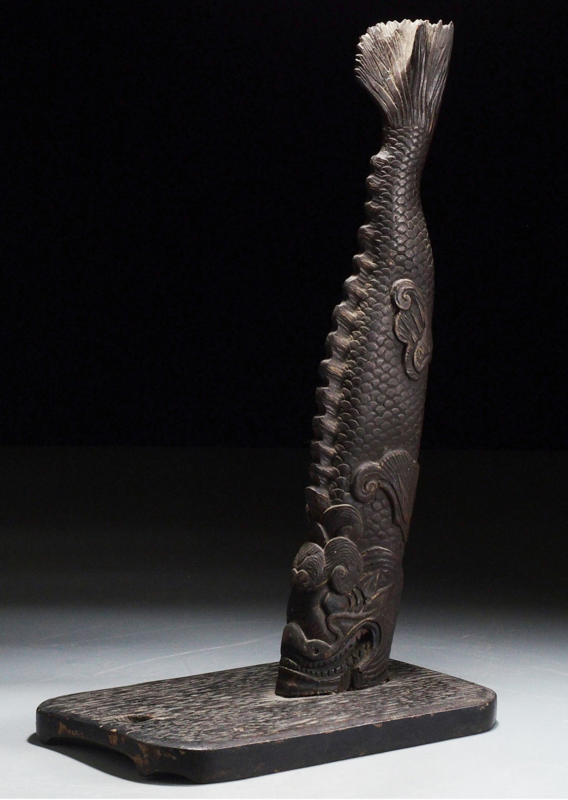
Well if you have the right koshirae - this is the Shachi tachi kake you need. https://www.jauce.com/auction/f1048239985
-
This seller has a variety of cheap boxes, you could do a bulk deal and save money even if you throw the inserts away. https://www.ebay.com.au/sch/i.html?_ssn=yumi3go55&store_name=mugendojapan&_dmd=2&_oac=1&_trksid=p2047675.m3561.l2562
-
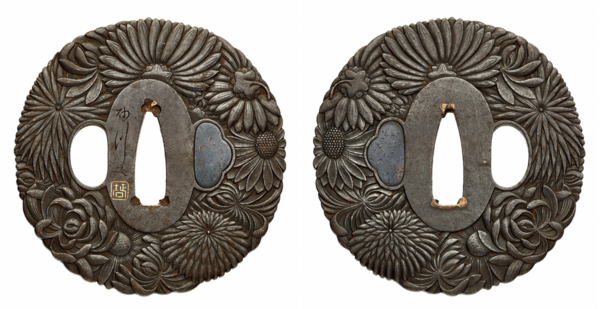
Jean S. I found this auction piece from back in 24.06.2021, https://www.lempertz.com/en/catalogues/lot/1179-1/708-an-iron-tsuba-edo-period-early-19th-century.html it has several elements close to your piece.
-
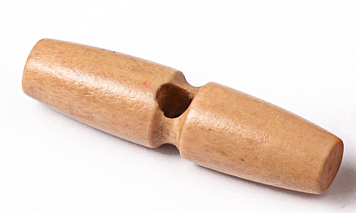
Geraint, thanks yes I am looking for less obstructive means of holding the tsuba on, a nice small toggle with a loop would work. [as long as I don't loose the toggle.] Something like this with a groove in it might work - just need it to be as small as possible.
-
Thomas which CHURCH catalogue do you refer to? I take it you mean A. H. Church but which particular publication?
-
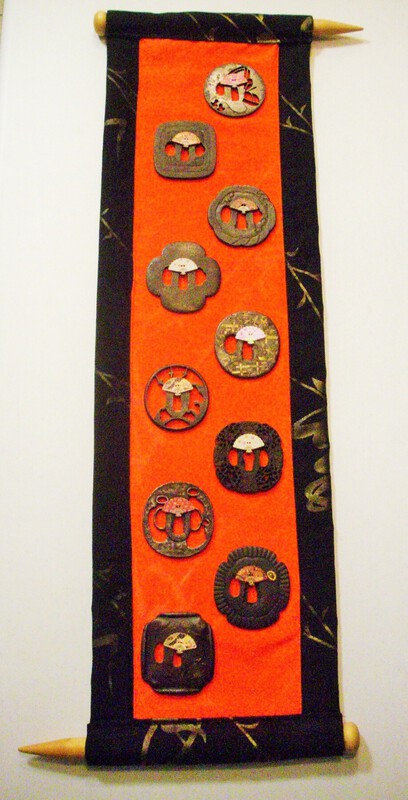
Taking a suggestion from Dan Derooy [well his wife really] I 'repurposed' an old Obi as a hanging scroll to display tsuba. The problem being how to attach tsuba to a fabric background without causing damage to the tsuba or puckering the fabric. Solution buttons. By using buttons that fit through the nakago-ana with enough thread to allow removal and a size that can retain the top of the nakago-ana it worked out fine. I had some Japanese fan buttons, flat and thin that served the purpose, but ideally a smaller button or toggle would work even better. My particular Obi was black with gold highlights which is not ideal for black tsuba display as they tend to disappear in the background but the lining was red so I folded and stitched the black over as a frame. I used oversized wooden knitting needles as rods, top and bottom, but these will be replaced with suitable dowels latter - it is a prototype and a work in progress. So if you need to display your guards in a different way give it a try.
-
A kagamishi guard here very much like yours - This one has wasps, some of which are hard to make out. https://tsubakansho.com/tag/cast/ You may be on the right track with squirrels but that hole in the middle is odd. The animal(?) may even be related to this thread.