Bruce Pennington
-
Posts
13,877 -
Joined
-
Last visited
-
Days Won
169
Content Type
Profiles
Forums
Events
Store
Downloads
Gallery
Everything posted by Bruce Pennington
-

Type 98 (I believe) - What to do with condition?
Bruce Pennington replied to centurion8's topic in Military Swords of Japan
Hi Craig! Start by reading this page on care and cleaning: Sword Care and Cleaning - Japaneseswordindex.com Here is a video demonstrating the technique mentioned by Leen: How to remove Sword Tsuka It is hard to see if the original paint is still there on your saya (scabbard). If it is, I would just use a rag and oil to clean it and stop the rust. For the brass & copper fittings, it is hard to remove the copper oxidation without removing the original paint/coloration. You might just try the rag/oil method and see how much comes off. I've made the mistake of using products like Brasso before. It will remove everything else, too! Some other guys might have some better tips. -
That's a great one, thanks for posting it!
-
Fun With My Late War Nco Gunto
Bruce Pennington replied to Bruce Pennington's topic in Military Swords of Japan
You can try posting in the "Wanted to Buy" forum. Also, Don Schlickman makes perfect replica parts, including screws. Pm me, if you want his number. -
Peter, Nice Type 98, maybe 94? John would know. If you already have removed the bamboo peg, mekugi, and still cannot move the tsuka (handle), it is just being held on by age, grime, rust, or a tight fit. I get mine off, when like that, by wrapping a work cloth tightly around the blade, so I can grip it, and tap the tsuba (handguard) lightly on alternating sides with a rubber mallet. Some use a wooden block. You won't damage anything. It's always nice to see who made the blade. It adds a lot to your appreciation of the sword, and sometimes, you may get a surprise by finding out it is something special. Give it a try, you won't hurt anything.
-
Nlf Gunto Discussion
Bruce Pennington replied to Bruce Pennington's topic in Military Swords of Japan
After our recent discovery that the circled-anchor stamp is most likely a Navy acceptance stamp, not specific to Toyokawa Naval Arsenal, it is still a mystery as to why all these souvenirs were stamped. I have 100 charted now, and only 4 are not stamped. Options: 1. The massive majority of blades used by Tenshozan for the souvenir were surplus from the war. If so, did the Navy inspector actually inspect/approve of blades that had not been finished? The nakago jiri on most of them were unfinished. I suppose this is possible, considering the loosening of quality requirements in the last year of the war. 2. There was a living Navy inspector working with Tenshozan after the war, stamping blades. 3. Tenshozan had the stamp and used it for the Wow effect on the souvenir blades as they made them. We may never know. -
Translation of a WW2 bringback
Bruce Pennington replied to riverdive's topic in Translation Assistance
It might match numbers on the metal fittings. Are there numbers on the tsuba, seppa, or other parts? -
habaki serial numbers - parade kuy / kai gunto
Bruce Pennington replied to Suci's topic in Military Swords of Japan
Not as a general rule. I cannot recall seeing something like that, but I don't study the Type 8/19s, nor the kyu in-depth. Maybe one of the other guys that studies them can say with more experienced background. -
Good one, John! In my search to verify Nick Komiya's claim that the tassel was invented and designated for the Gunzoku, in 1942, the chart seems to support it. This 1935 date would counter the claim, but I have 3 other gunto with older blades (one 1940; a 1918; and a 1920) that had the brown tassel. This one might have been originally bought by a Gunzoku with a brown/blue tassel and then switched over to the all brown after they were designated in the Uniform Regulation change.
-
Only 2 of the other 8 showed the hamon. Each was quite exotic, and different from the next one.
-
The re-worked tsuba would go along with this idea, too. I haven't seen a hamon that changes for fancy to suguha before, but I don't study that stuff. Quite unusual! I have 8 other Masafusa with one or both stamps, but an interesting one has the exact same mei, but just the registrations stamp, posted by @David McDonald back in 2013:
-
It has been proposed that the kobuse method used tamahagane, and blades stamped as such are gendaito. No proof either way, though. Have to examine the blade for evidence.
-
Need help to find info about my dads sword
Bruce Pennington replied to Kramer's topic in Translation Assistance
The handle and nakago (tang) look short. How long is the cutting edge? Tanto are under 12" Wakizashi (shorter sword) - 24" - 12" Daito ( katana, uchi-katana, tachi, no-dachi ) - over 24" Helpful info on this site: http://japaneseswordindex.com/measure.htm -
Hi Ken! You'll find more guys that can speak to sword era for you over at the NMB Nihonto Forum.
-
Attention Mantetsu Owners: A Survey
Bruce Pennington replied to Bruce Pennington's topic in Military Swords of Japan
Sad to see that! Is it actually up for sale, or are they still finishing it? -
Fun With My Late War Nco Gunto
Bruce Pennington replied to Bruce Pennington's topic in Military Swords of Japan
Check this out: Clause 2 discussion. Short version: "Nick Komiya in his Rinji Seishiki to Daiyou Seishiki Weapons Specs thread has uncovered specific documents detailing the conversion of this Clause 2 stamp to mean "Article 2 of this regulation defined Daiyo-Seishiki-Heiki as “weapons in specifications employing substitute materials in its component(s) or redesigned to conserve materials" or more succinctly "Substitute-Spec Weapons". Late war mil spec changes allowed non-standard materials and non-standard production in many weapons, including swords. The circled 2 originally would indicate the weapon could not be used for combat and should only be used in training. But the late-war reg change also changed the use of the stamp.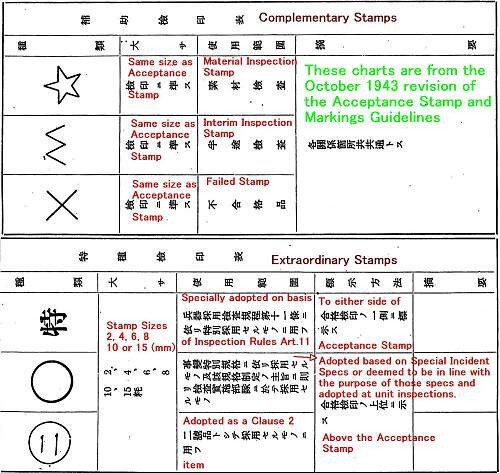
-
Emergency Late War Officer Gunto
Bruce Pennington replied to Bruce Pennington's topic in Military Swords of Japan
Thanks, Seth! No numbers or stamps on the blade, either under the habaki or just outside of it? I ask because I have 2 on file with similar shaped tsuba, and they have a kanji + numbers just outside the habaki. How about a full length shot? -
Fun With My Late War Nco Gunto
Bruce Pennington replied to Bruce Pennington's topic in Military Swords of Japan
Hi Seth! Those are tough ones, as they are likely not fully/cleanly struck. I suspect the one by the numbers and the top one on the nakago mune is the Clause 2 stamp, but it is much smaller than any I've seen before: On the mune, I'd say the Class 2 and below it, a very partially struck Seki stamp. Pardn my poor photo-shopping: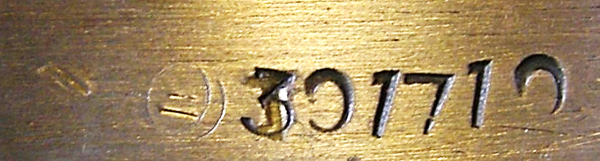

-
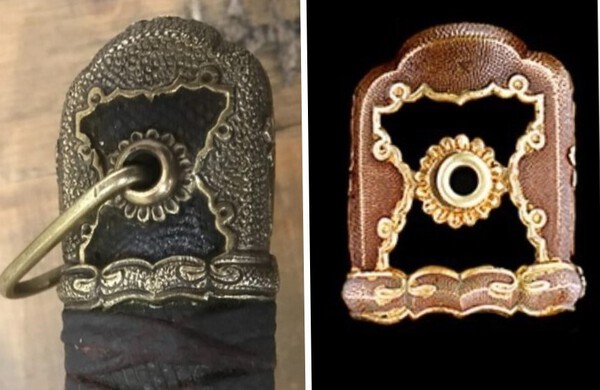
Mikko, You can clearly see the quality difference in the first photo. The saya parts (don't know about the actual saya) are copies. I have others on in my Fakes file similar, even with the bare saya:
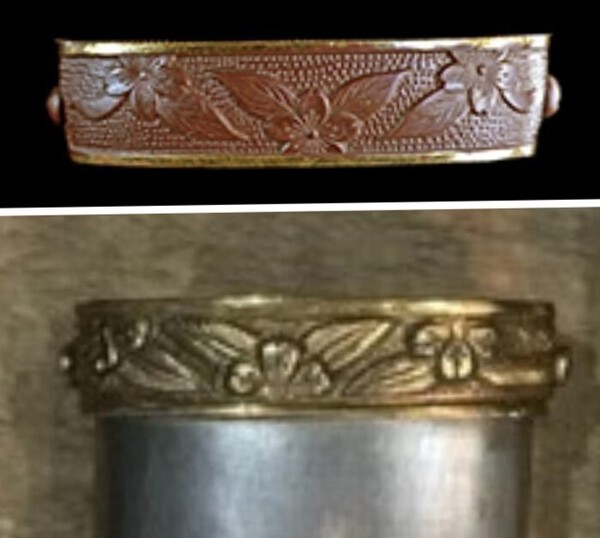
-
Thanks Steve! I'll just note that on the file.
-
So, the cut tester was Kanjuro, but we don't have a date? Sorry for the rookie questions, but in this, I really am a rookie!
-
We've seen the Heijo stamp on a blades.
-
That's cool, John! It's the I Ro Ha series, same thing used by SMR for the Mantetsu serial numbers. Nice to see other manufacturers using it, too.
-
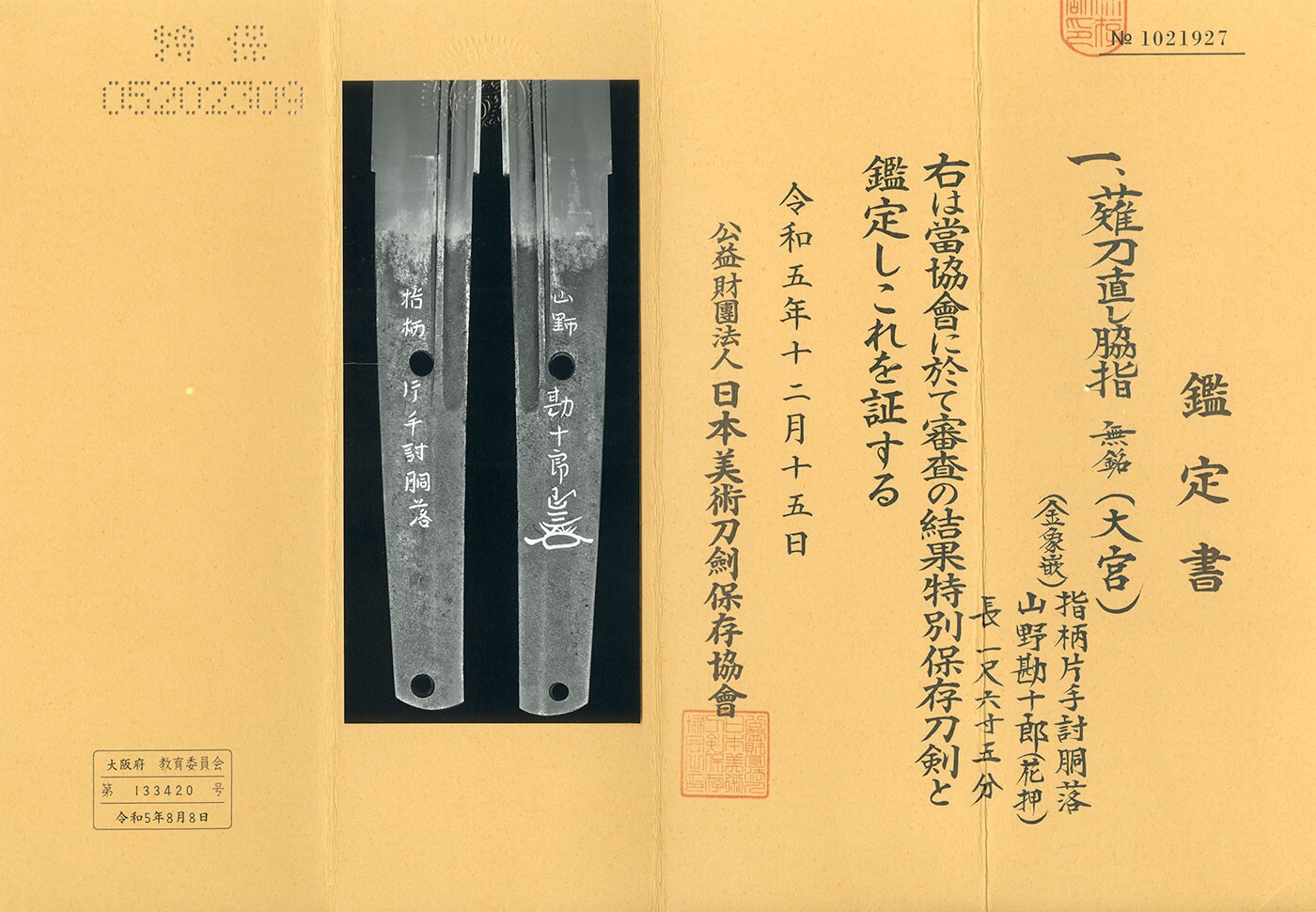
@SteveM Aoi Art says the cutter was Yamano Kanjuro, tested early Spring 1934 Do you concur with the name? I ask because his kakihan (kao) is identical to a cutter in the 1600's by the name of Nagahisa: Kanjuro Nagahisa


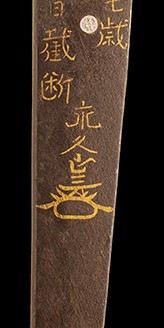
-
katana Kurihara Akihide Katana in Shingunto Koshirae
Bruce Pennington replied to Sutraken's topic in Sold Archive
That's quite beautiful, Stefan. Nice custom fittings as well. Good luck with the sale. -
I've had a couple swords come in tubes, with no dents or bends. But almost ever 4 sided, even 3 sided boxes have had dents and bends. Thankfully, no damage to the swords. I like the tubes!