Nobody
-
Posts
4,048 -
Joined
-
Last visited
-
Days Won
65
Content Type
Profiles
Forums
Events
Store
Downloads
Gallery
Everything posted by Nobody
-
Hi, The mei reads Ishihara Yoshisada (石原義定). He seems to be one of WWII smiths in Seki. FYI; from the site of Dr. Rich S. http://home.earthlink.net/~ttstein/seki.htm http://home.earthlink.net/~ttstein/yoshsad2.jpg
-
The mei is Nara Toshimitsu.
-
Need help with translation...
Nobody replied to S.Haugtredet's topic in General Nihonto Related Discussion
Although the phrase consists of kanji, the phrase is not Japanese language or at least modern Japanese. It might be a part of Chinese classics or Japanese classics using Chinese style. Anyway I am unsure about the meaning. Yesterday, I guess the meaning as below. But now, I think it is not the right answer. I really do not know the correct answer. “While making peace, prepare for the war.†Are there any persons who have an education of Chinese?......maybe, Guido, Milt?? -
Hi, You already read the mei! Bishu ju Mano Masayasu kitau kore (尾州住真野正泰鍛之). That means Mano Masayasu residing in Bishu forged this. He seems to be one of showa WWII smith. FYI; from the site of Dr. Rich S. http://home.earthlink.net/~ttstein/tosho.htm http://home.earthlink.net/~ttstein/masayasu.jpg
-
Need help with translation...
Nobody replied to S.Haugtredet's topic in General Nihonto Related Discussion
Hi, Could you tell us any backgrounds of the phrase? I am unsure about what it means, though I know each kanji and I can guess the meaning. -
FYI; Mikawa Manzai (三河万歳) http://www.sk.aitai.ne.jp/~bigbear/mika ... /etop.html
-
Hi, mei; Yoshiharu (義治) date; Showa Mizunoto Hitsuji Haru (昭和癸未春 = spring in 1943)
-
Here it is. Katsutomi (勝肥), Mutsu (陸奥) – Musashi (武蔵), Late Edo period, good craftsman Yatsuji (八辻) clan, Kisaburo (喜三郎; real name), studied under Matsumura Katsunari (松村勝成) in Aidu (会津), then went to Edo and started the business at Koishikawa (小石川) in Edo. Pseudonym; Annyosai (安養斎), resided in Koishikawa Edo (江戸小石川) note; the reading for 勝成 could be Katsushige, Masanari, Masashige, Yoshinari, or others.
-
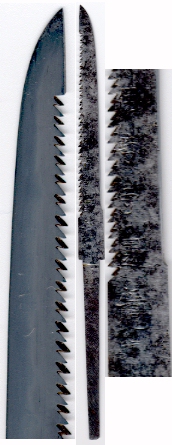
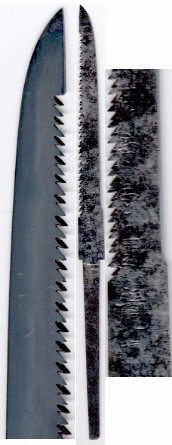
The explanation for the kogatana is loosely as follows; Mei: Ise no kami Kuniteru (伊勢守国輝) mid Edo period, sword smith in Osaka. This kogatana is especially thick at its mune to have serrations. Although the turnover of boshi of ordinary kogatana is generally long, it of this kogatana is short to make it possible to set a saw. According to my books, this Kuniteru seems to be a smith in ca. 1670.
-
I found a site showing kogatana collections. http://www.geocities.jp/ntooma/kogatasya.html The first one which was made by Kuniteru (国輝) has a saw on its mune. It reminds me of a Kaifuto (海部刀) with a saw which was introduced by Guido before.
-
Here it is. This site shows a copy of an article from a newspaper (Nihon Keizai Shinbun-sha). The article was written on the paper from Mar. 11, 2006. Title; Masamune did not exsist? (正宗はいなかった?) http://www.geocities.jp/ntooma/m-masamune0.html http://www.geocities.jp/ntooma/m-masamune1.html http://www.geocities.jp/ntooma/m-masamune2.html http://www.geocities.jp/ntooma/m-masamune3.html Though there might be an English version, I could not find it.
-
Do you accept Japanese articles? I know some.
-
Hi, The mei reads Matsuda Jiro (松田次郎). However, I am afraid that the sword may be fake.
-
Hi, Though I cannot read the 2nd kanji clearly, the mei may be Kanesada (兼定). Also it could be Kanemune (兼宗), I think.
-
Hi, I do not mind by which name I am called. Please do not bother about my name.
-
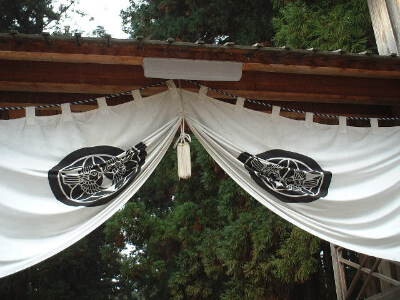
Though I cannot read Sosho (草書) well enough to identify all characters, the mei may be as follows. But I might make mistakes. 依相羽君命三所物 Mitokoromono ordered by Mr. Aiba (相羽). 彫之ハ辻 x x + kao Who carved this is Tsuji x x. "Tsuji x x" seems to be the maker's name. But I could not read the key charactes. Does anyone find the name from that info? p.s. FYI, a photo of Jinmaku (陣幕) is attached.
-
Though this tanto is not for sale, it was owned by Toyotomi Hideyoshi (豊臣秀吉). Its mei is Chiku shu ju Sa (筑州住 左). It was made in circa 1330. http://www.nona.dti.ne.jp/~sword/katana/1samonji.htm
-
Hi Curran, As I am a beginner, I have only a few swords. I like Bizen tradition most, but I am not so particular about sword traditions. I like the shape of swords rather than hada or hamon. And I also like to feel the hundreds of years of history behind old swords.
-
The pronounciation of 日向 is not Hyaga but Hyuga.
-
It is not mentioned in the explanation.
-
Hi, Their Japanese name is Nagashi (流し).
-
By guesswork, the gold mei could be; ? gyoku Hoin + Kao (? 玉法印 + Kao). Hoin means a priest or a title of a person of culture.
-
Hi Curran, My interest is almost in blades and I know nothing about kodogu. I can only read mei sometimes.
-
Hi, The mei may be Naonori (直徳). But I am unsure about the correct reading, because those kanji have many other readings for one's name.
-
Hi, There is a picture of a samurai shouldering an O-Dachi at battlefield.