Ian B3HR2UH
-
Posts
503 -
Joined
-
Last visited
-
Days Won
5
Content Type
Profiles
Forums
Events
Store
Downloads
Gallery
Everything posted by Ian B3HR2UH
-
Emergency Late War Officer Gunto
Ian B3HR2UH replied to Bruce Pennington's topic in Military Swords of Japan
It's a junker and almost certainly not Japanese Save your money for something decent . -
Thoughts on this Tanto
Ian B3HR2UH replied to Tsubafan's topic in General Nihonto Related Discussion
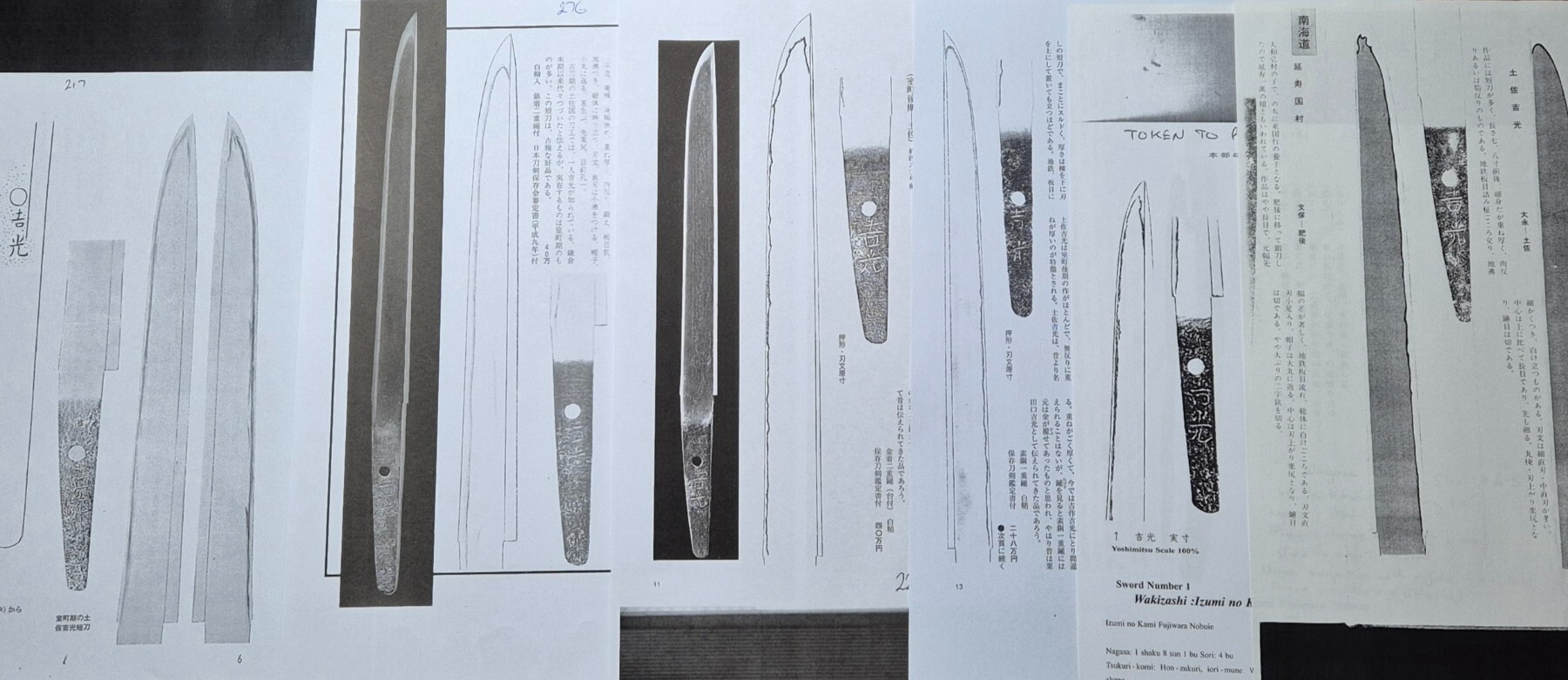
Lewis , there are a lot of smiths named Yoshimitsu . My old blue Hawley lists 38 and there are probably more . Attached is a montage of Tosa Yoshimitsu blades from Japanese publications . None of them have a nakago shape like that on the piece you attached . Personally with this discrepancy and the atypical hamon I have my doubts that the piece you put up is by Tosa Yoshimitsu . Perhaps it is by one of the other thirty odd Yoshimitsu. PS It is a nice piece Louis
-
Thoughts on this Tanto
Ian B3HR2UH replied to Tsubafan's topic in General Nihonto Related Discussion
If it was Tosa Yoshimitsu you would expect it to have a narrow suguha hamon and not be midare -
If it was Goto work you would expect the pieces to have a shakudo nanako front surface . The photos are terrible but the kozuka does not appear to be nanako . If this came out of Japan the seller will not have let genuine Goto pieces slip through his hands
-
I don't recall ever having seen this before and I have owned and handled a lot of kai gunto
-
I think the above tsuba depicts a stylised dragon in the clouds and is nothing to do with stars . What worries me about this theory that these shippo patterns represent stars is that the distances between the so called stars are equidistant whereas in actual constellations these distances vary. I am not saying that tsuba with star constellations on them do not exist . The attached Saotome tsuba is described as depicting the big dipper . Note how the distances and angles between the stars vary ,unlike with the shippo patterns

-
tachi Can someone tell me if this is fake. Thanks
Ian B3HR2UH replied to deldoe's topic in General Nihonto Related Discussion
Highly unlikely -
Identifying 2 WW2 swords with option to buy
Ian B3HR2UH replied to purdo's topic in Fake Japanese Swords
Those pictures confirm it is a fake Mark . The habaki is classic chinese junk and the other mounts are of really low quality. -
Identifying 2 WW2 swords with option to buy
Ian B3HR2UH replied to purdo's topic in Fake Japanese Swords
Hi Mark , everything in the top one looks not quite right, the color of the scabbard ,the quality and placement of the ashi , the color of the binding etc etc . Taking everything together I can only conclude it is a fake . That the other is also a fake reinforces that view . Better and closer photos of the blade, habaki, mounts and nakago would obviously help but I am sure the answer will remain the same . Ian -
Where is the evidence for this wild claim?
-
What is this sword, your thoughts please!
Ian B3HR2UH replied to DJL12345's topic in Military Swords of Japan
I think that at best it is something that the Japanese made in the islands during the war years -
Identifying 2 WW2 swords with option to buy
Ian B3HR2UH replied to purdo's topic in Fake Japanese Swords
So is the top one -
A question about namako, Higo, and Miyamoto Musashi
Ian B3HR2UH replied to OceanoNox's topic in Tosogu
i agree that these so called namako tsuba have nothing to do with sea slugs and are just a design . There is however at least one fitting depicting Namako, a mumei kozuka that I own . This piece is ex the J C Hawkshaw , Henri Vever and Peter Hawkins collections . Perhaps Dale, whose computer data base seems to be enormous ,can tell us if there are any other fittings depicting Namako . I don't recall ever seeing another one. Ian Brooks
-
This is from Bushido Magazine 1981

-
Your initial photos showed the menuki well . To my mind they looked cast and not very crisp but it is hard to tell from photos . Our member Chishiki has some papered gold menuki and if he reads this I hope he will comment
-
And what did you learn ? Hopefully not to mess with the koshirae next time
-
The mounts are exactly what you would expect from something made in the 1860s and not from something made in the 1940s. Let's not drift off into fantasy land though with talk about executioners swords
-
Alex why don't you try and find a showa piece that is straight and 75 cm long ?
-
If it was a showa era piece it wouldn't be that shape nor would it be 75cm long . Barry's opinion is correct .
-
You would need to post a picture showing the full tang and signature to get more information . I am certain that you will be told what others have previously told you namely that the signature is a fake one.
-
It looks unlike any " samurai " saddle that I have seen . They should look like those in Piers's link or the following


-
Why do you think this is a box for a sword rather than a box for something else ?
-
Count Ito Miyoji 1937 Auction
Ian B3HR2UH replied to Takezo's topic in General Nihonto Related Discussion
Attached is the catalogue entry for the Sa Hiroyuki / Kunihiro daisho . Also a couple of others being a ko Aoi Kanetsugu which was a National treasure at the time and also the Meibutsu Hocho Masamune which was Juyo bijutsuhin at the time and is now Kokuho.


-
Here are some Naval officers belts . The top one is a senior officers ( Lt Commander to Captain ) full dress belt for Medical officers . The central one is another full dress belt for senior line officers and the bottom one is the standard service belt .


-
General Yamashita the Gunto collector
Ian B3HR2UH replied to PNSSHOGUN's topic in Military Swords of Japan
I have seen one of these onshi swords in the flesh and a few in photos . The one I handled had a gold foil habaki and the characters were placed centrally on the habaki . My recollection is that those I have seen in photos had the same characteristics although I stand to be corrected on this . The cheap looking habaki and odd placement of the characters on this one raise a red flag for me .