Ian B3HR2UH
-
Posts
505 -
Joined
-
Last visited
-
Days Won
5
.thumb.png.4c5df79fec171b2dc4a23af38e280a4d.png)




Ian B3HR2UH's Achievements






-
I know this is a very long shot but here goes . Henry Charles Clifford 1861 - 1947 was an English painter who collected Netsuke , inro swords and mounts . The collection was auctioned by Glendining and Co on the 15th of December 1947 . Does anyone have a copy of his auction catalogue or know anyone who may have one .Alan Harvie had a copy in his library .
-
- 1
-

-
What a great result , Congratulations
-
Emergency Late War Officer Gunto
Ian B3HR2UH replied to Bruce Pennington's topic in Military Swords of Japan
It's a junker and almost certainly not Japanese Save your money for something decent . -
Thoughts on this Tanto
Ian B3HR2UH replied to Tsubafan's topic in General Nihonto Related Discussion
Lewis , there are a lot of smiths named Yoshimitsu . My old blue Hawley lists 38 and there are probably more . Attached is a montage of Tosa Yoshimitsu blades from Japanese publications . None of them have a nakago shape like that on the piece you attached . Personally with this discrepancy and the atypical hamon I have my doubts that the piece you put up is by Tosa Yoshimitsu . Perhaps it is by one of the other thirty odd Yoshimitsu. PS It is a nice piece Louis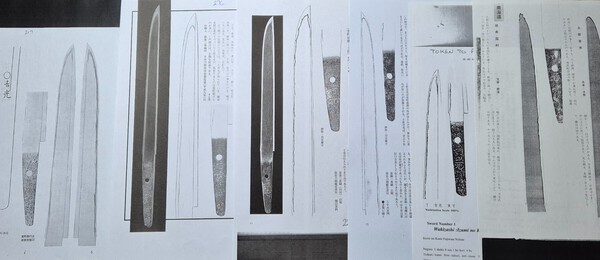
-
Thoughts on this Tanto
Ian B3HR2UH replied to Tsubafan's topic in General Nihonto Related Discussion
If it was Tosa Yoshimitsu you would expect it to have a narrow suguha hamon and not be midare -
If it was Goto work you would expect the pieces to have a shakudo nanako front surface . The photos are terrible but the kozuka does not appear to be nanako . If this came out of Japan the seller will not have let genuine Goto pieces slip through his hands
-
I don't recall ever having seen this before and I have owned and handled a lot of kai gunto
-
I think the above tsuba depicts a stylised dragon in the clouds and is nothing to do with stars . What worries me about this theory that these shippo patterns represent stars is that the distances between the so called stars are equidistant whereas in actual constellations these distances vary. I am not saying that tsuba with star constellations on them do not exist . The attached Saotome tsuba is described as depicting the big dipper . Note how the distances and angles between the stars vary ,unlike with the shippo patterns

-
tachi Can someone tell me if this is fake. Thanks
Ian B3HR2UH replied to deldoe's topic in General Nihonto Related Discussion
Highly unlikely -
Identifying 2 WW2 swords with option to buy
Ian B3HR2UH replied to purdo's topic in Fake Japanese Swords
Those pictures confirm it is a fake Mark . The habaki is classic chinese junk and the other mounts are of really low quality. -
Identifying 2 WW2 swords with option to buy
Ian B3HR2UH replied to purdo's topic in Fake Japanese Swords
Hi Mark , everything in the top one looks not quite right, the color of the scabbard ,the quality and placement of the ashi , the color of the binding etc etc . Taking everything together I can only conclude it is a fake . That the other is also a fake reinforces that view . Better and closer photos of the blade, habaki, mounts and nakago would obviously help but I am sure the answer will remain the same . Ian -
Where is the evidence for this wild claim?
-
What is this sword, your thoughts please!
Ian B3HR2UH replied to DJL12345's topic in Military Swords of Japan
I think that at best it is something that the Japanese made in the islands during the war years -
Identifying 2 WW2 swords with option to buy
Ian B3HR2UH replied to purdo's topic in Fake Japanese Swords
So is the top one -
A question about namako, Higo, and Miyamoto Musashi
Ian B3HR2UH replied to OceanoNox's topic in Tosogu
i agree that these so called namako tsuba have nothing to do with sea slugs and are just a design . There is however at least one fitting depicting Namako, a mumei kozuka that I own . This piece is ex the J C Hawkshaw , Henri Vever and Peter Hawkins collections . Perhaps Dale, whose computer data base seems to be enormous ,can tell us if there are any other fittings depicting Namako . I don't recall ever seeing another one. Ian Brooks