
Leaderboard



Popular Content
Showing content with the highest reputation on 04/09/2025 in all areas
-
Paul Nice sword. Do you have flexibility to travel? Les mentioned the upcoming sword show http://www.chicagoswordshow.com/ The show is in a few weeks. Bob Benson will be there so will many other experts. The NBTHK-AB is having a display/presentation so a number of members will be in attendance. In a weekend you would learn more than you can with pictures/emails etc. Experts could examine your sword and give accurate, specific information. You will also see hundreds of swords so you can compare yours in hand. If you have questions let me know. It is getting close but as of today a few rooms are still available at the Hyatt https://www.hyatt.com/en-US/group-booking/CHIRW/G-TOKE Mark nixe@bright.net3 points
-
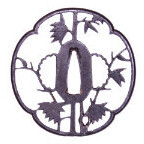
That is great idea and will no doubt be of immense merit to future collectors. As to the taxonomy I was going to try building a reference of known cast or "replica" pieces - the trouble seems to be that examples keep turning up making a comprehensive record next to impossible. For instance I started a record of Utsushi pieces that now makes up a book of 274 pages - and that is based on only about twelve basic designs! I am not talking about 274 examples but at least five times that number of individual pieces. Try the math 12 designs = at least 1,370 copies, times the number of known "common" designs and your guess is as good as mine. I still keep the book "open" adding utsushi when I find them. But it will never truly end. [a friend S.King did warn me!]3 points
-
Brian, for some reason I missed your inspirational answer here. I can 'see' in my mind exactly what you are saying; that will be a really great tip for next time. Although I had booked a slot at my friend's house for this coming Saturday, I actually managed the break-through yesterday morning. The wife was out so I had the house to myself, and I decided this thing was not going to defeat me. Altogether, including previous sessions, the whole effort took about six hours, but using Kure 5-56 spray, a tough wire and various pipe cleaners, from outside through the pan vent entrance, and from inside the barrel (angled sunlight showed the inner end of the channel), I started to get a blacker colour of gunge on the wire tip. It was a question of belief, as I could not be 100% sure that it had not been deliberately deactivated. Gradually I began to be able to 'see' what the tip of the wire was doing (the passageway is only one strand wide), as it scratched endlessly and then slowly began to engage; minuscule changes in the colour of what I was wiping off it became my only source of courage. But what a relief! I was dead pleased yesterday, and this morning the same feeling of relief is still with me. This matchlock (the Inatomi-Ryu long gun I was discussing in the translation section) was no more than an interesting decoration when I bought it, but it is now back to full working order. Lesson learned. Always check everything, including the vent channel; assume nothing.3 points
-
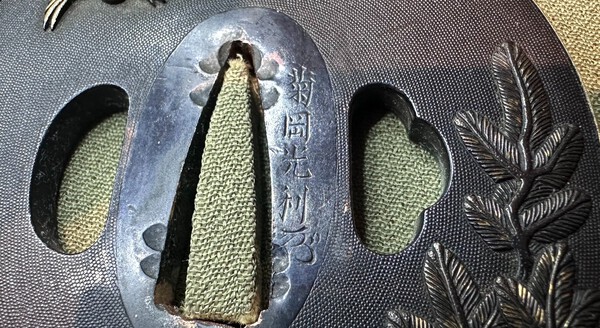
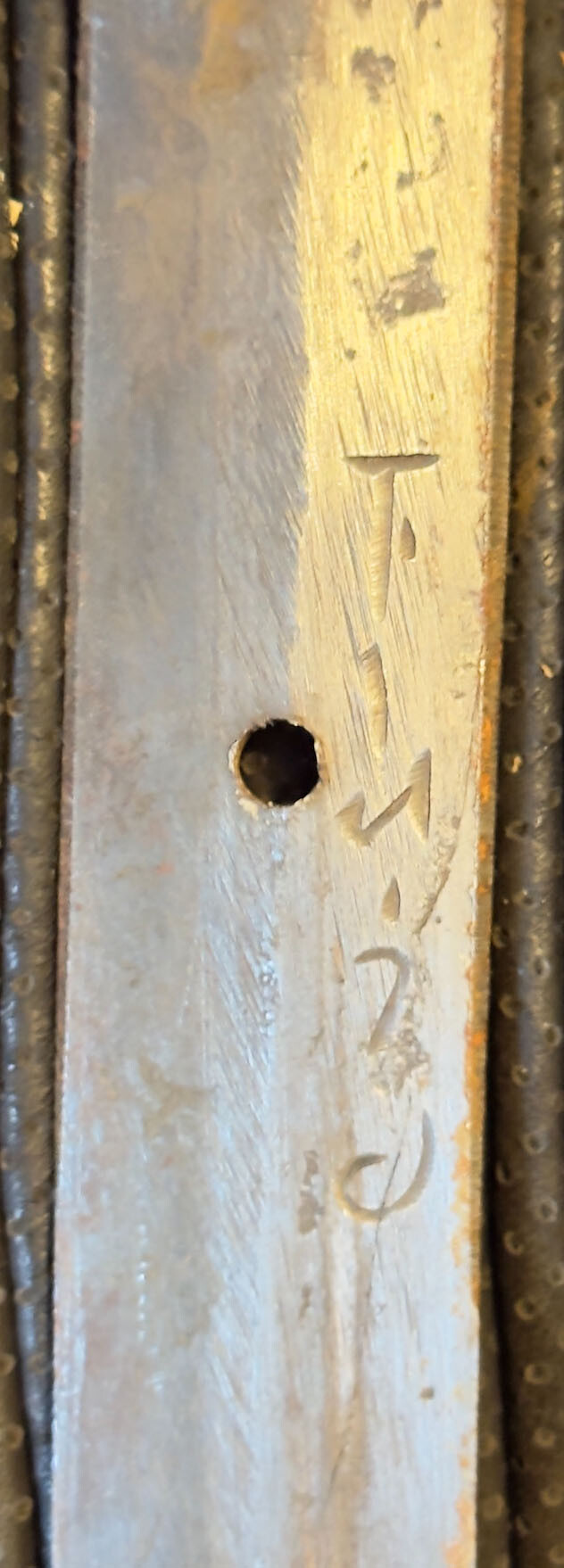
Hi fellas, This came with a sword I recently purchased. I’ve compared it with other examples by Mitsutoshi, and honestly, it doesn’t feel like a gimei—but I’d love to get a second opinion. Thanks a lot!


 2 points
 -
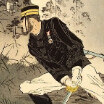
Attached is a picture of a group of Japanese naval officers wearing Sam Browne belts. I hope this settles the question for everyone as to whether the Japanese used them or not. Picture source: Derby, Harry. The Hand Cannons of Imperial Japan. Derby Publishing Company, 1981. Page 149.
 2 points
 -
2 points
-
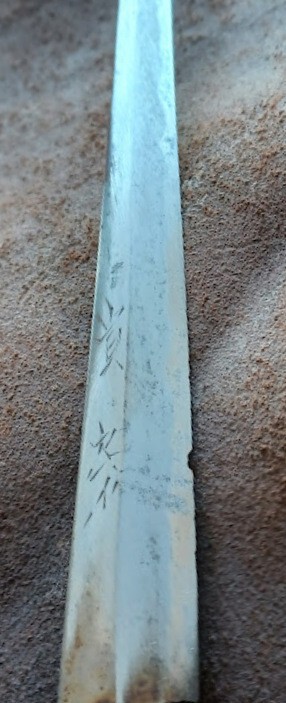
Piers, Here is my old TAKOHIKI which arrived only a few hours ago. NAGASA is 270 mm, width at the base is 21 mm, narrowing down at the square tip to 11 mm. It is forged in NI MAI technique, with KIRIHA grind. The slim TSUKA has "blond" buffalo horn KAKUMAKI (sleeve). The sloppy MEI could read something like SADAMITSU SAKU.

 2 points
 -
A similar one currently for sale on Mercari in Japan (¥179,200).
 2 points
 -
This is, was and always was illegal in Japan. At no stage would it have been allowed to be made in Japan, the laws prohibit it.2 points
-
Hi Peter, thanks for the further clarification. Most everything you say in your first paragraph about the police and modifications still holds true. I do know one importer who has deactivations performed abroad and successfully seems to import almost anything in some quantity. He must have established a track record to do this. Matchlocks modified to percussion caps do come up regularly in auctions in Japan. To purists, they do not hold the same value as a straight untouched matchlock, so interest will thin a little, but many collectors will not be too worried by the lockwork if the decorations look good, and most dealers will be aware of that and still hopeful they can sell. Some years back while I was writing the definitive Tanegashima book with Jan, we needed a gun for the Choshu section. I had a finely inlaid matchlock which had been modified to use percussion caps, so I sent him a set of photographs. "Actually, can you source a genuine matchlock?" he asked. Now that was difficult, as most Choshu guns you find on the market today were once modified to percussion. Eventually I did find an untouched Choshu matchlock, which I still have, but it does illustrate that in the case of Choshu guns it seems that modified ones are actually more common. Modifications certainly pre-date Meiji, and were happening in different iterations from Tempo (1830s?) onwards. Pill locks came first, but percussion caps soon followed; in strong demand regionally, guns were either imported, native guns were modified, or they were specially built in Japan.2 points
-
We are somewhat stuck with the definition of "Antique" = An object, often a collectible, that is at least 100 years old, prized for its age, beauty, rarity, craftsmanship, or historical significance. So we are stuck with anything over a hundred years old, but we have the choice to define what is beauty, rarity, craftsmanship or historical significance? I won't say most fakes are rare, have beauty or show any particular craftsmanship - but they may well have historical significance simply because they show a time when anything Japanese was all the rage - modern fakes are not antiques, but they may become that in another hundred years if we don't have the sense to 1. Stop the manufacture of landfill & 2. Make better use of energy and metals! Just an opinion.2 points
-
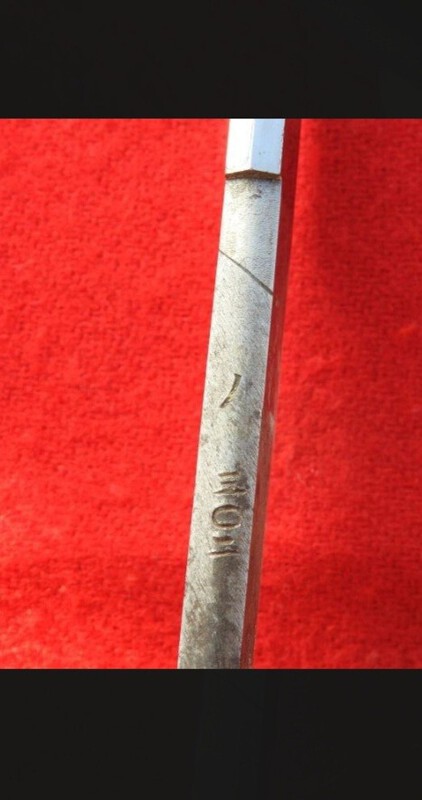
This is what Bruce will want to see on both swords
 2 points
 -
This looks quite spectacular actually. Appears to be a ginzogan (silver inlaid) 3 body cutting best dated 1652 (承応 - Jōō gannen). I am traveling at the moment, I am sure someone else will respond with a more detailed translation. Please be sure to care for it well (do not handle the blade with bare hands and keep oiled to preserve the condition and avoid rusting).2 points
-
A significant update for all who follow the SMR/Mantetsu production history. Thanks to Trystan - @BANGBANGSAN - we now have photos of 2 1937 first year of production blades! I don't know how you do it, Trystan, you have a gift! The first, we have known about, but had no photos. The serial number was not provided. With both you will immediately see they were dating with just the 2 Zodiacal kana for the year, and the Winter kana. The second, that just showed up, has serial number "104". You can see they were not using an Alpha/numeric system yet. That appears in 1938 (we have Spring and "B", "C" series forward, and the 4 seasons progress normally that year). First one Second one I have constantly been uncommitted on whether SMR was using a calendar year or fiscal year to date these blades, but it now seem obvious that they were using a fiscal year. These 1937 blades were "Winter" dates. The 1938 year began with "Spring" and showed all 4 seasons from there. The WWII Japanese fiscal year, in WWII, started April 14.




 2 points
 -
I have never statistically evaluated the presence of utsuri for higher rated blades in a time and school I agree with you that the prerequisite for the emergence of utsuri is first-class tamahagane. We can only assume that the typical appearance of Jifu utsuri is a consequence of fluctuations in the homogeneity of the raw material with respect to carbon content I am not a metallurgist and am not competent to make any conclusion However, I can attach examples of three different blades. All have nioiguchi in the ko-nie. The first is the Soden-Bizen school from the Nanbokucho period Prominent midare utsuri

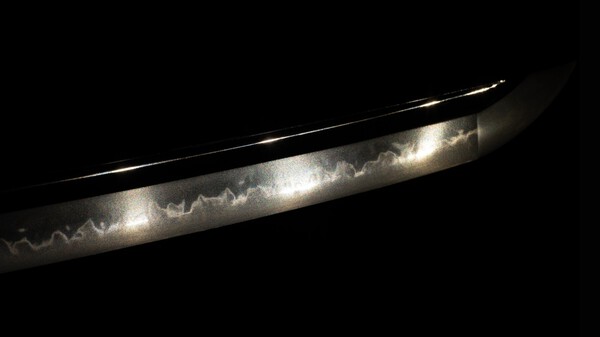

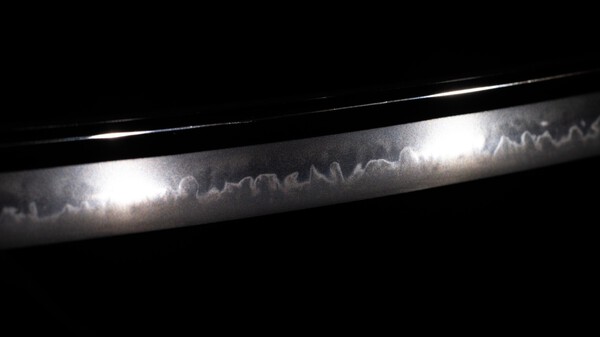 2 points
 -
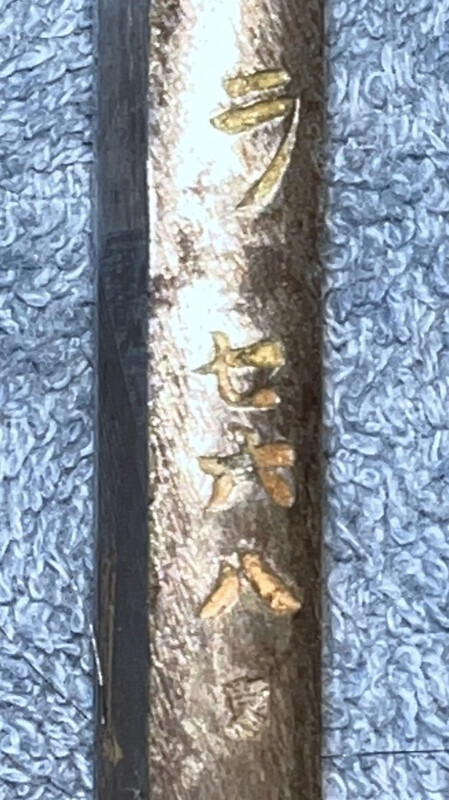
Here the pic on the edge of nakado and sarute -thanks

 1 point
 -
Brian is a great guy. I had many wonderful conversations with him at the Vegas show and learned a lot from him.1 point
-
Dale's Utsushi book really is an important collation of Tsuba information. I realise there is no way for a published version, and this is a proper shame for the community.1 point
-
I strongly suggest you get @Ray Singer’s help on this one and follow his recommendation. I can vouch for his character and ethics. The blade is likely quite valuable. It has Nambokucho period aura. Soden-Bizen or Sue-Sa comes to mind. Perhaps a few tens of thousands of dollars. Much less if it’s later work suriage, or if it has unseen flaws. More if it’s from a famous Nambokucho grandmaster. Which is unlikely, as cutting tests weren’t performed on top master blades. In any case you’re looking at ~1 year + significant costs to get it appraised, certified, and restored if it makes sense financially. Best of luck!1 point
-
They are pretty similar and mei looks legit so i’m sure it will get papers if you submit.1 point
-
A friend was given this "katana" in gratitude for helping out someone. It appears to me to be a post-war reproduction. The blade appears to be made with a solid steel core, with laminated facings on both sides, similar to the way that some Japanese kitchen knives are made today, although with signs of weld failure between the core and the laminated sections. It then appears to have been etched. It does have a "mei", and the tang has been filed. The fittings on the saya are cast, probably in white metal, and then possibly plated. The saya itself has been re-laquered (painted?) at some point, but is old enough to have been attacked by wood borers My conclusion is that this is a "reproduction" from the 1950's or 60's, made somewhere in Asia. Given the much greater expertise of many on this forum, I wonder if there are any further thoughts on this. I know that they are generally described as "chinese fakes", but wonder as well if things like this were ever made in Japan as well for the tourist trade?


 1 point
 -
Value is current spot price of scrap metal.1 point
-
Japan might made cheap products in those days, but never made such ugly products. The sword is absolutely not Japanese taste.1 point
-
True that counterfeiting has always been illegal on paper, but, in practice, Japan lacked meaningful enforcement mechanisms against counterfeit goods until legal reforms that were passed in the 1970s. Laws on paper are great, but without enforcement mechanisms, laws often meaningless. Post War Japan is a good example of this, particularly vis-a-vis counterfeit products.1 point
-
So if we add Ko-Hoki to the list we see early schools: Ko-Hoki, Ko-Bizen, Ko-Ichimonji, Yamashiro, Aoe and even Bungo that have Utsuri in some capacity. Is it not plausible to then say that if this feature was initially an accident it very soon became a consistent feature and part of the manufacturing process during Heian into Nanbokucho and slightly beyond? The steel that was made in these regions via Tatara (not the in house steels mos likely made by earlier shops) was distributed across the region and perhaps these smiths who worked in various methods had certain agreement on foundational procedure given the cross of the same raw material. How to fundamentally prepare this steel for sword making ? Perhaps the heat treatment that leads to utsuri is there because this was a tried and tested procedure for iron sands in this region? The exact history of steel distribution from in-house manufacturers in Heian to Tatara in Heian and after is known but that knowledge is with Paul Martin (from an English perspective) unless there is another member who has studied the distribution of raw iron sand and mass production of tamahagane in the medieval Japan? What is clear is that the Hoki and Bizen regions were epicentre locations for iron sand and the composition is quite similar.1 point
-
Not difficult at all to make your own. There are hundreds of resources online. Check these out: https://www.muzzleloadingforum.com/threads/preparing-matchlock-rope.190347/ (especially post #3) https://pyrodata.com/PyroGuide/index.php^title=Slow_match.htm1 point
-
I believe Quixotic might be a good term Something that is done from time to time on the board might be valuable if it was collated is to provide a list of red flags, with examples, for people to look out for. This is something that you do here for individual pieces (and in your books). Rather than try to find all the examples of all the fakes it might be better to find examples of the all the typical features that fakes tend to have. With the understanding that not all fakes will have all, or even any of them, and some real tsuba might have one or two. But… if a piece has too many red flags then probably better to walk away…1 point
-
Hi there @Stegel, who currently owns this 2nd from the top, “Prototype” or what seems to be a Bakelite-handled variant with the top latch? I’m curious about obtaining more pictures of it for my references. I haven’t seen this version in Fuller’s or Dawson’s books. But I’ve seen it throughout the years through a listing or two in 25 years, and here as well. Thank you.
 1 point
 -
I know almost nothing about Iaido practice. And this is only a physical consideration. Generally speaking, if its saki-kasane is thick, the blade is heavier in tip area compared with normal shape blades even if they have the same weight. So, its moment of inertia is greater than that of normal katana when you hold it by its tsuka. That makes you feel heavier when you hold or swing the katana. But at the same time, its cutting performance may be greater.1 point
-
See that bamboo pin on the side of the handle (tsuka)? Push it out from the smaller side with something flat about the same size. That little bamboo pin is the only thing that holds the entire assembly together. Make sure to put all the parts back on in the order they were removed! IF the pin breaks apart, that is okay. It can be easily replaced by a chopstick whittled to size.1 point
-
Hey Steve, This one is signed 肥前國住保廣作- "Hizen Kuni ju Yasuhiro Saku" and dated January 1942. The smith is Yasuhiro. It looks like he was from Saga. I don't have any additional details. This is not a Mantetsu, although it looks like it could be traditionally made. Conway1 point
-
1 point
-
Precisely - if only hadori is seen, it means either that hadori is very heavy or the hamon does not have any nie. The problem is that some of the photographs are from above, some taken at an angle. Both cases look nearly the same, but if you put the contrast to the max, there is some nie. Which suggests its very hadori heavy and most likely its ko nie without any large nie crystals. Otherwise you would see significant difference at different angles.1 point
-
Jifu on a Tomonari

 1 point
 -
If you have available the numbers on the top of the Tang will be very beneficial1 point
-
Bruce I know nothing about any of this ! I Have 2 that have photos worth posting -will start separate posts on them Thanks1 point
-
The Token Message Board has, once again, proven to be a wonderful resource. Thank you Piers and Jon for your guidance – and the 50 odd folks who paid the discussion some attention and offered opinions. I am not sure that I adequately explained the topic of my interest, but as a result of the discussion, I am enriched. A part of my interest is in Japanese style guns modified during the late Edo and Meiji era was what those modifications do to the value of the altered guns. Dick Dodge (who was an active early re-imported of matchlocks to Japan) opined to me and others, that the primary determinant of matchlock values in Japan was the Tokyo police. His argument was that guns they judged legal could be imported to enter the Japanese market as antiques. Guns that they judged ”modern” could not be imported, and were therefore excluded from the Japanese market. Modified arms already in Japan could be registered. All this to say that I raised this question because I was kind of wondering about the value of these modified shooting irons. The information Jon shared on Murata shotguns interestingly shows that in Meiji times Japan had a hunting gun industry and folks who hunted game either commercially or for sport. By the 1880s there seem to have been folks who could get ahold of Murata bolt actions and insert in old and new guns. It would be interesting to know where this was done and why they sometimes used old guns. Tanegashima modified to use percussion caps seem to me to offer a potentially more interesting riddle. To my eye, these look like they might predate Meiji times so that they might reflect the dynamics of the terminal Edo period. As Piers notes, Sawada presents a great range of firearms that were imported into Japan throughout the later Edo period. Clearly, the Japanese were well aware of world firearms development. (For us sword collectors, it is also worth remembering that the Shin-shinto era was basically about re-arming and modernizing weaponry.) But, in Sawada’s 60 odd pages devoted to late Edo period guns, I see very few matchlocks modified to use percussion caps (page 175). Another (page 185) is shown right next to a tanegashima that was modified to use a Murata bolt action. The collectability of such arms, however, remains uncertain. Peter1 point
-
Hizen smiths usually signed with a tachi-Mei meaning the signature is facing outwards when the blade is worn cutting edge down. It’s one of the things that this school did that is fairly unique on blades in Shinto and later eras. There may be some confusion of the previous owner regarding the smith in question. Mecox above has a wartime smith that signed this way and the fittings also match that. Unless there is another Hizen smith that signed this way from the Shin Shinto era, it’s more likely that this is a wartime smith. The other stuff on the tags all seems correct.1 point
-
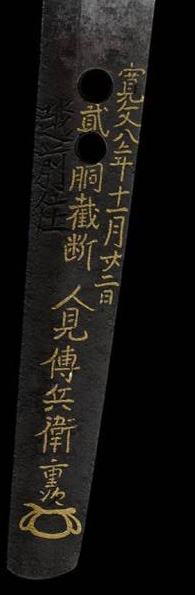
Paul, it is best if you can show the entire inscription in a single clear, straight-on, vertical image. Please see below for an example. Do not do anything on your own to clean or polish the blade.
 1 point
 -
This photo helps a lot. I admit that I initially thought it cast. Now I think it is not cast, but rather has been coated with something akin to clear lacquer or varnish. It would both make the tsuba look "wet" AND mute the appearance of the tsuba in a way that looks like many of the cast tsuba we have seen. If as heavy as some of the varnishes that I have used in painting, it might even fill (cement) in the signature enough to explain some of the odd look of the signature. The extra photo helped a lot.1 point
-
継利以南蠻鐵作 = made by Tsugutoshi using nanban-tetsu1 point
-
Thank you Bruce A closer pic of Saya

 1 point
 -
My new fan

 1 point
 -
One thing I have tried before successfully is to put a very short section of cable, such as bicycle brake cable, into a drill, and go slowly. The multiple wires in the front act as a flexible "drill" but take it very easy and use oil.1 point
-
1 point
-
unf(a/i)nished? Holding it for a while and still no clue about the school.
 1 point
 -
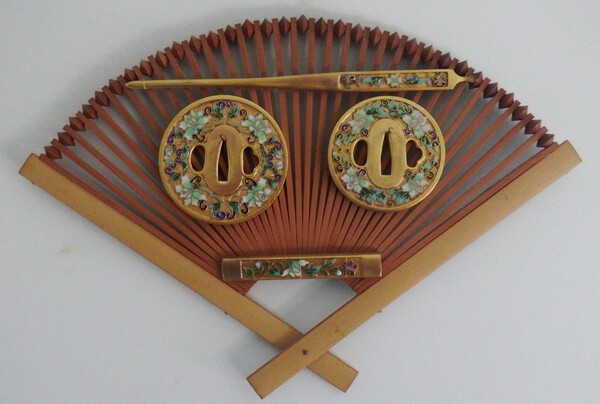
From Okan's sublime to ebay's shabby. strong design similarity with these two? I am sure this was not the intention of the thread but this is a display board of mine with some pretty common cloisonné tsuba on it.
 1 point
 -
I'm just a fan
 1 point
 -
Just beware not to start giving the impression that any of the same designs must be repro or cast or copies. The schools had pattern books, and mass production of fittings was a valid and known thing. So you really have to examine each item for signs of casting or identical flaws. Same designs can still be perfectly valid.1 point
-
Eric with all respect. What will you find out? You ask for opinions for your sword. It is a oil quenched showa-to blade with stamps that not indicates that it is a gendaito. It is a Type 98 Gunto with a fast chissled signature, in good condition.1 point

























This leaderboard is set to Johannesburg/GMT+02:00